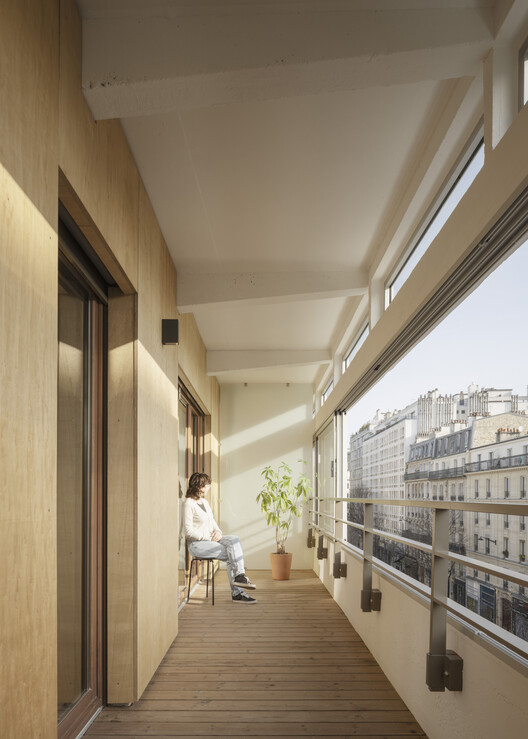
As cities struggle to provide adequate and affordable housing, examining built examples of collective housing can help inform decisions about what to build and how. These projects offer opportunities to assess solutions, understand their limitations, and consider what might be applied elsewhere. In Paris, two recent examples combine apartments of different sizes with access to gardens, courtyards, and other outdoor spaces, working with structures already in place.
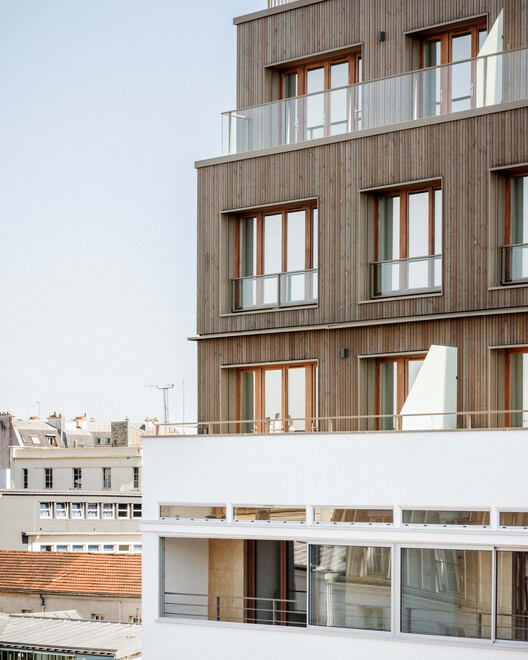
La Métropolitaine, by Ignacio Prego Architectures and Thibaud Babled Architectures, and a garage conversion by Atelier Téqui Architectes won the second edition of the European Collective Housing Award in the new construction and renovation categories, respectively. The winners were announced on October 8, 2026, in San Sebastián, following a selection process involving 192 entries from 36 European countries.
One builds above existing transportation infrastructure; the other adapts and expands a former garage. Alongside their architectural solutions, the jury highlighted their provision of affordable homes in sought-after urban areas.
Living Above Infrastructure
Built above existing transportation infrastructure at the boundary between Paris and its neighboring municipalities, La Métropolitaine forms a continuous frontage facing the new Palais de Justice. The complex brings together social housing, affordable student housing, and public and community facilities within a single structure.
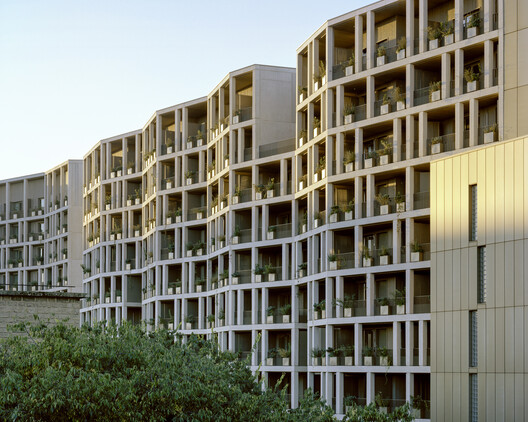
The building's shallow depth guides the apartment layouts. Ranging from one to five bedrooms, all units extend through the building, facing the city on one side and a garden on the other. The jury recognized the ambition of bringing these uses together above existing infrastructure and highlighted the public owner's commitment to maintaining affordable rents in this location.
Turning a Garage into Housing
In the renovation category, Atelier Téqui Architectes received the award for the conversion and expansion of a garage in Paris's 11th arrondissement. The 1957 building, designed by Grand Prix de Rome winner Claude Béraud, now houses 63 apartments and a retail space.
The intervention retained much of the existing building. Floor slabs, columns, beams, and the facade's cantilevered concrete elements were preserved, while the vehicle ramps were removed. Landscaped courtyards, winter gardens, and a rooftop vegetable garden were introduced.
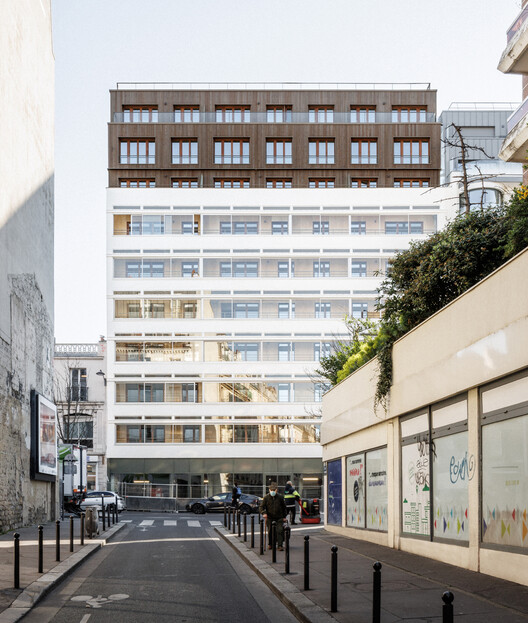
Above the retained structure, the vertical addition combines a steel frame, cross-laminated timber (CLT) floor slabs, and larch cladding. According to the award documentation, this addition incorporates up to 99 kg/m² of bio-based materials.
The jury highlighted the apartment layouts and efficient use of the available space, which made it possible to accommodate different housing types within the original structure. It also emphasized the spatial quality of the resulting homes.
An Award Dedicated to Collective Housing
Established in 2024, the European Collective Housing Award is organized by the Basque Architecture Institute in San Sebastián and arc en rêve centre d'architecture in Bordeaux, with support from the Basque Government. The initiative recognizes built projects for their architectural quality, social impact, and contribution to housing in Europe.
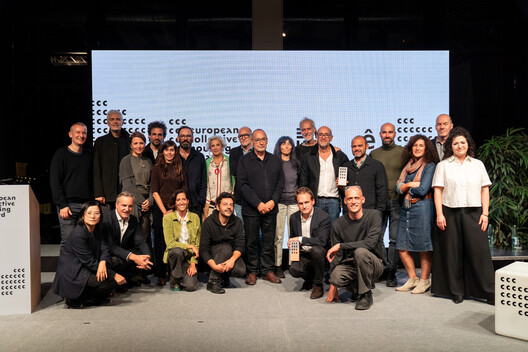
In its second edition, the number of countries represented nearly doubled, from 19 to 36, while the total number of entries rose from 170 to 192. The inaugural edition recognized La Borda in Barcelona, by Lacol, and the conversion of a wine warehouse in Basel, by Esch Sintzel Architekten.
The 2026 jury was chaired by Carme Pinós and included Jing Liu, Catherine Sabbah, David Madden, and Lucia Tozzi. The ceremony took place in the new home of the Basque Architecture Institute at Tabakalera, with opening remarks by Denis Itxaso, head of the Basque Government's Department of Housing and Urban Agenda. The event brought together the nine finalist teams, members of the award's advisory board, institutional representatives, and invited guests.
The announcement concluded the European Collective Housing Days, two days of debates, conversations, and presentations on housing. The finalist projects will be featured in a publication and a traveling exhibition scheduled to visit European museums over the next two years.
The two winning projects demonstrate ways to add housing to the existing city while providing varied apartment layouts and access to outdoor spaces. Their affordability also matters: as the jury noted, maintaining affordable homes in sought-after neighborhoods can help retain residents and support greater social diversity. The architectural decisions described here are part of that broader task of making room for people to live in the city.
