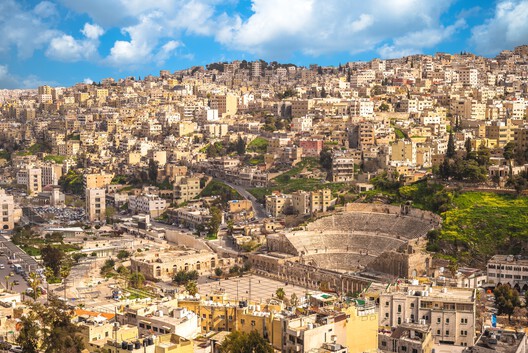
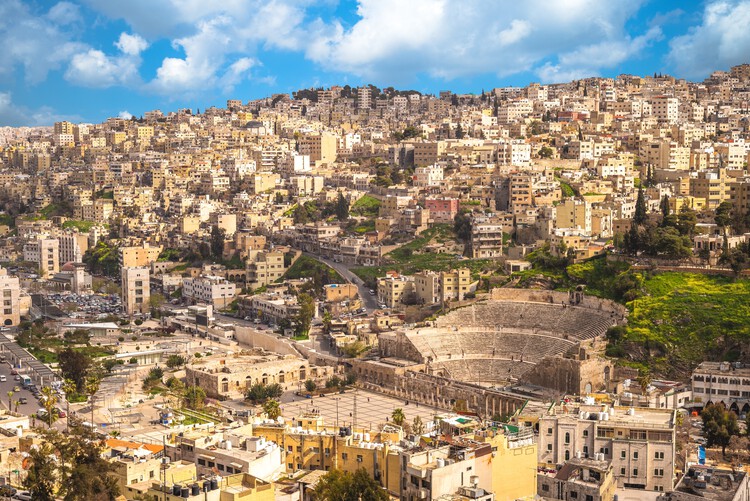
Built across several hills, Amman has grown at a pace few Middle Eastern capitals have matched. The city has received successive waves of migration — Circassians in the late 19th century, Palestinian refugees in 1948 and 1967, the Iraqi population after 1990, and Syrians since 2011 — each reshaping its density and social profile. Locally quarried limestone, extracted from quarries across Jordan and required by law for façades since the 1970s, has become the city's only common visual denominator. Behind this material uniformity, however, lies a continuous dialogue between vernacular tradition and international ambition.
This condition has taken concrete architectural form over the past decades. The monumental scale of the Al-Iskan (Housing Bank Center), built in Shmeisani between 1980 and 1984, consolidated large-scale architecture as a symbol of the country's emerging financial capital. At the same time, prominent Jordanian architects, including Jafar Tukan and Ammar Khammash, developed a distinct architectural vocabulary that reinterprets stone masonry, topography, and the natural landscape in contemporary terms, producing museums, conservation centers, and environmentally responsive buildings of remarkable local sensitivity. More recently, international firms and technologies have expanded this urban infrastructure through new geometries and bioclimatic solutions.


