Cities depend on systems that already exist around them. When architects design on water or beyond Earth, those systems are no longer available. Without fixed ground or nearby networks for energy, water, transport, and waste, architecture has to take on functions the larger city would normally provide.
The reason for moving beyond familiar ground also changes from one project to another. In the Maldives, building on water responds to the vulnerability of existing land. In Busan, floating development creates another direction for urban expansion. On the Moon, the challenge is more absolute: there is no existing infrastructure to connect to at all.
Under these conditions, infrastructure becomes part of the architectural problem itself. How people move, how resources are distributed, and what a settlement can depend on have to be planned alongside the spaces people inhabit.
Related Article
Digital Worlds and the Limits of Frictionless Space: Rethinking Scale and Materiality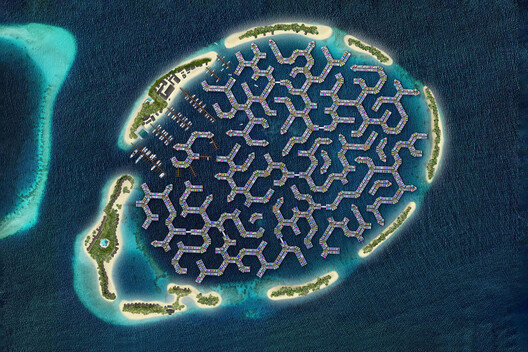
Building Without Fixed Ground
For the Maldives, building on water is closely tied to the vulnerability of the land itself. Much of the country sits less than one meter above sea level, making future development increasingly connected to questions of sea-level rise and limited land availability.
Maldives Floating City, developed by Waterstudio.NL, sits in a lagoon near Malé and remains tied to the capital. Its location allows the development to stay within an existing urban and economic context while requiring many of its basic systems to be reorganized around water.
The development is organized around canals. They work as the transport and logistics network, the way roads do on land. Most movement happens on foot, by bicycle, or by boat. Housing is placed together with hotels, restaurants, shops, and a marina across a flexible grid that adapts to the water itself rather than imposing a rigid street pattern.
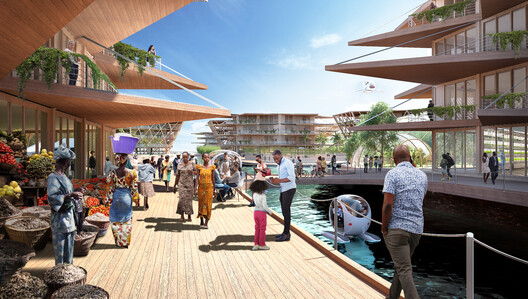
The floating units are built locally and connected to underwater concrete hulls anchored with telescopic steel stilts. Artificial coral banks below support coral growth, while the reef reduces wave impact. Infrastructure and environment work together.
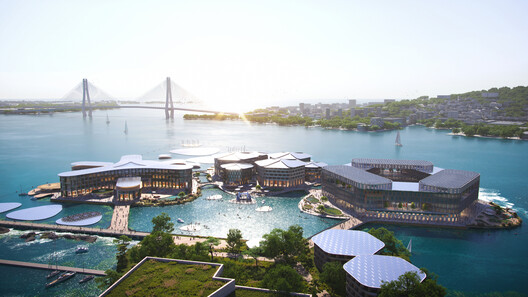
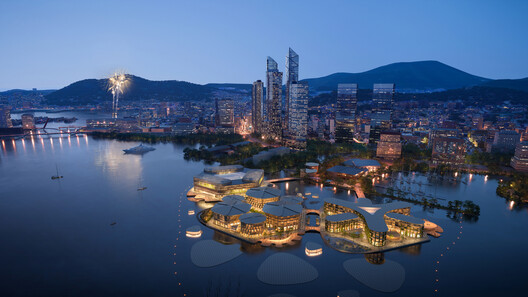
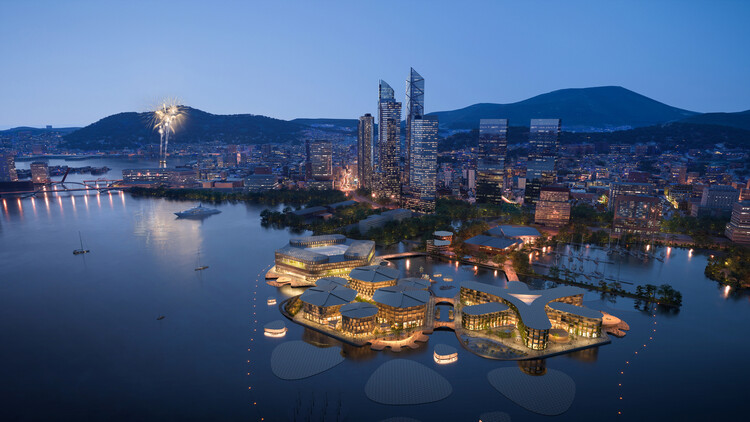
OCEANIX Busan takes a different approach to the same problem. Rather than creating something entirely new, it proposes expanding Busan itself onto the water. Developed by OCEANIX with UN-Habitat and a team including BIG, the floating platforms create additional urban territory without requiring new land. The initial development is planned for around 12,000 residents and can expand through additional platforms.
The platforms are organized as interconnected neighborhoods: one for living, one for research and maritime innovation, one for lodging. Each neighborhood generates its own energy through photovoltaic panels. Water is managed in closed loops. Food is produced on-site. Waste systems operate internally. Rather than connecting to Busan's existing infrastructure once built, the platforms are designed to function as a complete system from the beginning. Energy generation, closed-loop water systems, food production, waste management, and mobility are integrated into the development from the start.
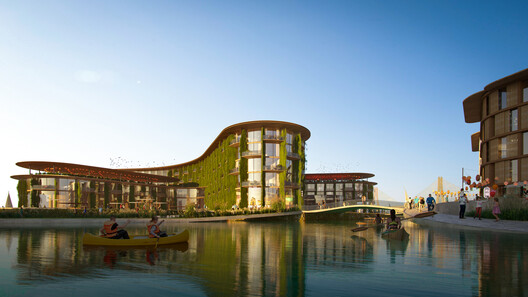
In both cases, moving onto water doesn't mean disconnecting from the city on land. Malé and Busan remain part of the larger networks that support these developments. What changes is the physical condition through which the city expands. Canals replace some land-based movement. Floating structures replace fixed foundations. Marine conditions become part of the urban plan rather than something to be resisted.
When Systems Become Architecture
Building beyond conventional ground changes one fundamental thing: it forces systems that are normally separated to become part of the same design problem.
In a conventional city, the supporting infrastructure is already in place. Water arrives through municipal networks. Electricity comes from a larger grid. Waste is handled elsewhere. Existing roads determine how people and goods move. In an existing city, buildings usually connect to systems established at a much larger scale.
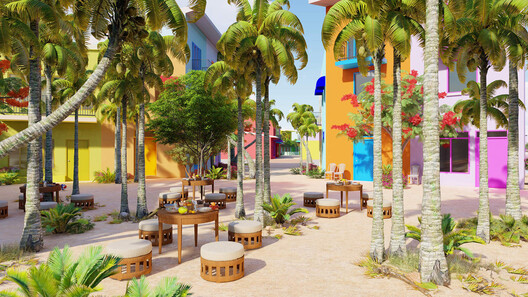
In Maldives Floating City, architects designed these systems into the development itself. Electricity is powered predominantly by solar energy generated on-site. Sewage is treated locally and repurposed as manure for plants. Deep water sea cooling replaces air conditioning. The city operates on a smart grid designed to respond to dynamic demand, weather, and climate change.
OCEANIX Busan goes further. The design integrates six interconnected systems: zero waste and circular systems, closed-loop water systems, food production, net-zero energy, innovative mobility, and coastal habitat regeneration. The platforms generate 100 percent of their operational energy on-site through floating and rooftop photovoltaic panels. Hydronic tubing integrated into the hull itself acts as a giant closed-loop heat exchanger with the ocean for heating and cooling.
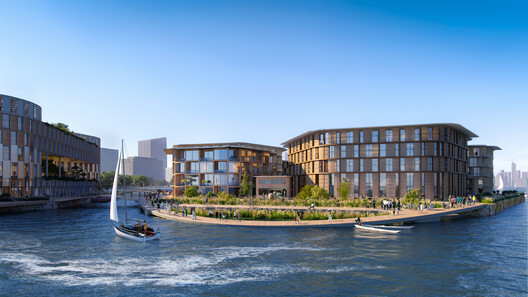
In both projects, energy, water, waste, and mobility shape the architectural plan from the start. They determine where the city sits, how it's organized, and what density it can support. Systems have to be decided at the beginning because there's no existing infrastructure to connect to.
Building Without an Existing City
The relationship between architecture and infrastructure changes again once there is no existing city nearby to support the settlement.
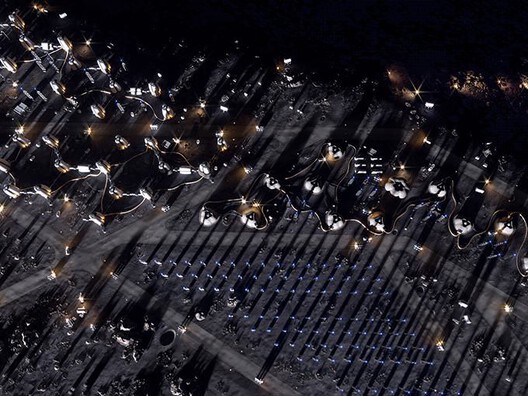
SOM's Moon Village, developed with the European Space Agency and MIT, explores permanent habitation near the Moon's south pole. Unlike the floating developments in Malé and Busan, it cannot extend an existing city or depend on nearby networks for water, energy, transport, or other basic services.
The proposal is organized around habitation modules made from rigid structural frames and inflatable shells. Grouped into connected clusters, they form pressurized environments where people can live, work, gather, and move through the settlement.
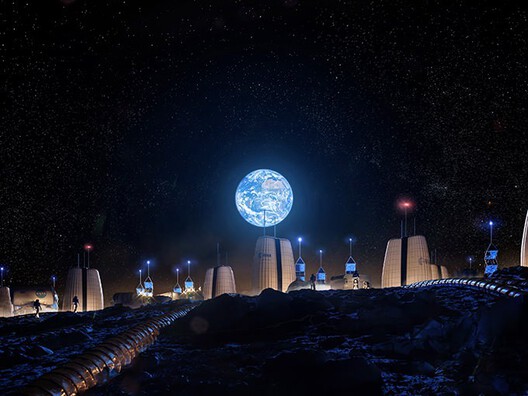
The site also determines how many of these spaces can function. Long periods of daylight near the south pole could support solar energy production, while nearby deposits of water ice could provide water and contribute to producing breathable air. Location, infrastructure, and habitation therefore become much more closely connected.
Resources that would normally arrive through larger urban networks have to be found, produced, stored, or reused close to where people live. Energy, life support, circulation, and access to basic resources have to be planned together from the beginning.
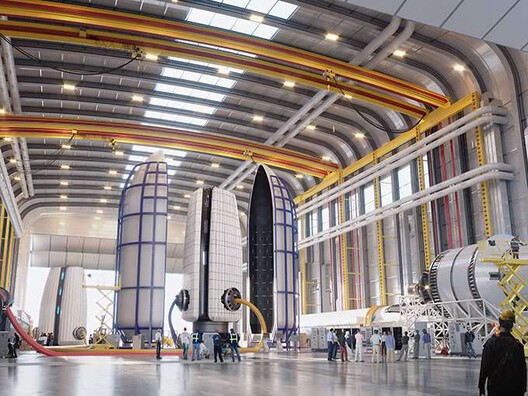
At the same time, permanent habitation still brings familiar architectural questions with it. People need places to sleep, work, gather, circulate, and spend time alone. Privacy, shared space, and everyday routines remain part of the project even under very different physical conditions.
Moon Village pushes the same question seen in the floating projects further. In Malé and Busan, new development remains connected to existing cities on land. On the Moon, much more of the framework that supports daily life has to be established within the settlement itself.
What These Settlements Make Visible
The Floating City in the Maldives remains connected to Malé, OCEANIX extends Busan onto the water, and Moon Village takes the basic infrastructure needed for everyday life and reworks it for the conditions of the Moon. As these projects move further from existing cities, more of the systems that normally support urban life have to be designed into the settlement itself.
Water, energy, mobility, waste, housing, and shared space become closely connected design decisions. Systems that an urban project would normally connect to after construction have to be considered from the beginning.
These projects therefore show how much architecture usually depends on infrastructure beyond the site. Once fixed ground, utility networks, and nearby resources can no longer be assumed, those systems become part of the architecture itself.
This article is part of the ArchDaily Topic: The Lure of Escapism in Architecture and Alternative Worlds. Every month we explore a topic in-depth through articles, interviews, news, and architecture projects. We invite you to learn more about our ArchDaily Topics. And, as always, at ArchDaily we welcome the contributions of our readers; if you want to submit an article or project, contact us.