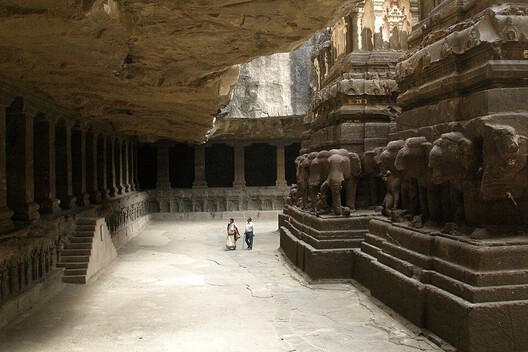
A cave in Maharashtra can now be entered without travelling to it. Through a virtual reality experience developed around Ajanta, visitors can move through a digitally reconstructed version of the caves from somewhere else entirely. The project raises an architectural question: if architecture is experienced through movement, scale, sequence and perception, what happens when those experiences can be recreated outside the physical site? IITM Pravartak's Digital Ajanta project uses 3D scanning, filming, modelling and virtual reality to document the caves and translate that record into an immersive experience.
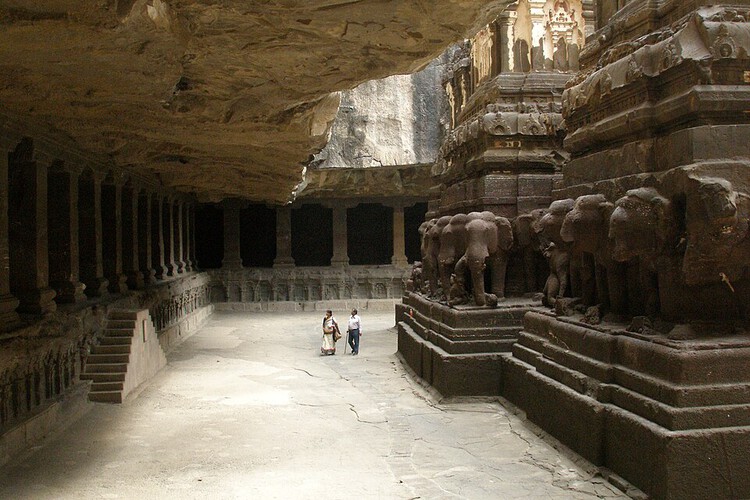
Digitisation can preserve fragile places, make them accessible to people who cannot visit, and create records for future research. An immersive environment also gives that information a spatial structure. Once a visitor can move through a digital cave and experience its surfaces and sequence, the digital record starts to function as an environment rather than an archive.
Digital Ajanta begins with an act of measurement. The project uses 3D scanning, filming, modelling and virtual reality to create a digital record of the caves, their sculptures and paintings. The documentation serves research, but is being translated into a 3D movie and VR experience. Once that record becomes navigable, documentation begins to do something different. A conventional survey attempts to describe a building so that someone else can understand it.
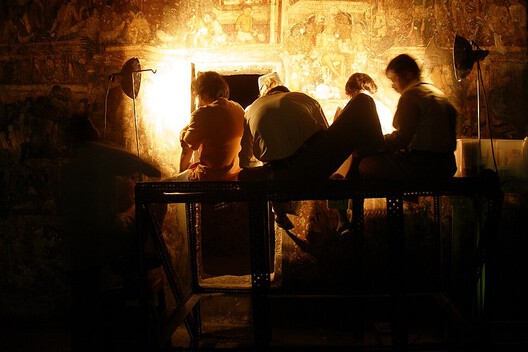
A digital model can describe the same building while also becoming an environment that someone can enter. The Department of Science and Technology describes the resulting "Tales of Ajanta – VR Experience" as a combination of 3D scanning, modelling and animation intended to preserve and present the caves beyond their physical location. A photograph records a wall. A point cloud records its geometry. A virtual environment determines where a visitor stands in relation to that wall, how they approach it and what surrounds it. The documentation is beginning to structure how the architecture is experienced.
The Replica Has to Be Designed
Once a digital model becomes navigable, it requires decisions that a conventional archive does not. Someone has to determine where the visitor moves, what becomes visible, and which elements receive attention. Those decisions give the digital site its own spatial logic.
The Virtual Avebury project reconstructed the Neolithic landscape as it might have appeared and sounded around 2300 BCE and tested how visitors experienced it through exploration, participation and sensory stimulation. More than 1,200 people encountered the simulation during its public evaluation. The researchers found that the more believable participants considered the simulation, the stronger their reported sense of place.
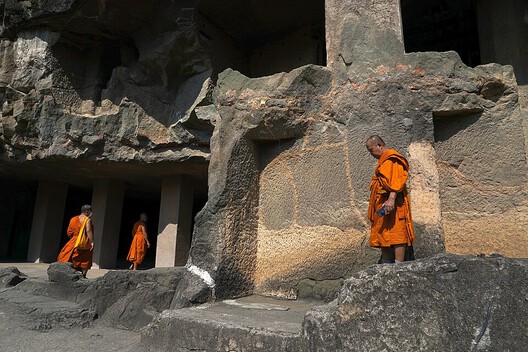
The point is not whether the virtual environment can convince someone that they are physically elsewhere. A sense of place can emerge through relationships between movement, perception and information even when the physical architecture is absent. The digital model is no longer simply representing architecture. It is organising how architecture is experienced. Plans and models have always mediated how buildings are understood, but VR introduces the possibility of inhabiting the representation. With VR, the model becomes the environment through which the building is experienced.
When Reconstruction Becomes Interpretation
The problem becomes more complicated when the digital environment represents what has been damaged, altered, or lost alongside what still survives. Ajanta makes this problem especially clear because its significance lies in the relationship between rock-cut architecture, sculpture and mural painting. Digital preservation can capture existing conditions with extraordinary precision. Reconstruction introduces something different: interpretation. A scanned surface is evidence of what exists. A reconstructed surface is a proposition about what existed. Once both are rendered with the same visual clarity, the difference can become difficult for a visitor to perceive.
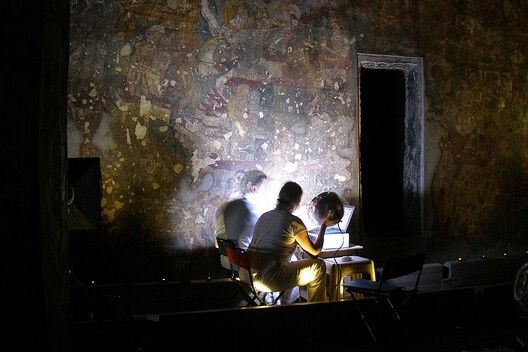
Virtual heritage research has raised the same concern. Archaeologist Jeremy Huggett has argued that virtual heritage sits between the demands of presence and realism, cautioning against assuming that greater visual realism automatically produces a more truthful representation of the past. He proposes "loose-realism" as a way of acknowledging the interpretive nature of digital reconstruction rather than presenting technological precision as evidence of historical accuracy. Accuracy is only part of the problem. The digital environment also needs to make clear where evidence ends, and interpretation begins. That distinction becomes harder to maintain as the replica becomes more convincing.
The Digital Site Is a Place of Its Own
A virtual environment does not need to replace the physical monument to become a meaningful spatial experience. Digital Ajanta gives someone who cannot travel to Maharashtra another way to encounter the caves: the experience is removed from the physical site, but remains structured by its spatial information. This does not make the virtual Ajanta equivalent to the physical one. The heat of the rock, the smell of the cave, the limits of bodily movement and the material resistance of the site cannot simply be transferred into a headset.
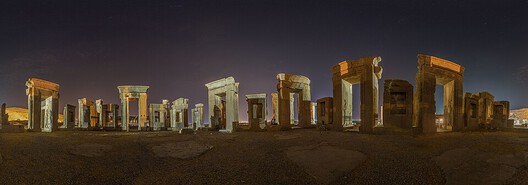
The digital environment also allows forms of access that the physical site cannot. It could make inaccessible areas navigable, alter viewpoints and bring together information that would otherwise require separate forms of interpretation. Its limitations are different because the medium is different.
What Happens to the Original?
A digital counterpart also changes what access to a fragile site can mean. The Department of Science and Technology presents Digital Ajanta both as a preservation initiative and as a way of bringing the caves to a global audience. The project is intended to support non-invasive investigation while creating an immersive public experience. It would be premature to claim that digital access can replace physical visitation, or that it has already reduced pressure on the caves. For now, its stronger role is as a complement to physical visitation: extending access without claiming to reproduce every quality of the original.
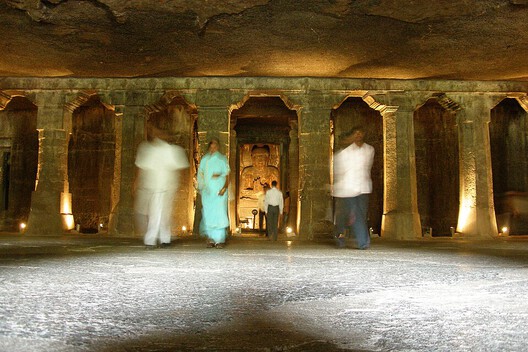
The same question will become more important as similar initiatives move beyond Ajanta. The Centre of Excellence for Indian Heritage in Digital Space is also developing immersive visualisations of Ellora and Dwaraka. The experiment is therefore already moving beyond a single monument. Each new site will bring a different problem of translation. Some will be highly measurable. Others will contain fragments, gaps or competing interpretations. The question will be how those gaps and competing interpretations are made visible within the digital environment.
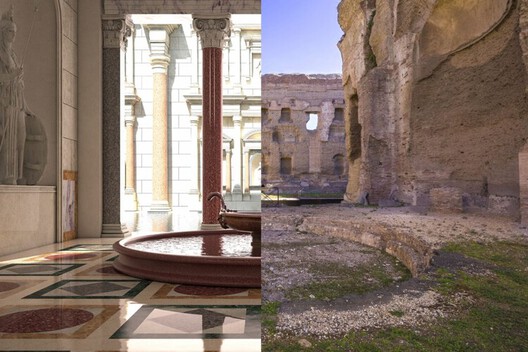
Digital heritage introduces another condition: architecture measured in one place, constructed through data, and experienced by a body somewhere else. The question is what happens once the replica becomes familiar. If people begin to return to it and use it as a way of learning about the original, the digital reconstruction becomes more than a record. It becomes another way of knowing the place.
This article is part of the ArchDaily Topic: The Lure of Escapism in Architecture and Alternative Worlds. Every month we explore a topic in-depth through articles, interviews, news, and architecture projects. We invite you to learn more about our ArchDaily Topics. And, as always, at ArchDaily we welcome the contributions of our readers; if you want to submit an article or project, contact us.