The conclusion of the FIFA World Cup 2026 marks the end of the tournament's largest edition to date. Hosted across Canada, Mexico, and the United States, the competition expanded to 48 national teams and brought together sixteen host cities distributed across three countries. For decades, FIFA World Cups have served as catalysts for architectural production. Each edition has generated a distinct collection of stadiums, transportation investments, public spaces, and urban interventions that often remain part of their host cities long after the tournament concludes. While recent competitions have become associated with landmark stadium projects and ambitious national building programs, the 2026 edition followed a different trajectory, relying primarily on existing venues adapted to FIFA's technical and operational requirements.
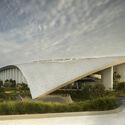
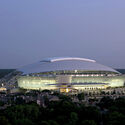
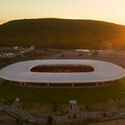
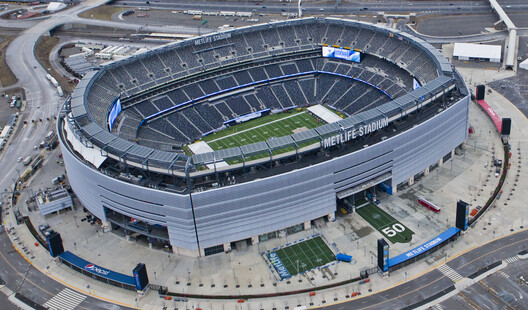
This approach reflects broader shifts within sports architecture, where increasing attention is given to the long-term performance of existing buildings, adaptive reuse, and the integration of sports venues within wider urban systems. As preparations continue for the 2030 FIFA World Cup, these themes remain central to discussions surrounding the architectural legacy of international sporting events.
Across different editions of the tournament, stadiums have reflected the technological, cultural, and urban priorities of their time. While some have become enduring civic landmarks, others have prompted discussions around maintenance, adaptability, and long-term use after the event. The stadiums of the 2026 and 2030 FIFA World Cups provide an opportunity to examine how contemporary sports architecture is responding to these evolving expectations.
Related Article
Discover the Full List of Stadiums Hosting the 2026 FIFA World Cup in the United States, Mexico, and Canada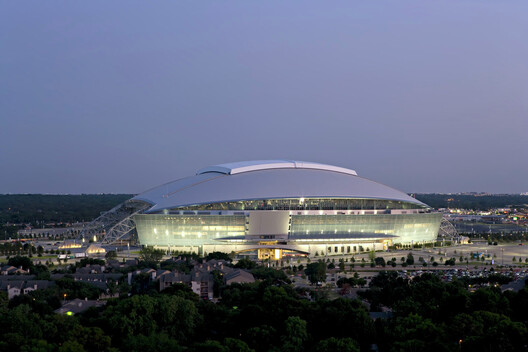
FIFA World Cup 2026: Adapting Existing Stadiums
Unlike several previous editions of the FIFA World Cup, the 2026 tournament was organized around an existing network of stadiums. Most host venues were originally designed for American football or as multipurpose facilities and required targeted interventions to accommodate international football. Modifications included the installation of natural grass playing surfaces alongside upgrades to seating layouts, accessibility, player facilities, media infrastructure, hospitality areas, security systems, and spectator circulation. Rather than producing a collection of newly constructed landmark venues, the tournament demonstrated how existing stadiums can be adapted to accommodate changing operational requirements while remaining in active use beyond the event itself.
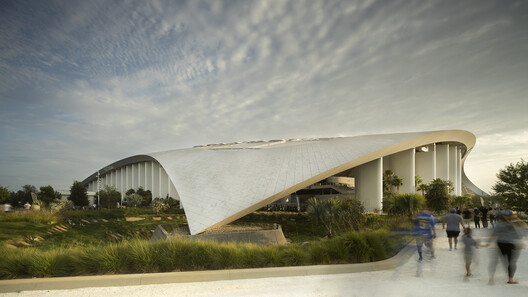
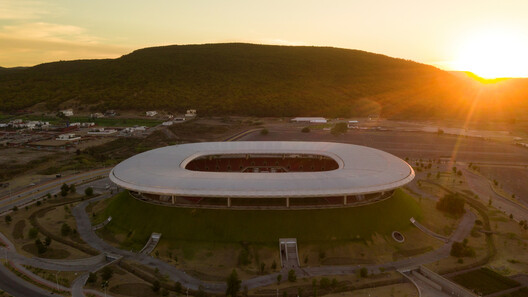
Several host venues illustrate this strategy. SoFi Stadium, designed by HKS, was conceived as a multipurpose sports and entertainment venue, characterized by its large-span roof structure, indoor-outdoor organization, and integration within the broader Hollywood Park development. Mercedes-Benz Stadium in Atlanta, designed by HOK, combines a retractable roof with flexible programming that supports sporting events, concerts, and public gatherings throughout the year. In Mexico City, Estadio Azteca underwent another phase of renovation ahead of becoming the first stadium to host matches across three FIFA World Cups.
Looking Ahead to the 2030 FIFA World Cup
Attention now turns to the FIFA World Cup 2030, which will introduce the tournament's most geographically distributed hosting model to date. Matches are scheduled to take place across Europe, Africa, and South America, with eleven venues expected in Spain, six in Morocco, and three in Portugal. In addition, Uruguay, Argentina, and Paraguay will each host one of the tournament's opening matches in commemoration of the centenary of the inaugural FIFA World Cup, held in Uruguay in 1930. Preparations are underway across the host nations through a combination of new construction and the redevelopment of existing stadiums. Several venues are undergoing modernization, while additional projects form part of wider national investments in transportation and public infrastructure.
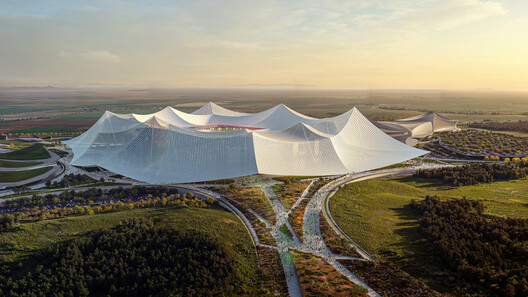
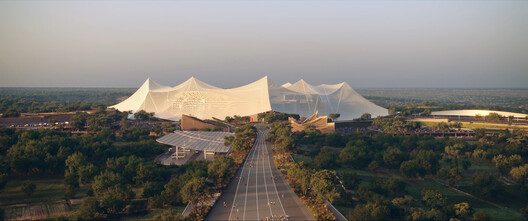
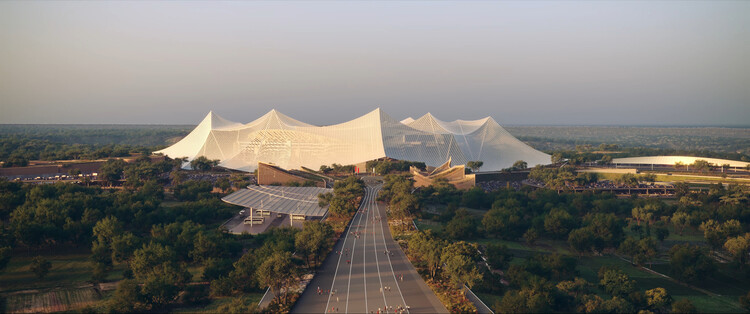
Among the most closely followed projects is the proposed Hassan II Stadium near Casablanca, designed by Oualalou + Choi in collaboration with Populous. Planned to accommodate approximately 115,000 spectators, the venue would become one of the world's largest football stadiums. Its large tensile roof references the traditional Moroccan moussem tent while forming part of wider regional infrastructure and development initiatives. The project is also among the venues under consideration to host the 2030 FIFA World Cup Final. Elsewhere in Morocco, Prince Moulay Abdellah Stadium in Rabat has recently been redeveloped as the new home of the Moroccan national team, while additional upgrades are underway at Adrar Stadium in Agadir, Grand Stade de Marrakech, Fez Stadium, and Ibn Batouta Stadium in Tangier. These interventions generally combine increased capacity, new roof structures, facade renovations, and the removal of athletics tracks to improve proximity between spectators and the playing field.
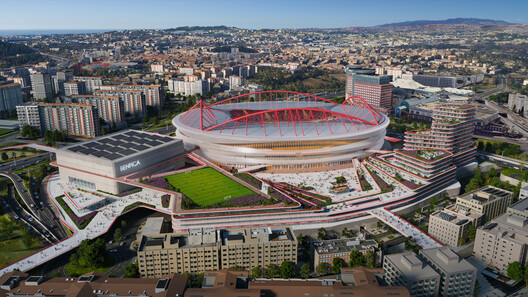
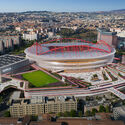
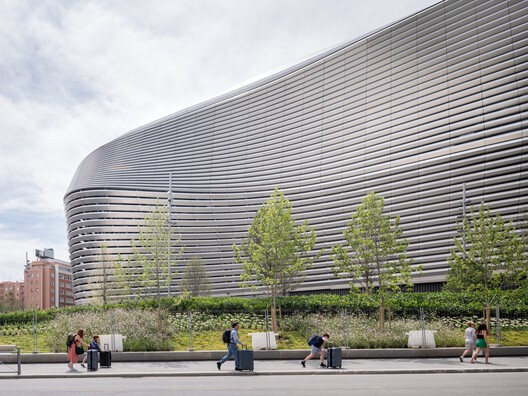
Spain's preparations similarly combine recently completed projects with ongoing redevelopment. Alongside the transformation of Santiago Bernabéu Stadium and the continuing renovation of Camp Nou, projects at venues including La Cartuja in Seville and Gran Canaria Stadium expand seating capacity, introduce new roof structures, and modernize facilities while extending the operational life of existing stadiums. In Portugal, renovations to Estádio da Luz and Estádio José Alvalade similarly prioritize increased flexibility, spectator experience, and mixed-use programming integrated with broader urban regeneration initiatives.
The distributed nature of the 2030 tournament introduces a different architectural framework, bringing together historic stadiums, renovated venues, and new construction across multiple cities and urban contexts. This shift reflects a broader evolution in sports architecture, where venues are increasingly designed as flexible, multi-use infrastructures. Recent projects such as BIG's multi-use stadium proposal for Shakira's World Tour in Madrid and the 350-acre Sardar Vallabhbhai Patel Sports Enclave in Ahmedabad, centered around the 132,000-seat Narendra Modi Stadium, further demonstrate this move toward sports districts that integrate competition venues with public landscapes and community facilities.