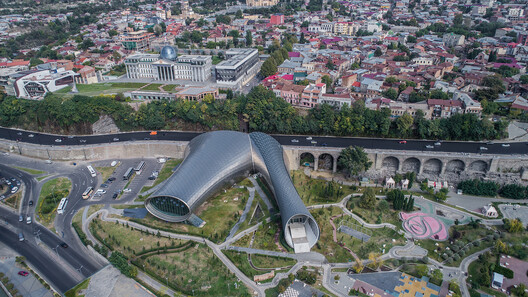
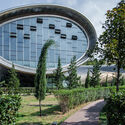
On July 13, 2026, Tbilisi City Hall issued a permit to dismantle Rike Park's tube-shaped Music Theater & Exhibition Hall. The complex, designed by the Italian firm Studio Fuksas, was never officially opened since its completion in 2012, around the same time as the firm's Tbilisi Public Service Hall. The design has been a source of controversy between authorities and citizens since its commission in 2011, when it was built during the government of the United National Movement (UNM), and was suspended after the change of government in 2012. The two structures, often referred to as the "Rike Tubes," were originally intended to house a music theater and exhibition space but remain to this day without any official use.
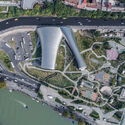
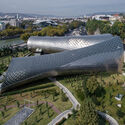
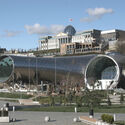
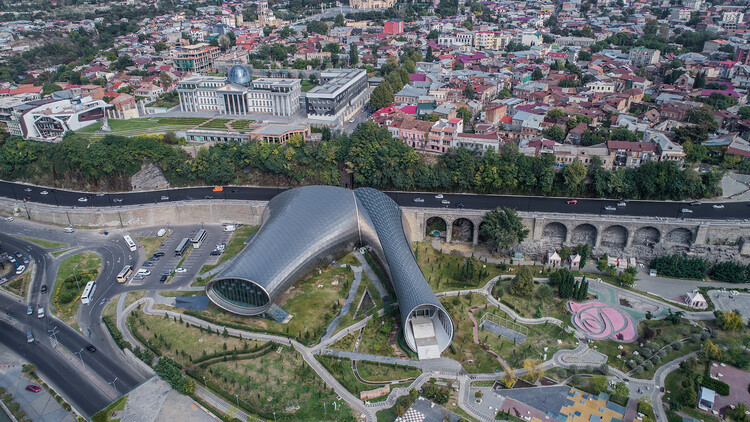
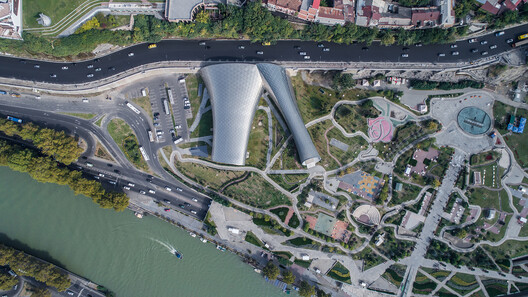
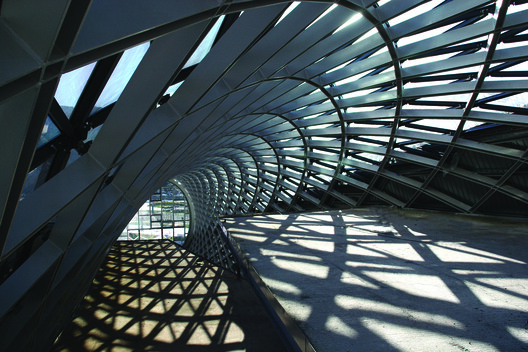
The 10,000-square-meter complex is located on the banks of the Kura River, within the park, and stands out for its shape and material. The building comprises two distinct, soft-shaped volumes united as a single body at the retaining wall, each with its own function: a Musical Theater and an Exhibition Hall. The northern portion houses the Musical Theater Hall, with 566 seats, alongside the foyer, various facilities, technical spaces for theater machinery, and storage areas. The Exhibition Hall is entered via a ramp that guides visitors up from street level, while the Musical Theater Hall rises above ground, allowing occupants of the foyer and cafeteria to look out over the river and the city skyline. Acting as a periscope onto the city, the hall's orientation frames views of the river and the historic core of Old Tbilisi.
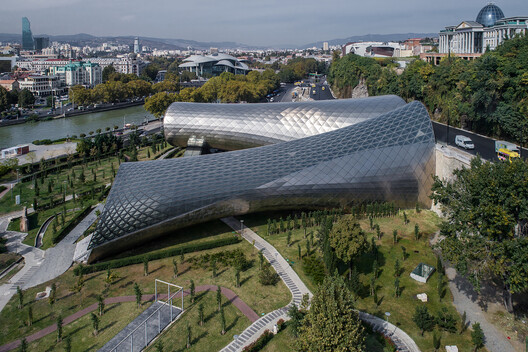
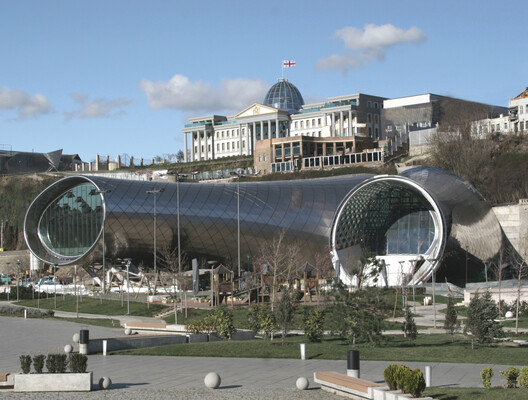
The cultural complex has been called a symbol of the previous political regime, which has been cited as a reason for its abandonment and planned demolition. Officials have publicly voiced their dislike for the building, with Prime Minister Irakli Kobakhidze saying in May 2025 that its ugliness doesn't benefit the capital city. The concert hall was commissioned as part of a state urban renewal program launched by then-president Mikheil Saakashvili. The government planned the construction of architectural landmarks by international firms to project the image of a Western-facing metropolis, alongside privatization, foreign investment, and rapid construction and infrastructure upgrades.
Related Article
How to Save a Building from Demolition: Emerging Procedures to Uncover the Potential of Existing StructuresAcross the years, the Rike Park Music Theatre and Exhibition Hall passed through a series of owners, went to auction more than once, and attracted repeated proposals for redevelopment, none of which ever materialized into a viable new use for the structure. In 2022, control of the building shifted to a firm belonging to entrepreneur Davit Khidasheli, who subsequently transferred the property to new hands. Rike Dome, the current owner, took over the site in June 2025. That same year, the accidental death of a teenager on the grounds drew renewed public scrutiny to the abandoned structure, prompting the Mayor to declare that it would be demolished.
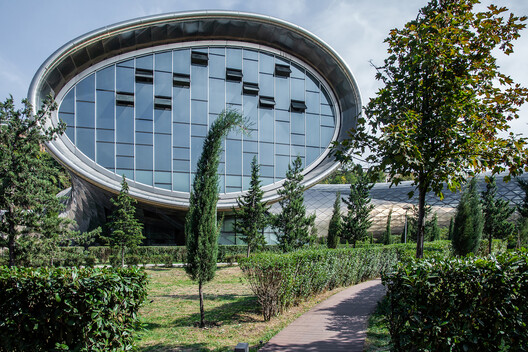
This outcome was confirmed in late June 2026, when Tbilisi City Hall's Architecture Service granted formal approval for the demolition plan filed by the property's current owner, following an endorsement from the municipal Cultural Heritage Protection Council. Per the terms of that approval, the owning company must complete the demolition by December 25. The building's architects, Massimiliano and Doriana Fuksas, have spoken out against the demolition, calling instead for an alternative use of the building. In the studio's words: "We understand the vision behind the city's new development strategy and, at the same time, believe that the iconic Rike Park building can be reimagined through a new program capable of reconnecting the structure with public life and the future development of Tbilisi, preserving the value of the existing investment while integrating a renewed urban vision."
Recent demolition announcements around the world tend to concern buildings representative of modern architecture, rather than contemporary examples like this one. A comparable contemporary case is the demolition of Christian Kerez's Pearling Path car parks in Muharraq, Bahrain, built in 2023, tied to a broader plan to reorganize the historic area. In France, the Îlot 8 housing complex, a Brutalist landmark designed by architect Renée Gailhoustet, faces partial demolition plans justified by concerns over structural deficiencies, safety, and maintenance. In the United States, debate intensifies around the possible demolition of I.M. Pei & Partners' Dallas City Hall, following growing concerns over long-deferred maintenance and the need for major investment. In Japan, organizations are working to preserve Kenzo Tange's Kagawa Gymnasium, permanently closed since 2014.


