
Most of Europe's future housing already exists, yet renovation continues to happen too slowly to address climate, housing, health and resource challenges at the scale required. Re:Living explores how renovation can move from isolated projects to a scalable approach for transforming existing buildings. At the heart of the initiative is a new research project, The Housing We Need for the Future We Want, which examines how better use of the existing building stock can unlock new opportunities for architects, cities and communities.
In 2023, Living Places demonstrated that it is possible to build homes with a significantly lower carbon footprint while achieving a healthy indoor climate and maintaining market-viable costs. The project brought together architects, engineers, researchers and industry partners to explore what better housing could look like when people and planet are considered together.
With Re:Living, the focus shifts from new build to renovation.
The initiative starts with a simple observation: Europe's greatest housing opportunity is not what we build next, but what we already have. Across Europe, existing buildings represent both a significant challenge and a largely untapped resource. Many are inefficient, unhealthy or underused. At the same time, cities are under pressure to deliver affordable homes, reduce emissions and use resources more responsibly.
Re:Living is a partnership-driven experiment designed to explore how renovation can move beyond isolated upgrades and become a scalable solution. Through a real-life demonstration project, the partners will test how healthier indoor environments, lower environmental impact and affordability can be achieved within the existing building stock.
The initiative will be launched on 3 July 2026 in Barcelona during the UIA World Congress of Architects and Barcelona World Capital of Architecture, bringing together architects, design partners and industry professionals to discuss one of the most pressing questions facing the built environment today: how can renovation scale?
The Research Behind Re:Living
The first phase of Re:Living is not a building, but a new perspective on housing.
Developed by VELUX together with BPIE, Artelia, RISE and No Objectives, the Green Paper The Housing We Need for the Future We Want challenges one of the building industry's most deeply rooted assumptions: that meeting future housing needs primarily requires building more.
Instead, the research asks what becomes possible when we start with the buildings already standing.
For architects and planners, the report offers a quantified view of where the greatest opportunities lie across Europe's existing building stock. Rather than treating renovation as a single intervention, it analyses a spectrum of strategies - including renovation, adaptive reuse, conversion, extensions, attic conversions and the activation of underused spaces - and evaluates their potential to address housing needs while reducing environmental pressure.
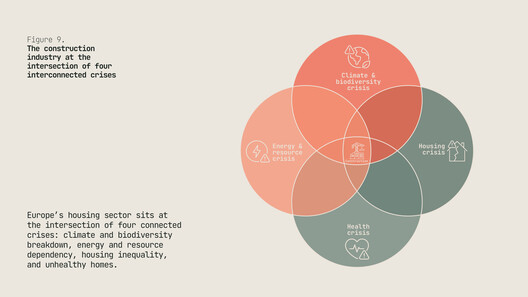
The findings are significant. The research indicates that up to 107 million additional homes could be unlocked within Europe's existing building stock through a combination of renovation, conversion, extension and better use of existing space. Rather than viewing existing buildings as a constraint, the report presents them as a resource capable of addressing multiple challenges simultaneously: climate, housing, health, resource consumption and biodiversity.
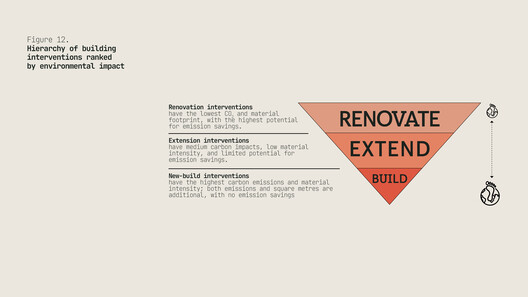
The report identifies renovation and better use of existing buildings as the highest-priority interventions, with new construction becoming the last rather than the first response.
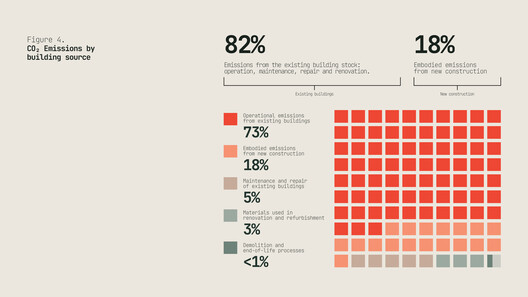
Importantly, the research broadens the conversation beyond carbon. While emissions remain critical, the report highlights resource consumption and biodiversity as equally important measures of impact. This perspective encourages a more holistic understanding of building performance - one that considers not only operational and embodied carbon, but also the wider ecological consequences of how and what we build.
For Re:Living, the Green Paper provides the evidence base for the experiment that follows. We aim to explore how existing buildings can become catalysts for healthier living, lower environmental impact and greater affordability.
Ultimately, Re:Living seeks to turn a shared challenge into a shared learning process - openly documenting its findings and engaging the wider value chain in the transition.
Because the question facing the industry is no longer whether renovation matters.
The question is: How can we make renovation scale?


