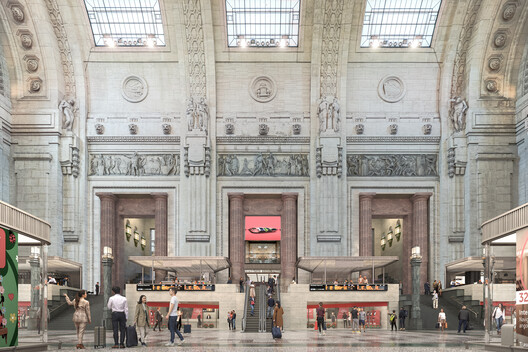
Milano Centrale is the main train station in northern Italy and the second-largest station in Italy behind Roma Termini. The building was officially opened on July 1, 1931, replacing the city's first central station, which opened in 1864. The construction was intended to showcase the power of then-Prime Minister Mussolini's fascist regime, with a notorious scale, massive arches, and an imposing facade. Following a private competition promoted by Grandi Stazioni Retail, Park, an Italian interdisciplinary collective, was selected to redesign the station's ground floor and mezzanine levels, transforming the historic city landmark into a contemporary urban platform.
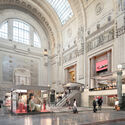
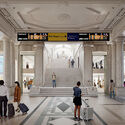
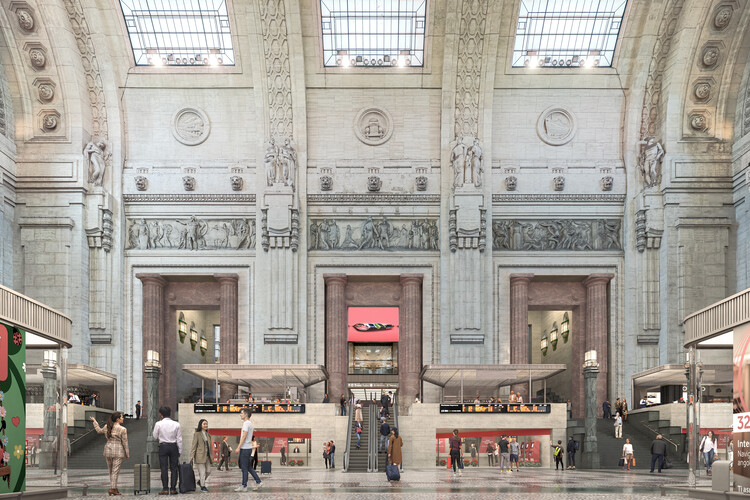
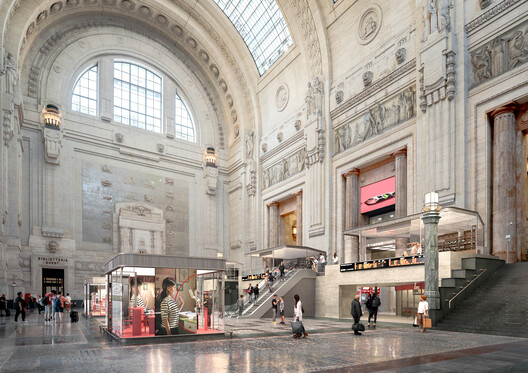
The station has 24 tracks today, with regular daily service to Italian and European cities. Over 320,000 people pass through the station daily. The roof over the platforms is composed of iron-and-glass vaults; the building is enclosed by a 200-meter-wide marble façade; and the walls are adorned with Fascist-era iconography, Roman-garb sculptures, and Art Deco details. Shops and restaurants are located on the station's platform level, mezzanine, and upper levels. The building is directly connected to the Milan Metro, accessible from the platform level. Park's project aims to transform the building from a transit infrastructure into a contemporary urban hub, reinterpreting one of the city's most heavily frequented places.
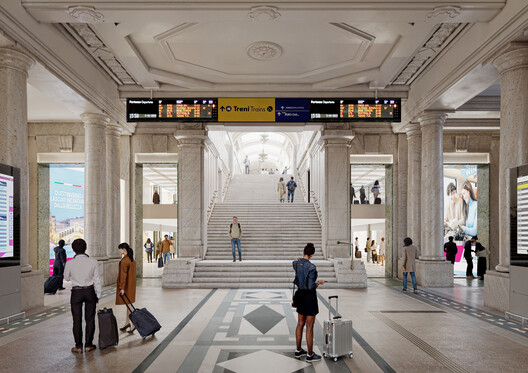
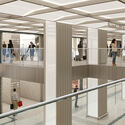
The project, designed in dialogue with the Local Heritage Authority, intervenes in a localized area of the station originally reserved for luggage storage facilities, transformed in 2010 to introduce a retail gallery and moving walkways. According to Park, these spaces lacked the architectural qualities that characterize the station's monumental elements, and the intervention was not designed in accordance with the building's architectural identity. In response to the question of how a commercial space can help shape the station's urban experience, the proposal redesigns the station's retail areas to integrate mobility, commerce, and public life into "a more seamless, accessible, and recognizable experience."
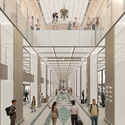
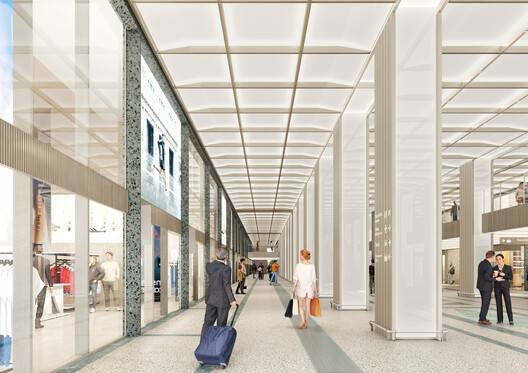
The current retail gallery will be conceived as a public space connecting the station's different levels to improve the passenger experience and strengthen the connection between the building and its urban surroundings. The commercial environment is given a unified identity through a redesign of the internal façades, new shopfronts in response to the station's architectural language in terms of proportions, materials, and details, and a transformation of the columns into elements of orientation and illumination. In its entirety, the project is based on the reinterpretation of the station's original defining characteristics, operating through three intertwined architectural themes: the monumentality of its spaces, natural light, and the richness of its material palette.
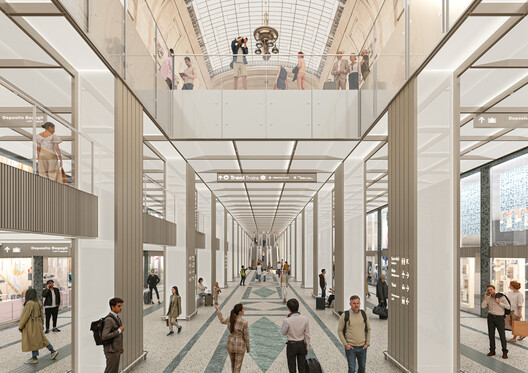
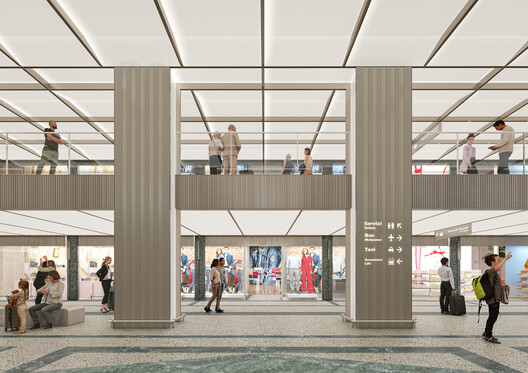
Monumentality is reinterpreted through a reconsideration of proportions and spatial relationships, reactivating the connection between the retail level and the platforms, while new voids and openings encourage intuitive wayfinding. Natural light is the second generative element: an illuminated ceiling system, inspired by the skylights of the Galleria dei Mosaici, introduces a diffuse and even quality of light that was previously absent from the retail gallery. Finally, material richness is addressed by translating colours, textures, and compositional principles into a contemporary palette; warm-toned metallic finishes matched with the Botticino marble, the vertical rhythm of the new devices echoing the existing pilasters, and the flooring patterns extending the marble geometries of the monumental halls into the gallery.
Italian cultural heritage, some of it part of the world's heritage, is being reinterpreted in various regions of the country. The Italian architecture studio STARTT recently designed a new access to the archaeological areas behind the Pantheon in Rome, allowing visitors to reach parts of the building's archaeological fabric previously reserved for technical functions. Also in Rome, Stefano Boeri Architetti is transforming an abandoned tram depot dating back to the early 1900s into a multifunctional civic space that introduces cultural, educational, commercial, co-working, and leisure functions. In Milan, Settanta7 has begun construction of Bosco della Musica, a new campus for the Conservatorio Giuseppe Verdi in a former industrial area that has come under scrutiny due to incidents of violence and public safety concerns. The project is part of a broader urban regeneration program that includes the redevelopment of a 17,400 sqm site and the adaptive reuse of the city's "Ex Chimici" industrial building.


