

There is a standard way of telling the history of architecture and food. It begins with the human decision to cultivate, to store, to distribute, to consume, and ends with the building that decision produced. In this version of events, food is the occasion and architecture is the response.
But what if the story runs differently? What if the tomato built Almería? What if the cod redesigned the North Atlantic? What if the soybean is, at this moment, constructing a port in Santos and demolishing a forest in the Cerrado simultaneously, and the architect has simply not been told? These are descriptions of processes already complete, or well underway, that have produced some of the most spatially consequential contemporary landscapes. Much of the built environment is shaped by the pressures, metabolisms, and territorial ambitions of what we eat. Architecture, in this, is often less a project than a consequence, and the discipline has been telling its own story from the wrong end.
What changes when you read about the built environment from the food outward is the very idea of authorship. The granary did not follow the harvest. The harvest made the granary necessary, and necessity, applied with sufficient force over sufficient time, is a more powerful designer than any architect who ever lived.
What the Soil Remembers
Bruno Latour argued that modernity was built on a founding act of separation: nature on one side, culture on the other, with a clean line drawn between them that allowed both to be governed independently. This separation, Latour insisted, was always fiction because it concealed the degree to which non-human actors were doing political work. The potato was not neutral in the hands of the Nazi regime, as the grain was not innocent in the colonial project it fed. To read the built environment in which food is produced is, in part, to read what that separation was designed to hide.
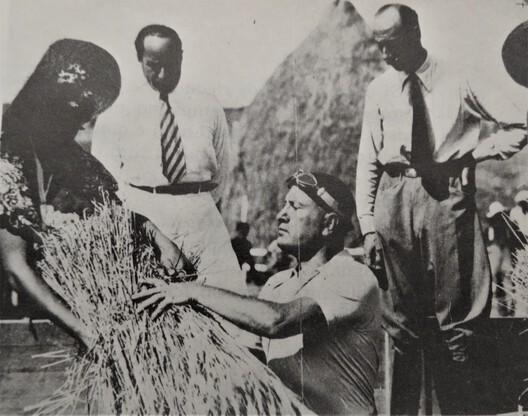
The Italian fascist battaglia del grano, launched by Mussolini in 1925, reorganized the agricultural landscape of the peninsula around a single crop and a single imperative: autarky. The wheat varieties developed by geneticist Nazareno Strampelli were distributed through a state bureaucracy whose spatial reach extended to fifty-five thousand villages. The same varieties travelled to Portugal's Estado Novo, where they organized the latifúndio of the Alentejo and exhausted its soils under the same autarkic logic. In Germany, the annual Erntedankfest at the Bückeberg, where half a million people gathered under the motto Blut und Boden around harvested wheat, rye, and potatoes arranged as scenography (Albert Speer designed the set), was the staging of a relationship between a people, a crop, and a territory that the regime needed to make appear eternal.
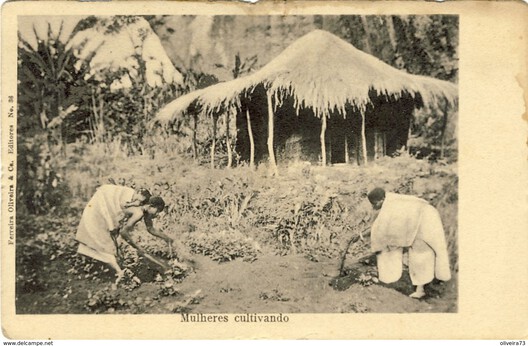
What is remarkable, in retrospect, is how legible this architecture remains. Amílcar Cabral, an agronomist, not an architect, understood it with unusual precision through mapping soil erosion in Guinea-Bissau for the Portuguese colonial service in the early 1950s. He recognized that the same spatial logic that had exhausted the Alentejo, monoculture expansion in the service of state autarky, was operating on the African continent as an instrument of extraction. His erosion charts, plotting the relationship between colonial cash crop cultivation and soil depletion across eight peoples of Guinea-Bissau, became decolonization maps. The grain had built the colonial territory, and the colonial territory, read carefully enough, contained the tools for dismantling it.
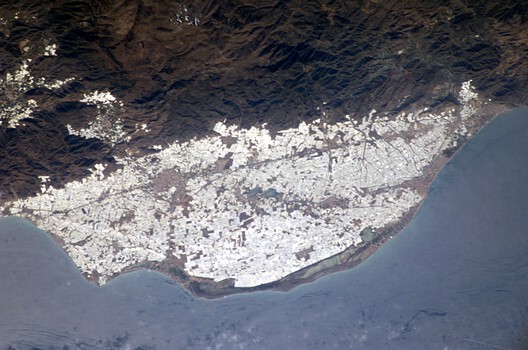
The contemporary version of this political geography is no less architectural, and no less concealed. The migrant workers who remove plastic sheeting from Almería's greenhouse roofs, without protective equipment, at height, in heat, are there because a chain of spatial decisions, made across three continents over several decades, left them with few alternatives. The overfishing of West African coastal waters by the European salmon industry destroyed the livelihoods that once sustained their communities. The soy grown on deforested Brazilian land to feed the salmon industry follows the same logic. These are spatial systems, distributed across hemispheres, whose architecture becomes visible only when the full territory is held in view at once.
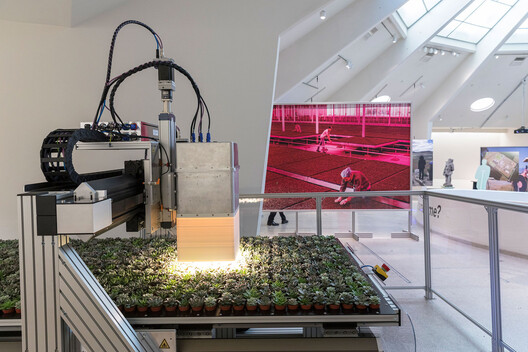
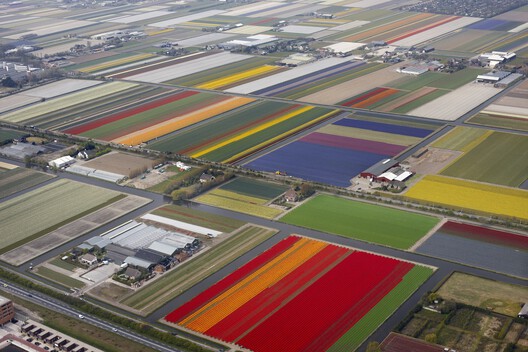
Rem Koolhaas's Countryside: A Report, presented at the Guggenheim Museum in New York in 2020, attempted something like this. A survey of what happens to territory outside the city, in the zones where the architectural imagination was consistently abandoned, and logistics, extraction, and monoculture took over. The Dutch greenhouse appeared as one of the most consequential spatial inventions of the modern period; a Cartesian space, in Koolhaas's reading, the physical expression of Descartes's imperative to make ourselves masters and possessors of nature. The countryside, on that account, is its most radical laboratory. What the analysis stopped short of saying is the more uncomfortable thing that these spaces were not designed by architects; they were designed by food. The relevant unit of analysis is the supply chain, one of the most consequential and least examined forms of construction the modern world has produced.
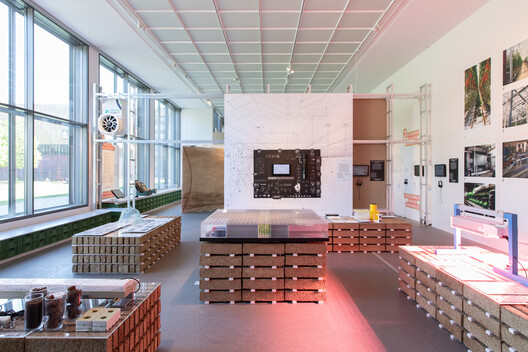
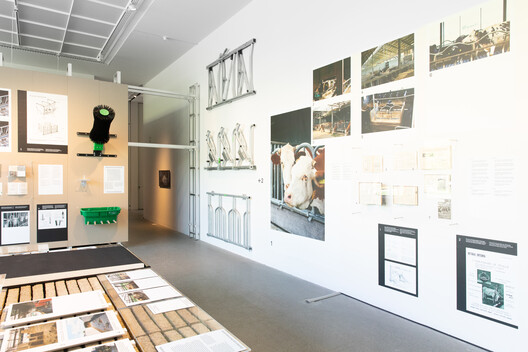
Convivium: Food Systems at the Limit, presented at the Architekturmuseum der TUM in Munich, arrives as a form of belated reckoning. All these typologies are spatial forms through which the political, ecological, and economic conditions of the present become legible in ways that no civic building or urban plan could match. The exhibition insists that these spaces are architectural subjects, and that the discipline's long refusal to see them was a choice, with consequences for the territory, for the people who work within it, and for a profession that claimed relevance while averting its gaze from the built environment that feeds the world.
The Body as Program
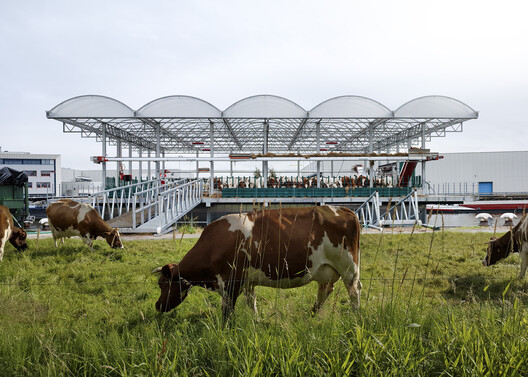
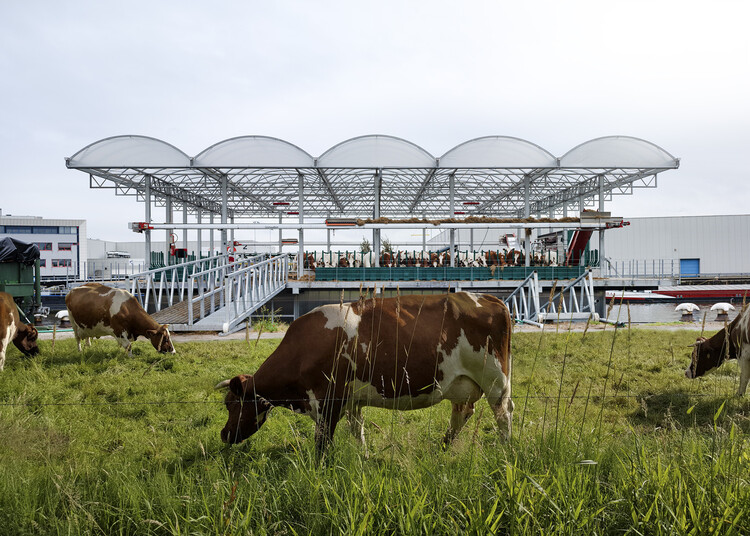
The dairy barn is one of the most thoroughly documented building types in the history of construction. Its archive lives in the zootechnical handbooks that circulated transnationally from the late nineteenth century onward, updated with each generation of veterinary research, translated and redistributed across Europe and North America in editions that cross-referenced each other with the fidelity of a scholarly tradition. The central question was always the same: what spatial conditions maximise the cow's productive output? And the answer, refined across decades of experiment, failure, and revision, generated a typology as internally consistent and as globally distributed as any building type the discipline has canonised.
What the handbooks reveal is that the barn's form is a direct transcript of the animal's body mediated, at every point, by the requirements of capital. The cow's preference for wide, unobstructed routes to the milking robot is efficiency: an animal under stress produces less milk, and stress can be caused by space. The ventilation systems are calibrated to bovine thermoregulation, the head-locking feeding gates that prevent competition between animals at the trough, and the cubicle dimensions derived from the average body mass of the Holstein-Friesian.
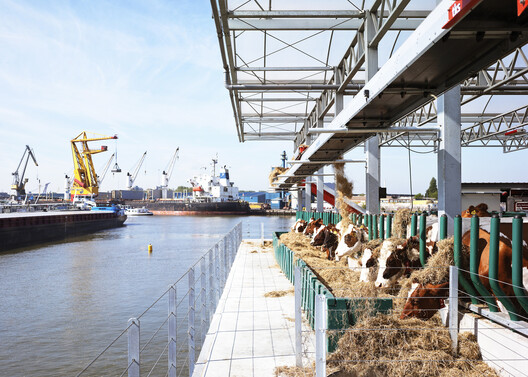
This logic has a history that is longer and more politically entangled. The modernization of the European cattle barn in the early twentieth century was a political project. In Fascist Italy, tubular steel elements for dairy barns were promoted as instruments of the regime's autarkic ambitions, part of the same battaglia zootecnica that sought to rationalise animal production as an extension of national will. In the postwar Netherlands, Sicco Mansholt (first as Minister of Agriculture, then as European Commissioner) pushed the industrialisation of dairy farming as the spatial foundation of the Common Agricultural Policy. Economies of scale, scientific management, and export capacity as the architecture of European food sovereignty. The average Dutch dairy farm grew from nine cows in the postwar years to over a hundred by the end of the century. The barn grew with it, absorbing each new requirement (automated milking, robotic scrapers, sensors monitoring individual animals' reproductive cycles) until the building became something closer to a laboratory. A factory, a clinic, and a metabolic apparatus simultaneously. The cow had not changed.
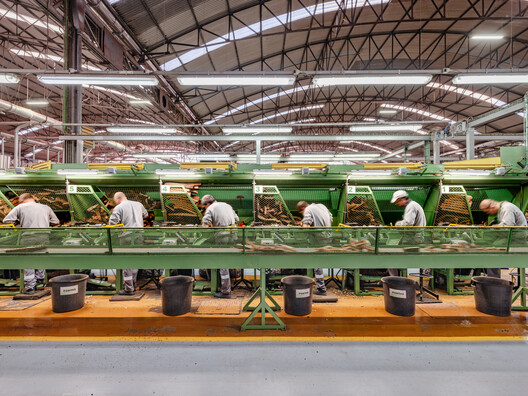
The same dynamic operates in the greenhouse, where the plant's requirements have generated a typology of radical consistency across radically different geographies and political systems. The Venlo greenhouse, developed in the Netherlands in the 1930s, with its standardised steel sections and modular glass panels subsequently exported, as components or as capital, to every continent, is not a Dutch invention in any cultural sense. It is the spatial consequence of the tomato's need for controlled light, temperature, and humidity, translated into buildable geometry that can be replicated anywhere the economic conditions make production viable. In Germany alone, more than a quarter of all vegetables consumed are tomatoes. Roughly seventy per cent are imported from the Netherlands and Spain. The greenhouse that produces them was designed by the fruit it contains.
Territories Without Authors
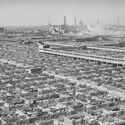
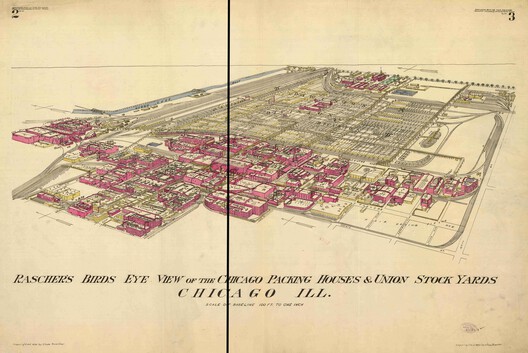
The Chicago Union Stockyards, opened in 1865, marked the moment when the logic of industrial food processing first achieved spatial form at a scale that restructured a continent. All railroads led to Chicago, as Carolyn Steel observes in Hungry City, because they were built to bring the produce of the American plains to a single point of conversion. By 1870, the stockyards were processing three million head of cattle per year. Their spatial organisation, the gridded pens, the disassembly lines, the refrigerated rail connections pioneered by meatpacker Gustavus Franklin Swift to carry products to the East Coast, was designed for the efficient movement of animals through successive stages of conversion. The architectural historian Sigfried Giedion, writing in Mechanization Takes Command in 1948, recognised this as a genuine spatial invention that preceded and informed the logic of the factory assembly line.
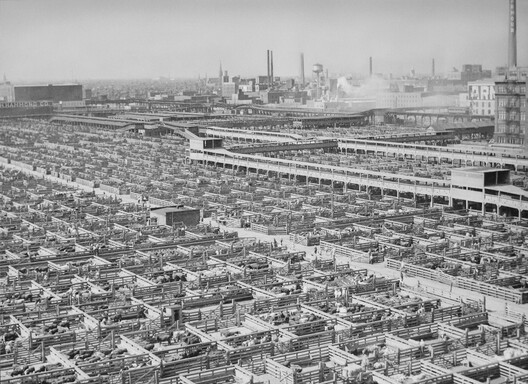
What followed was a century of territorial reorganisation driven by the same imperative subordination of landscape to the productive requirements of a single commodity, operating at ever larger scales and with ever more durable consequences. The Green Revolution of the mid-twentieth century, led by the Ford and Rockefeller Foundations and disseminated through international agricultural research centres, is remembered as an agronomic event with new seed varieties, chemical fertilizers, mechanized irrigation, and a doubling of yields across Asia and Latin America. It was also, and perhaps primarily, a spatial one. Agronomists, geneticists and development economists converted diverse agricultural landscapes into monoculture systems of extraordinary territorial extent, ecologically simplified and logistically integrated, optimised for export and dependent on inputs whose supply chains extended across continents.
The sea, on the other hand, presented a different problem and a different solution. For centuries, the ocean had been treated as a common, ungoverned, unregulated resource. But what changed was not technology but fish; the depletion of coastal stocks by industrial trawling through the mid-twentieth century forced a reckoning with the question of who owned the water. The answer, formalized through successive extensions of maritime jurisdiction, from three nautical miles to twelve, then to fifty, then to two hundred, culminating in the United Nations Convention on the Law of the Sea in 1982, was among the most consequential acts of territorial construction of the modern period. The ocean was divided, and the coastline, which had been a physical fact, became a political geometry redrawn by the progressive absence of fish from waters that had once seemed inexhaustible.
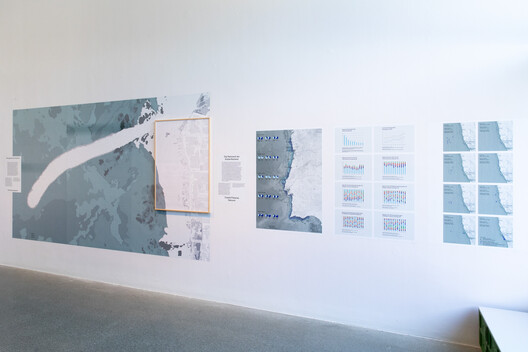
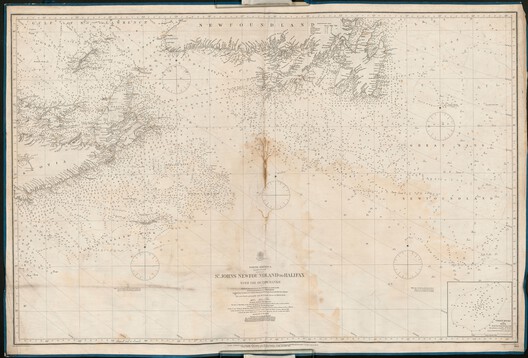
What this redrawing produced architecturally is what the research project Fishing Architecture, led by André Tavares at the University of Porto, has spent years recovering. Its premise, distilled in the title of Tavares's 2024 MIT Press book, Architecture Follows Fish, is that the built environment of the Atlantic coast cannot be read without the fish that organised it. Cod is, perhaps, the clearest case. Followed for centuries by Basque, Portuguese, English, and Norwegian fleets across the Grand Banks, it organised coastlines: the processing stations of Newfoundland, the salting houses of Gafanha da Nazaré, the dried-fish warehouses of Bergen, the canning infrastructure of Matosinhos, the port facilities of Lisbon and Bristol built to receive, store, and redistribute a single species across a continent. Comparing the bathymetric profiles of Newfoundland and the Portuguese coast, as the project has done, reveals not two different geographies but two complementary halves of the same spatial system, separated by three thousand miles of ocean and joined by the migration route of a fish.
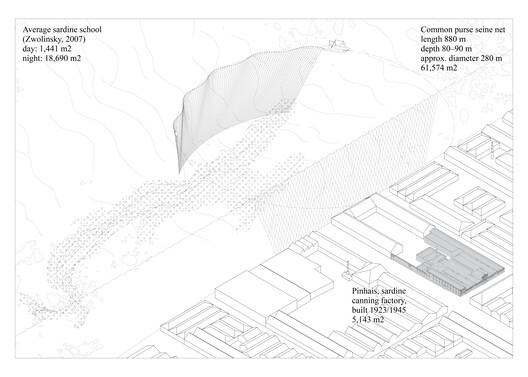
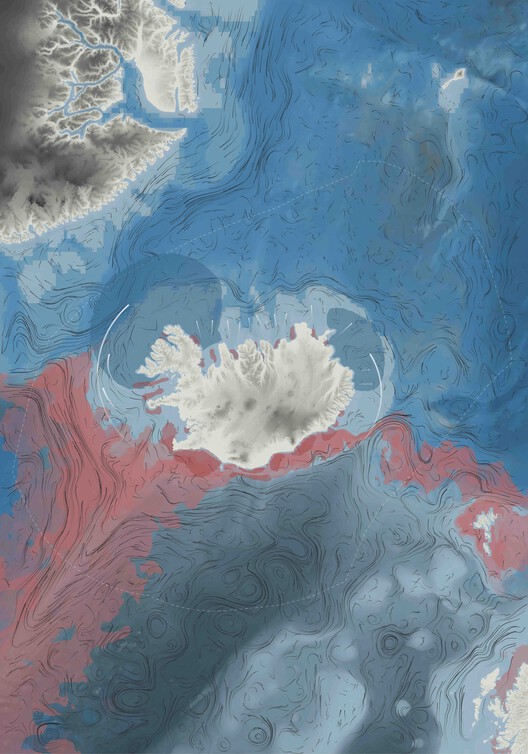
When the cod collapsed, a slow catastrophe visible in catch data for decades before it was politically acknowledged, architecture had also collapsed with it. Harbours and processing plants, the sardine canneries of Brittany and the Adriatic coast, the octopus fisheries of Angeiras, the small-scale fishing communities that had organised themselves around specific species and specific seasons for centuries, found themselves without a program. The fish had left, and the buildings stripped of the logic that had generated them were now only ruins of a spatial system whose author had departed.
The salmon tells a different version of the same story. When wild stocks could no longer sustain industrial demand, the fish did not disappear from the supply chain. Aquaculture, expanded rapidly from the 1970s onward, transferred the productive logic of the greenhouse to open water: controlled density, managed feeding cycles, monitored growth rates, optimized yield. The Norwegian fjords, whose particular geometry of enclosed, cold, deep water made them ideally suited to this purpose, were converted into a new kind of territorial infrastructure, a landscape of floating cages, feed barges, and underwater sensors that reorganized the relationship between coastline and sea as thoroughly as any port construction program.
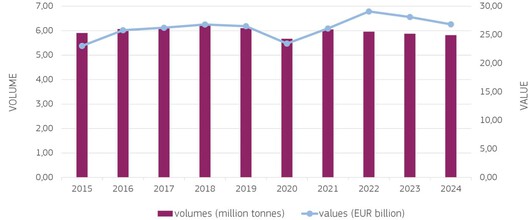
But something else changed, too. The salmon itself was transformed. Selectively bred for rapid growth, fed on pellets derived from the same soy that feeds European pig farms, confined to densities unimaginable in its migratory life, the farmed salmon became a different organism. The coastline changed its geometry as the fish changed its organoleptic. Architecture, in both cases, was the instrument of the transformation and the record of what had been lost.
The Unclaimed
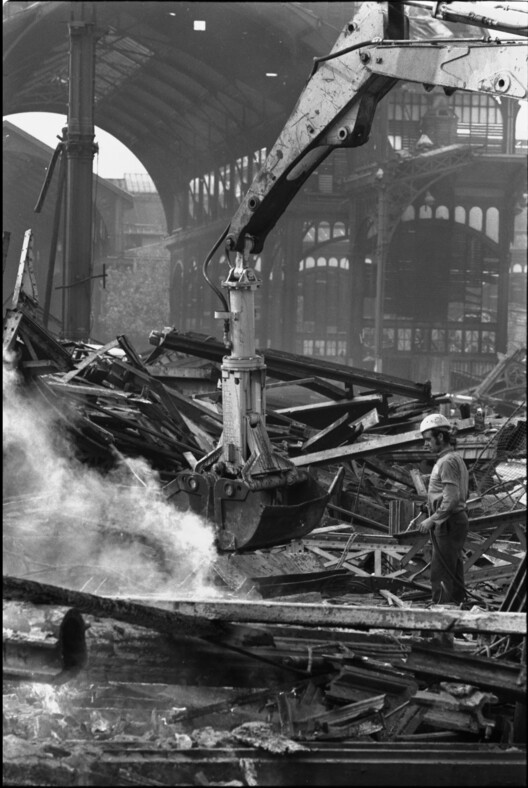
There is a moment, somewhere in the middle of the nineteenth century, when the city and its food began to separate. The abattoirs moved to the periphery, the wholesale markets were relocated, and the fishing quays were absorbed into industrial port complexes. Les Halles in Paris, that cast-iron cathedral of daily sustenance at the centre of the capital, described by Zola as Le Ventre de Paris precisely because it made the city's metabolism visible and public, was demolished in 1971 and replaced by a shopping centre and a metro interchange. The food kept coming, and nobody asked where.
The supermarket, that radical spatial invention of the early twentieth century, whose genius lay not in what it offered but in what it concealed, completed the separation that the industrial food system had begun. The building is designed so that the question of where food comes from cannot be asked because the space provides no surface on which the question could land. They became, in the process, the most territorially dominant building types of the modern period, covering more ground, organising more labour, and consuming more material, while remaining professionally invisible, unclaimed, and unnamed. Bastard architectures, essential, ubiquitous, and without a parent, as Eduardo Castillo-Vinuesa and Manuel Ocaña called them in FOODSCAPES.
Nobody claimed them. That, too, was a choice.
This article is part of the ArchDaily Topic: Transspecies Architecture: The Life of Materials, Ecological Alliances, and Nature's Agency. Every month we explore a topic in-depth through articles, interviews, news, and architecture projects. We invite you to learn more about our ArchDaily Topics. And, as always, at ArchDaily we welcome the contributions of our readers; if you want to submit an article or project, contact us.


