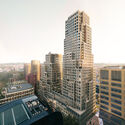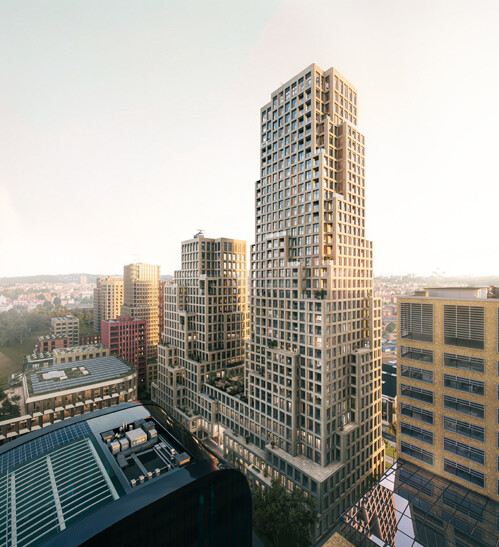
Rotterdam-based firm MVRDV has announced a new milestone in the development of its Tour & Taxis Towers, a mixed-use project in Brussels, Belgium. The design was commissioned by real estate investor and developer Nextensa in 2021, within the framework of a site-specific land use masterplan also designed by MVRDV. The two-tower project combines offices, housing, and public amenities across 58,000 m², forming a landmark in the neighbourhood and reaching 126 metres at its highest point. Recently granted construction permission, the project is designed to reduce embodied carbon through the use of a hybrid structure and lightweight façade elements, aiming to minimize the use of concrete in both the structure and foundations. From the early stages, the firm has employed its CarbonSpace software to guide these decisions.
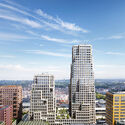
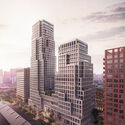
MVRDV's Tour & Taxis Towers is part of a Specific Land Use Plan for the neighbourhood dating back to 2017. This plan is a site-specific legal instrument that defines the future development of the area, including housing, offices, retail, and public spaces. It aims to enable higher building densities while maintaining a dialogue with the surrounding context, residents, and relevant institutions. MVRDV was appointed master urban planner in 2019 and developed the plan over two years, translating urban planning requirements and architectural, social, and environmental ambitions into a concrete concept and volumetric study. Between 2021 and 2025, the team developed a Visual Quality Plan, conducted stakeholder engagement sessions, and submitted building and amended permit applications, ultimately securing planning and environmental permits for the Lake Side project in April 2026.
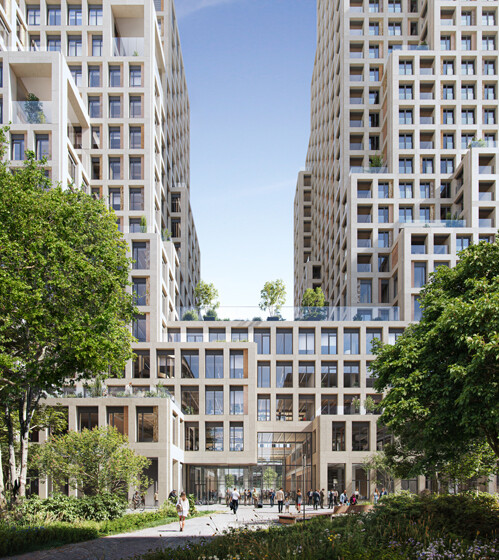
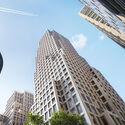
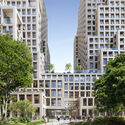
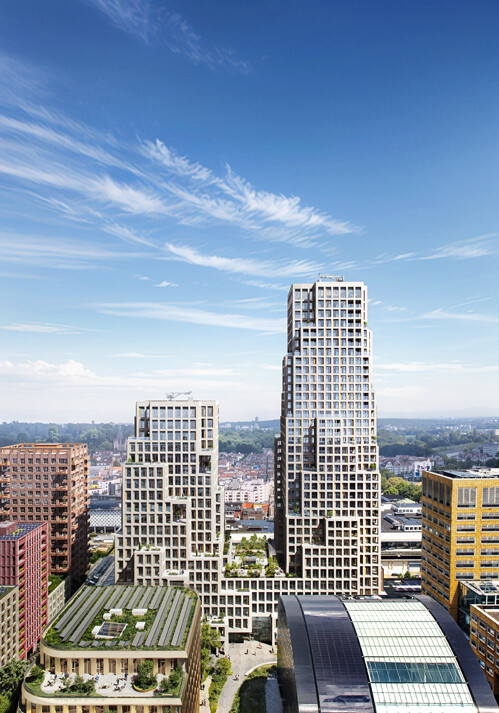
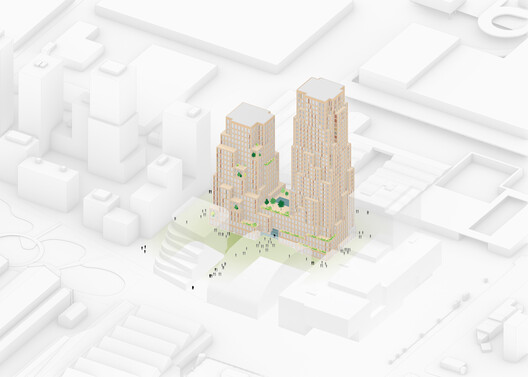
The project, a starting point for the masterplan realization, consists of two towers connected at the base by a five-storey plinth. The western tower rises to 20 storeys and is dedicated to office use, while the 35-storey eastern tower accommodates 199 apartments ranging from studios to three-bedroom units. The plinth integrates office space and public programmes and is topped by a terrace. The structure is based on 2.7-metre façade modules, allowing for adaptability over time. In terms of form, the towers incorporate irregular setbacks informed by light and wind studies. These create opportunities for both collective and private terraces, as well as corner windows that expand access to city views.
Related Article
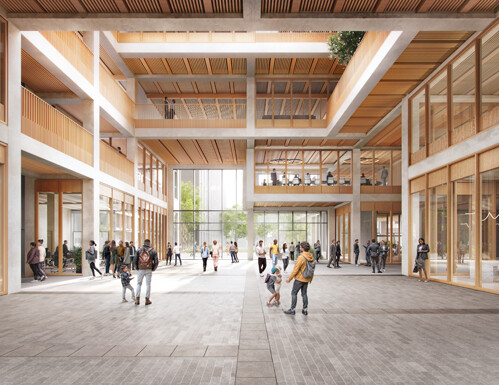
CarbonSpace: Designing with Carbon from the First SketchAccording to the designers, particular attention has been given to integrating the towers into their surroundings. The overall form responds to the urban context, acting as a transitional element between the predominantly residential buildings of Lake Side's courtyard and nearby office complexes, including those of the Flemish Government administration. The plinth is designed to host public-oriented programmes that activate the street level throughout the day. The complex is traversed by a passage connecting the Lake Side area to Anna Bochlaan, while an atrium extending to the top of the plinth offers glimpses into the office spaces above.
With the Tour & Taxis Towers, as well as the masterplan itself, we continue to pursue a variety of MVRDV's goals: high-value, dense, mixed-use neighbourhoods that allow for future flexibility. In this way, we allow cities to develop to their full potential without sprawl. Crucially, we have always investigated the requirements of responsible density, and the way we define that is continuously expanding. Nowadays, that includes the carbon emissions of new tall buildings. - Nathalie de Vries from MVRDV
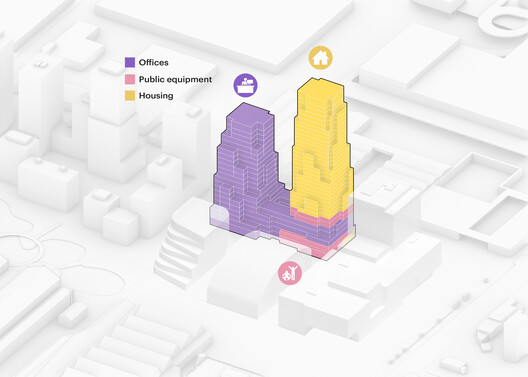
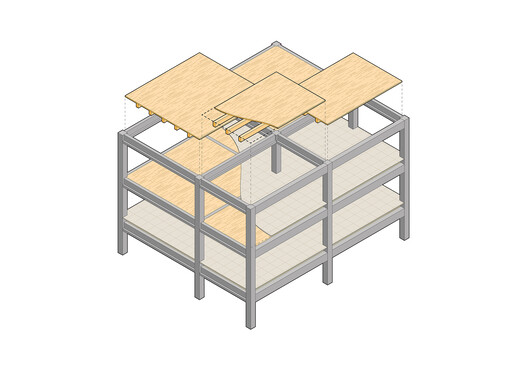
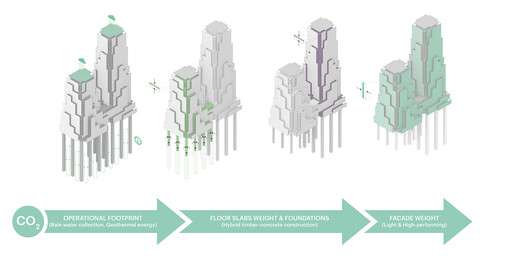
Recognizing that tall buildings typically generate high levels of emissions, the Tour & Taxis Towers were designed using MVRDV's proprietary CarbonSpace software, which estimates embodied carbon even in early design stages. The project aims to align with the EU taxonomy for sustainable activities, making low-carbon design a central principle. This approach informed the adoption of a hybrid structural system for the office tower, where a concrete frame supports cross-laminated timber floor slabs. Such decisions reduce both the building's weight and the amount of concrete required in its structure and foundations, significantly lowering its carbon footprint compared to conventional buildings of similar scale.
MVRDV recently unveiled the design for a new health research and education facility for the University of Toronto, developed in collaboration with Diamond Schmitt Architects and Two Row Architect. Earlier this year, the firm also partnered with Snøhetta, Bjarke Ingels Group, and local practices KEYM, DB Architects, Rasa, and Bilgin Architects to design an 84-hectare, landscape-led residential community in Istanbul, Türkiye. In addition, MVRDV was among the five shortlisted teams in the Shift Sustainability Landmark competition in Rotterdam, which explores diverse visions for sustainability and climate action.