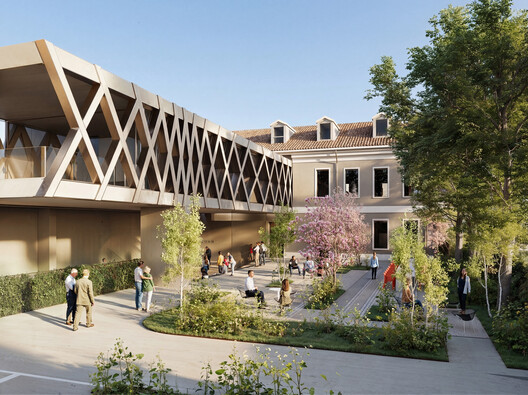
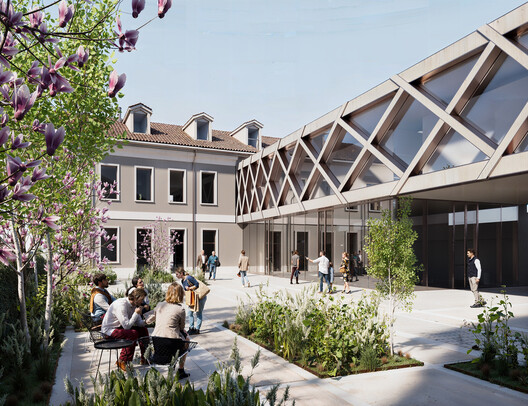
CRA–Carlo Ratti Associati has been selected to design the Buzzi Heritage cultural center in Casale Monferrato, Italy. The proposal introduces a 100-meter-long suspended truss that links two former educational buildings, consolidating archival, research, and cultural functions within a single structure. The project also marks the first real-world application of a patented structural system developed through research by Carlo Ratti Associati in partnership with Maestro Technologies. Positioned above a system of open spaces, the intervention reconfigures the site as a publicly accessible cultural complex while maintaining a clear distinction between built and landscaped areas.
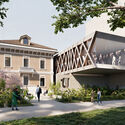
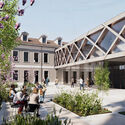
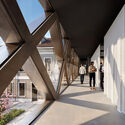
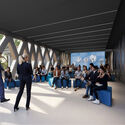
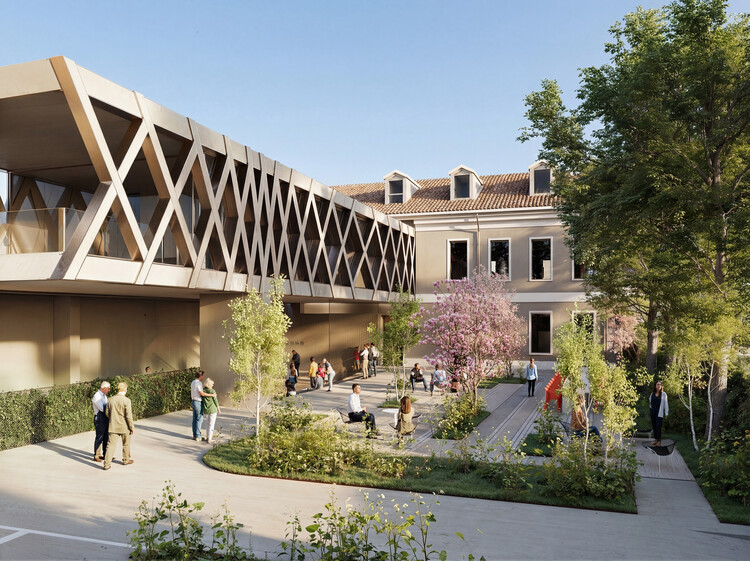
The project examines the integration of digital fabrication processes into reinforced concrete construction, highlighting that while materials such as steel and timber have undergone significant transformation through digital production methods, reinforced concrete has largely retained conventional casting techniques. The proposal aims to address this condition by incorporating digitally fabricated components into the construction system, using the truss as the primary structural and organizational element.
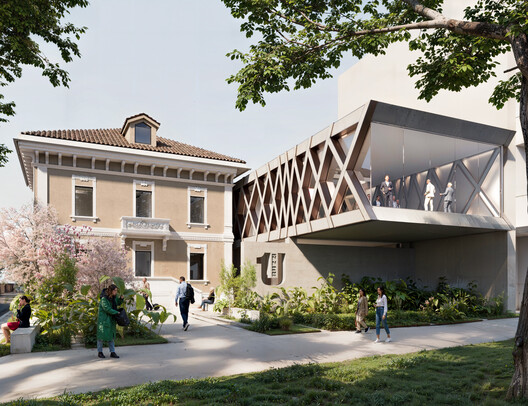
Developed in collaboration with Maestro Technologies, the structural system combines cast-in-place concrete with prefabricated steel elements produced through laser cutting and CNC machining. These components operate as both permanent formwork and reinforcement, remaining embedded within the structure after assembly. Fabricated off-site and installed with a high degree of precision, the system aims to streamline construction processes while modifying the relationship between formwork, structure, and material use.
Related Article
CRA–Carlo Ratti Associati and Italo Rota Transform MAE Carbon Fiber Archive Into an Interactive Museum in ItalyAt ground level, the suspended volume establishes a sequence of three courtyards defined by varying degrees of accessibility. The first courtyard remains fully open to the public, extending the urban fabric into the site. The second accommodates shared uses, supporting informal activities and daily occupation. The third is more contained, serving the functions of the Centro Incontro Fondazione Maurizio Buzzi and introducing a more private spatial condition within the overall layout.
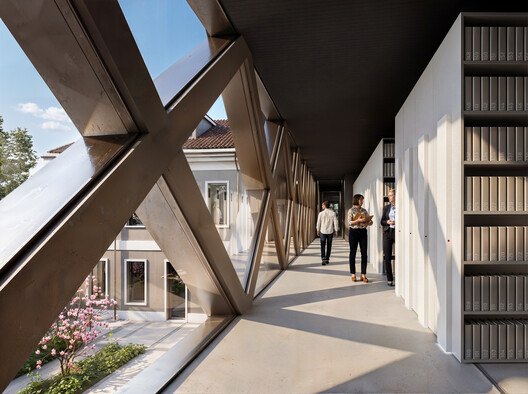
The project is informed by ongoing research into construction methods and adaptive reuse strategies within the practice. Rather than treating the existing buildings as isolated elements, the proposal frames them within a broader spatial system defined by the elevated structure and the landscape below. This approach aligns with earlier interventions such as AGO Modena Fabbriche Culturali, where an 18th-century hospital complex in Modena was transformed into a multidisciplinary cultural and innovation hub through the insertion of new spatial and structural elements, including a triangular public plaza set beneath a kinetic roof developed in collaboration with Italo Rota and artist-engineer Chuck Hoberman.
Within this broader trajectory, recent work by CRA–Carlo Ratti Associati continues to expand across cultural and infrastructural scales. In Fiorenzuola d'Arda, Italy, a museum dedicated to the science of carbon fiber has opened, based on a design initiated in 2021 in collaboration with Italo Rota. The practice has also released images of a proposal for a new cultural center in Addis Ababa, Ethiopia, and, in parallel, has been selected, together with The Blossom Avenue Partners, to design X-Change, a multimodal logistics hub planned on the site of a former railway yard in Alessandria, Italy.