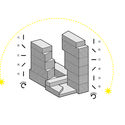
SOM and Fender Katsalidis have won an international design competition for Central Place Sydney, a commercial development that will introduce new transformative public space and high-tech towers. Located in Sydney's Central Business District, Australia, the proposed project seeks to transform the western edge by introducing innovative buildings and public realm improvements.
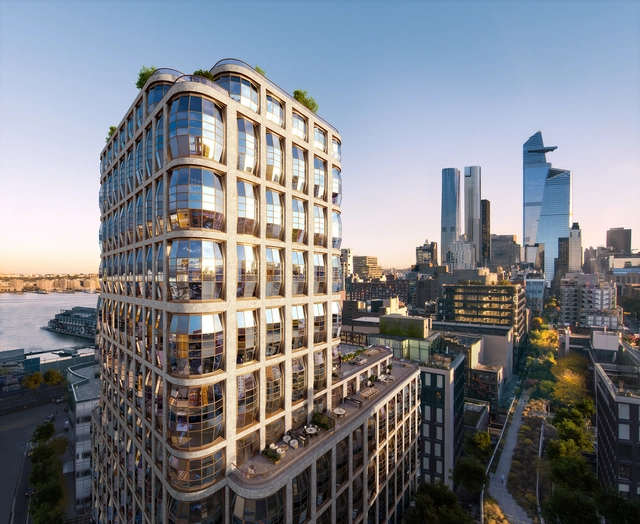
New renderings were unveiled for Heatherwick’s first residential project in New York, currently under construction. The recently dubbed “Lantern House”, in West Chelsea’s neighborhood, will join a series of developments, expanding the High Line's facades.
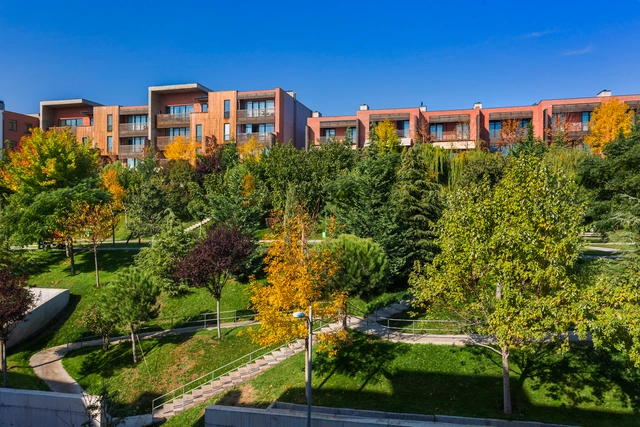
Lisi Green Town. Image Courtesy of Lisi Development
Architects and developers have always been on opposite ends of the construction world. While the first wanted to create dreamy spaces, the latter just wanted to cater to the basic needs. In these past few years, the world has witnessed significant changes, with the aggravation of climate-related issues, the evolution of technological solutions, and the newly acquired awareness and growth of the population.
While everything is transforming, building trends also evolved, mainly due to an alteration in people’s perceptions and priorities. However, one question remains unanswered: Could all these changes mean that the never-ending conflict between architects and developers reached some sort of common grounds? And could they finally be seeking one same goal, of a sustainable, resilient and inclusive future?
Sky Green, WOHA’s first project in Taichung, Taiwan has just been completed. Commissioned by the developer Golden Jade, with Feng Chia University as an advisor, the project is the first green and sustainable mixed-use development in the city.
Led by Iyad Alsaka, Reinier de Graaf, Jad Semaan, and Adrianne Fisher, OMA’s proposal was selected as the winning entry for a residential project on Kuwait City’s waterfront. In collaboration with local partner Kuwait-based consultant Pace, The Wafra tower will be OMA's first venture in the country upon its completion.
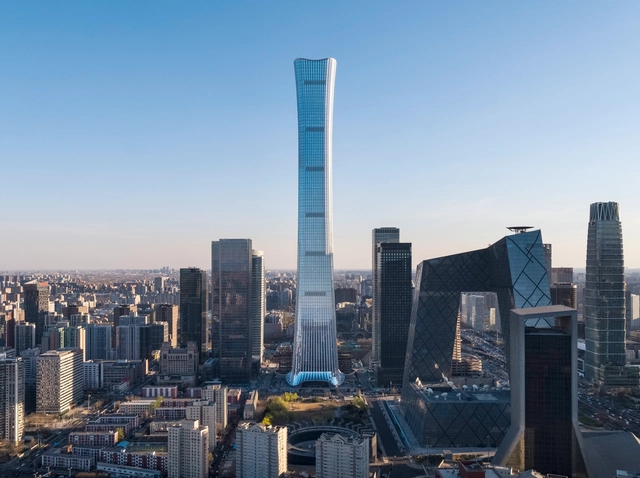
The 528 meters CITIC Tower, was inaugurated, standing tall as Beijing’s highest building to date. Designed by Kohn Pedersen Fox Associates (KPF), the supertall innovative architecture remains culturally appropriate, drawing inspiration from the “zun”, a ritual vessel originating in Bronze Age China.
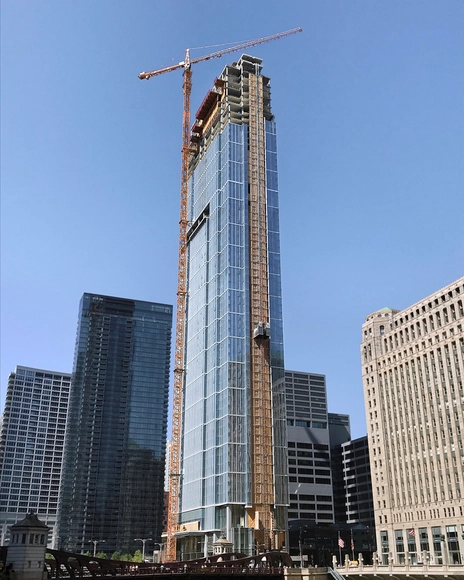
Wolf Point East, a 665-foot residential tower, part of the last remaining development along the Chicago River, topped off and is near completion. Designed by Pelli Clarke Pelli Architects, and part of a master plan to redevelop the area, the east tower generates 700 rental units, 35,000 square feet of amenities, and 4,000 square feet of retail at street level.
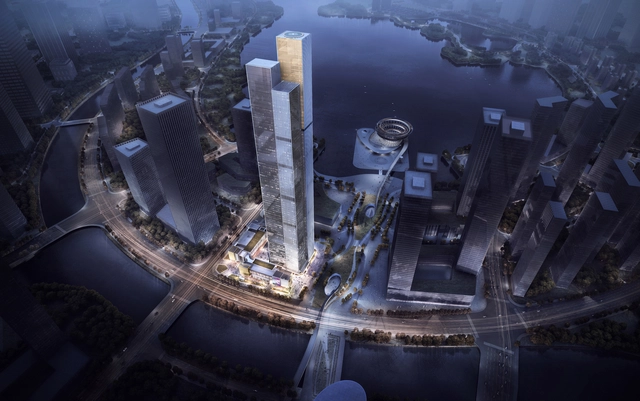
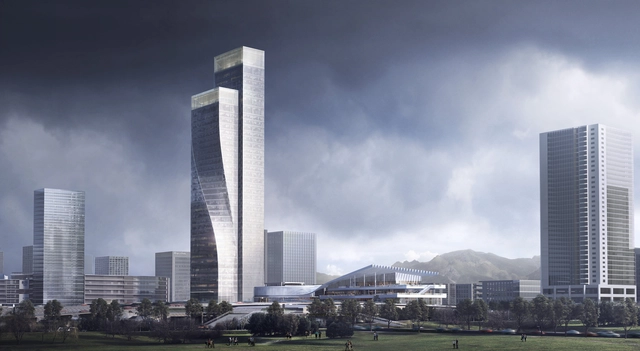
Aedas, one of the world’s leading architecture and design practices, designed the 323 meter Changsha Jinmao Tower. Located in the newly planned Changsha CBD, the architecture firm created a high-rise that reflects its context, especially the local steep mountainous landscape.
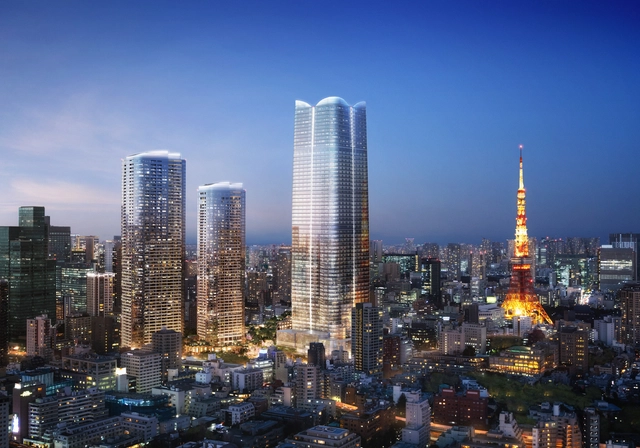
Towers of Pelli Clarke Pelli Architects . Image Courtesy of DBOX for Mori Building Co.
Pelli Clarke Pelli Architects generate for the first time in Japan, a high rise complex that holds the tallest building in the country, at the height of 330 meters. The U.S firm designed 3 towers for the district of Toranomon-Azabudai in Tokyo, part of a whole urban regeneration scheme for the central area of the capital.
The Chongqing Gaoke Group Ltd Office building designed by Aedas has reached new heights as construction progresses, and the project is taking form in the urban fabric and the city center’s skyline. Standing tall at the north of Xingfu Plaza, in Jiangbei District of Chongqing, in the southwest of China, the high rise introduces a vibrant and dynamic movement in the surrounding.
The Robinson Tower, a 24 000 m² boutique retail and office tower, was inaugurated in Singapore. Designed by the international firm KPF or Kohn Pedersen Fox Associates, and executed in collaboration with Associate Architect A61, the building addresses the cultural and social aspects of the city, creating a singular and refined experience. The tower stands out from its context showcasing novelty in form and function, changing the city’s skyline.
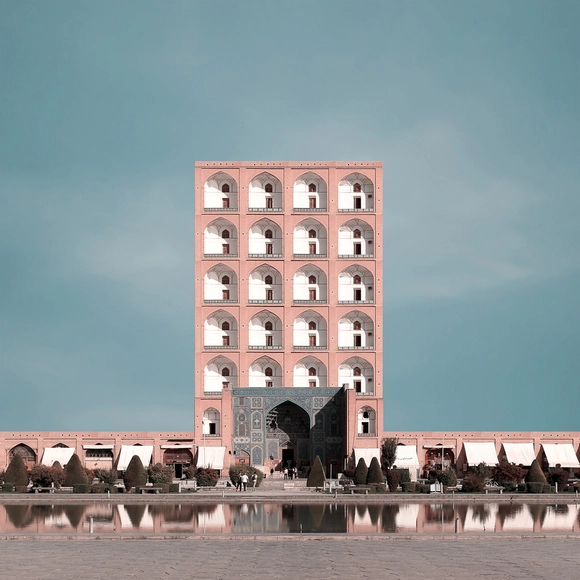
Traditional Iranian architectural monuments are often built low to the ground due to the lack of beam and column technology. Palaces, mosques, and public buildings are thus built with only one or two floors, and Iranian architecture rarely features towers or high-rise buildings as a result.
https://www.archdaily.com/921683/traditional-iranian-monuments-reimagined-as-high-rise-buildingsLilly Cao
Kohn Pedersen Fox Associates (KPF) has announced the completion of the SOHO Gubei office tower in Shanghai. Inspired by the proportions of Constantin Brâncuși’s “Endless Column” sculpture, the tower manifests as an undulating obelisk with a diagonally canted zig-zag profile.
Each side of the tower’s sculptural form consists of four stacked volumes, with a series of shifted grids creating a density of wall surfaces that offer shade, reduce glare, and create a sense of urban solidity.
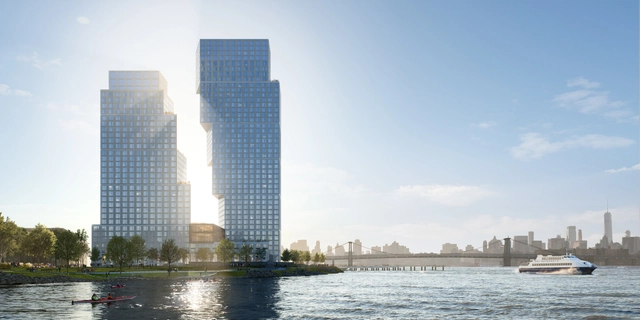
OMA, led by the firm’s partner Jason Long, has designed two towers at Greenpoint Landing in Brooklyn, New York. The towers, in conjunction with a lower seven-story building, will offer 745 housing units (30% of which are affordable) and over an acre of new public space for the neighborhood. As OMA New York’s first ground-up building in Brooklyn, the scheme will serve as “a catalyst in the transformation of the waterfront from a post-industrial edge to an accessible and dynamic part of the neighborhood.
The two towers, extending Eagle Street and Dupont Street, expand the existing waterfront esplanade, incorporating 2.5 acres of public open space along the shoreline, and 8,600 square feet of ground-floor retail. Manifesting as two dancers, the towers simultaneously lean into and away from each other. While the taller tower widens towards the east as it rises, its partner steps back from the waterfront to create a series of large terraces.
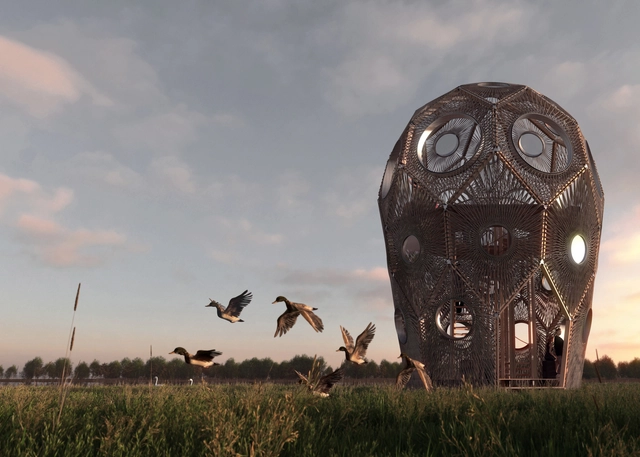
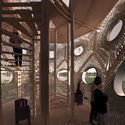
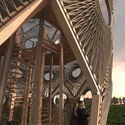
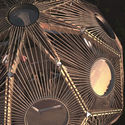
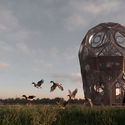
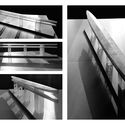
Bee Breeders have selected the winners for the Pape Bird Observation Tower competition, which saw participants submitting designs for a new bird observation station located in the Nica and Rucava Municipalities in the South Western region of Latvia. The competition is the first in a series organized by Bee Breeders in collaboration with Pasaules Dabas Fonds, Latvia's leading nature conservation fund. The competition asked for proposals for a tower that would replace a previous tower that was struck by lightening.
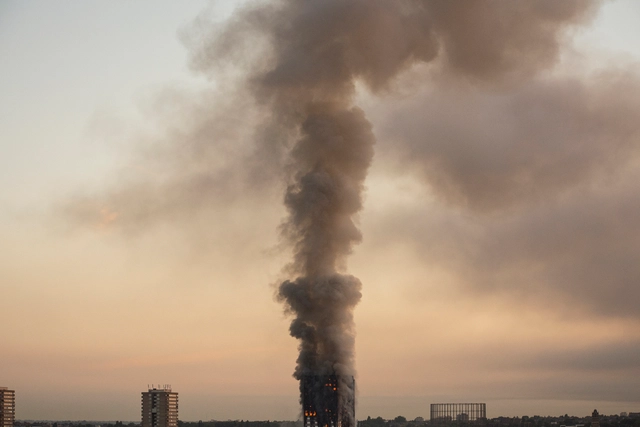
"As a precaution," the British Prime Minister Theresa May told the House of Commons today, "the [UK] Government has arranged to test cladding in all relevant tower blocks." This initial investigation ordered by the British Government following the devastating fire and loss of life at Grenfell House in London on June 14, have returned initial results which show that "three samples," according to the BBC, "are 'combustible'." Further results are expected to be made public over the course of the next 48 hours. The Prime Minister also declared that:
No stone will be left unturned. For any guilty parties there will be nowhere to hide.
https://www.archdaily.com/874266/indications-suggest-that-hundreds-of-residential-towers-england-uk-clad-in-potentially-combustible-reynobond-pe-grenfell-houseAD Editorial Team
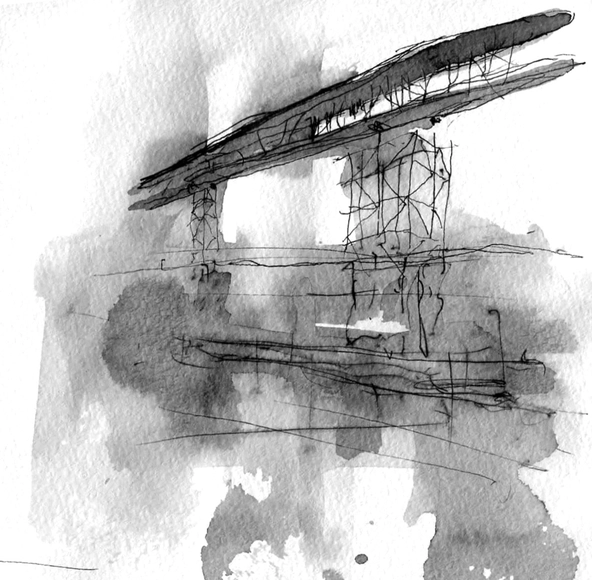
The design concept evokes the image of a rowing boat cutting through water. Image Courtesy of BIVAK
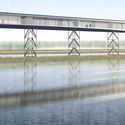
BIVAK Architecture and Design has won a competition to design a rowing arena in Hungary for a host of championships taking place in the country in the coming years. The competition, hosted by the Hungarian Rowing Association (MKKSZ) and Hungarian Academy of Arts, was open to architects under 40 years of age. BIVAK’s winning proposal, announced in February 2017, centers on a 90-meter-long tower ‘gliding’ above the water.


.jpg?1597587766&format=webp&width=640&height=580)

.jpg?1597587782 "Courtesy of SOM | Fender Katsalidis")
.jpg?1597587827 "Courtesy of SOM | Fender Katsalidis")
.jpg?1597587803 "Courtesy of SOM | Fender Katsalidis")
.jpg?1597587766)




.jpg?1576051979&format=webp&width=640&height=580)
.jpg?1576051840 "© Kuomin Lee")
.jpg?1576051957 "© Kuomin Lee")
.jpg?1576052609 "© Kuomin Lee")
.jpg?1576052676 "© Kuomin Lee")
.jpg?1576051979)
_OMA.jpg?1571676595&format=webp&width=640&height=580)
_OMA.jpg?1571677954 "Courtesy of OMA")
_OMA.jpg?1571684132 "Courtesy of OMA")
_OMA.jpg?1571683555 "Courtesy of OMA")
_OMA.jpg?1571674872 "Courtesy of OMA")
_OMA.jpg?1571676595)
_HG_Esch_(4).jpg?1570092438 "© KPF")
_HG_Esch_(6).jpg?1570092512 "© KPF")






_Tim_Griffith_(4).jpg?1564671406&format=webp&width=640&height=580)
_Tim_Griffith_(3).jpg?1564671392 "Courtesy of Tim Griffith")
_Tim_Griffith.jpg?1564671491 "Courtesy of Tim Griffith")
_Tim_Griffith_(5).jpg?1564671417 "Courtesy of Tim Griffith")
_Tim_Griffith_(7).jpg?1564671445 "Courtesy of Tim Griffith")
_Tim_Griffith_(4).jpg?1564671406)