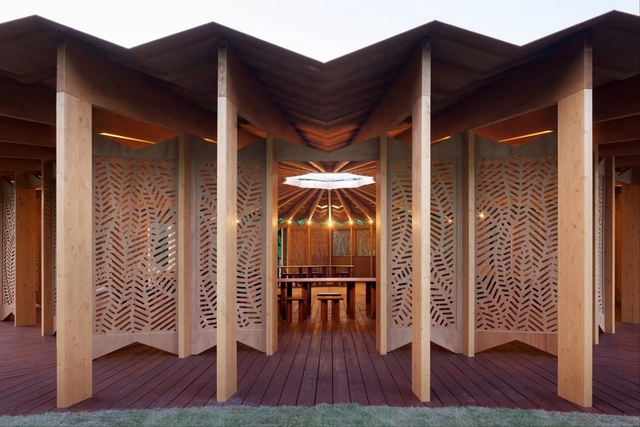
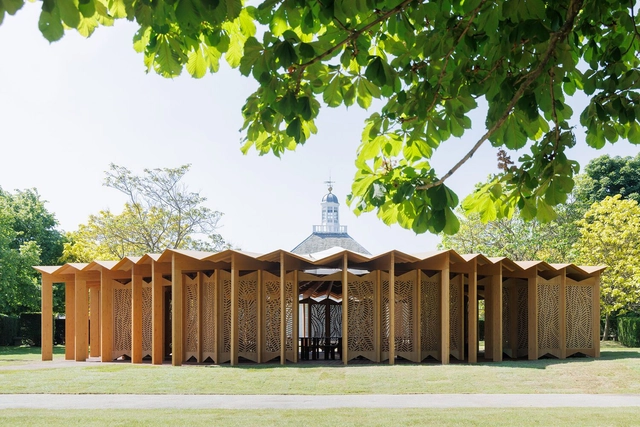
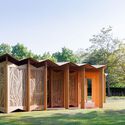
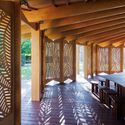
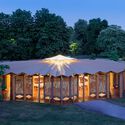
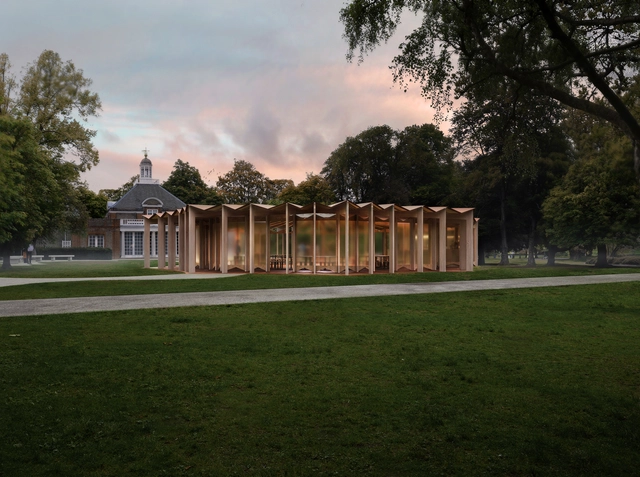
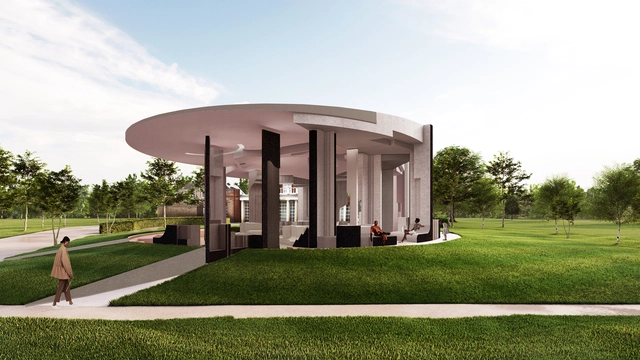
As you make your way through the symphony of wooden colonnades, leafy screen walls, and unfurled roofing, towards the converging veins of flooring and ceiling ribs leading to the light, it feels like a space that was always meant to be there. Part of the park, the pavilion complements the nature around it, reflecting its patterns, and illuminates a main interior feature: a concentric set of tables and stools that inspire people to sit at the moment, hold conversations, and connect with each other. This narrative tells the tale of this year's Serpentine Pavilion, designed by French-Lebanese architect Lina Ghotmeh.
Titled, À table, It draws inspiration from the designer’s connection with nature growing up and is reminiscent of the French call to sit together at a table, share a meal and enter a dialogue. It foregrounds the table as a laboratory of ideas, concerns, joys, connections, and essentially brings people together. It further reflects on the architectural ideals that can provoke and welcome moments of collective conversations.
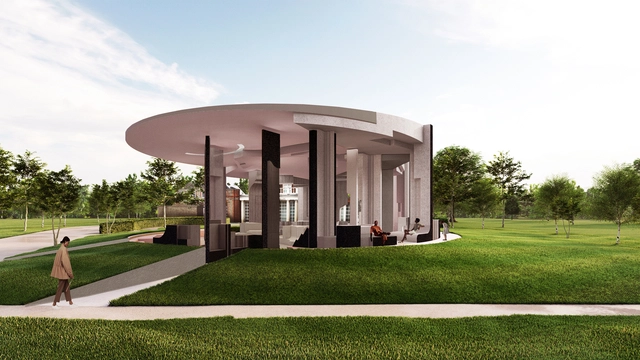
The Serpentine has announced the official opening of the 22nd Pavilion, designed by French-Lebanese architect Lina Ghotmeh, at Serpentine South on June 9th, 2023. The Pavilion is titled À table, a French invitation to sit down together at a table and engage in an open dialogue while sharing a meal. The interior space of the pavilion is defined by the large table that encircles the perimeter, offering an opportunity for conviviality and the sharing of ideas, concerns, joys, and traditions. The 300-square-meter structure, inspired by the architect’s Mediterranean heritage, is designed to be lightweight and fully demountable to ensure a minimal carbon footprint. The Serpentine Pavilion will be open and free of charge every day from June to October 2023.
The First Islamic Arts Biennale, artistically directed by Sumayya Vally, opened on January 2023 and is still ongoing until May 23, 2023, in Jeddah, Saudi Arabia. The inaugural event was commissioned and produced by the Diriyah Biennale Foundation and was curated by Vally alongside Dr. Julian Raby, Dr. Omniya Abdel Barr, and Dr. Saad Al-Rashid. The biennale re-imagines the Western Hajj Terminal at King Abdulaziz Airport, designed by Skidmore, Owings & Merrill and winner of the 1983 Aga Khan Award, as a cultural space to redefine Islamic Arts from "within, in a way, that connects some of these art forms and forms of artistic expression to the experience and rituals" of those that live it.
Sumayya Vally is a South African architect, founder, and director of the Johannesburg-based collaborative architectural studio Counterspace. Designer of the Serpentine Pavilion in 2020/2021, she was the youngest architect to get this commission. Part of Time’s 100 emerging leaders who are shaping the future, in 2021, the only architect to make the list at that time, Sumayya started her career as a curator and teacher, and recently she was appointed as artistic director of the first Islamic Arts Biennale in Jeddah. ArchDaily had the chance to talk with Vally about her contribution to this biennale, her vision of the exhibition, the venue, the scenography, and the participating architects. Sumayya also shared some exclusive info about her entry for the 2023 Venice Architecture Biennale, starting on May 20th, in Venice, Italy.
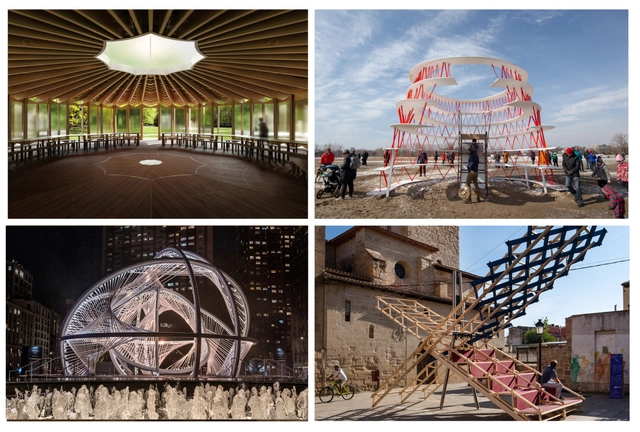
Staged stories on community and identity, ephemeral architecture showed that in 2022 it doesn't have to be permanent to be powerful. A direct and popped-up public installation can shift from preparation to action, reclaiming and defining what makes a community unique. Highlighting installations to acknowledge linguistic diversity in NYC, a giant table to celebrate culinary in Barcelona, and a large-scale net in Dubai to represent the local culture, among others, these initiatives seek to understand ways in which local and regional expressions can help cities to be more equal and diverse.
Globalization has connected the world boundaryless. While it has also made information more accessible, it has led to homogeneity and identity crisis at melding unique societies and cultural expressions. Cultural differences are undeniable as globalization grows. Hence, as architecture produces common living standards, it can also highlight singularities. Festivals, installations, and pavilions, 2022 was the year to express local memories to be recognized and celebrated, setting Community and identity as central topics in ephemeral architecture throughout the year.
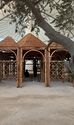
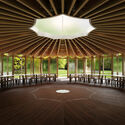
Beirut-born, Paris-based architect Lina Ghotmeh has been announced as the designer of the 22nd annual Serpentine GalleryPavilion. Titled “À Table,” the French expression for sitting together to eat, her proposal introduces a slender wooden structure with nine pleated petals supported by radial ribs. Inside the pavilion, a ring of tables and benches invites visitors to enter, sit down and relax, eat or work together. According to the architect, the modest space and low-slung canopy is meant to make people feel close to the earth. The Serpentine Pavilion will be open from June to October 2023.
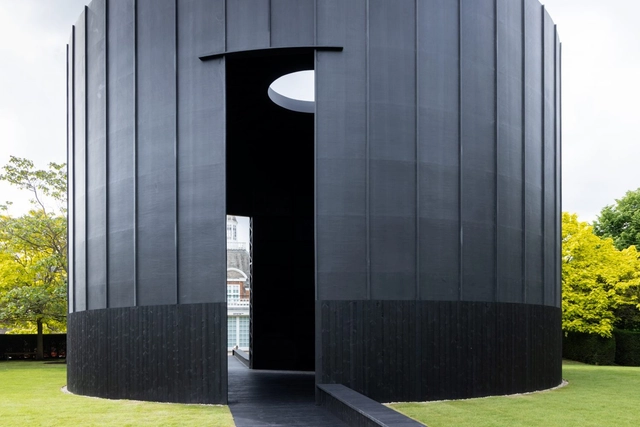
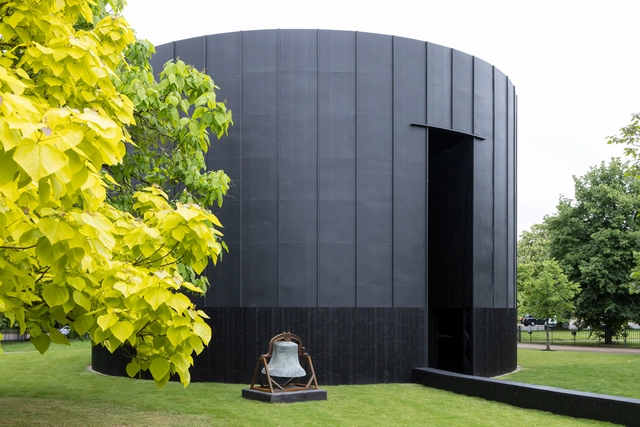
A few weeks ago, this year’s edition of the Serpentine Pavilion opened to the public. Designed by Chicago-based artist Theaster Gates, it’s an evocative project, its cylindrical form referencing American beehive kilns, English bottle kilns, and Musgum adobe homes found in Cameroon.
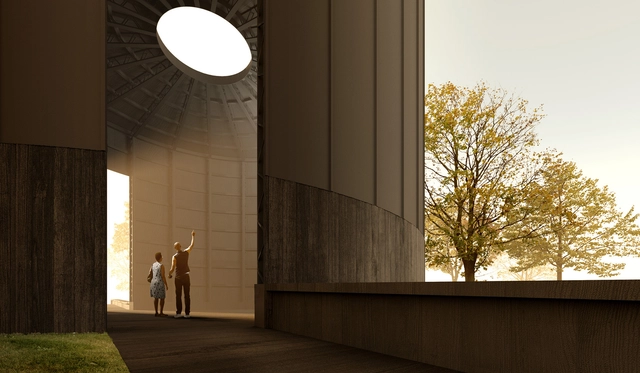
What the pavilion is named tells the viewer a lot more about its intentions as a spatial experience. Titled Black Chapel, it houses a spacious room with wraparound benches, and an oculus above that allows daylight to filter into the space. It’s a fairly minimal interior – designed as a site for contemplation and reflection. This minimal quality of Gates’ Serpentine Pavilion raises particularly interesting questions. How artists and architects opt for a “less is more” approach when designing meditative spaces, but also how these introspective spaces have been equally enhanced by ornamentation.
The 21st Serpentine Pavilion, Black Chapel, designed by Chicago-based artist Theaster Gates opens today, on June 10, 2022. On display until the 16th of October 2022, the project is realized with the architectural support of Adjaye Associates with Goldman Sachs’ patronage. In 2021, the Pavilion events program was planned to reflect Gates’ concept of interlinking architecture and music, particularly emphasizing artistic explorations of monastic sounds and hymns. The pavilion will act as a platform for Serpentine’s live program throughout the summer, offering the public space of reflection, connection, and joy.
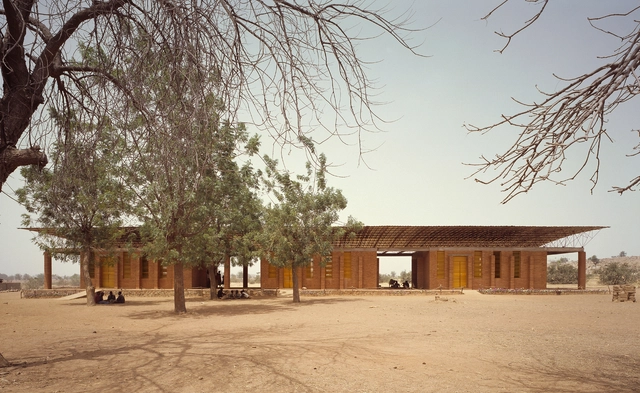
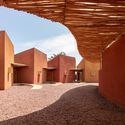
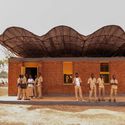
Diébédo Francis Kéré founded his architecture practice Kéré Architecture, in Berlin, Germany in 2005, after a journey in which he started advocating for the building of quality educational architecture in his home country of Burkina Faso. Deprived of proper classrooms and learning conditions as a child, and having faced the same reality as the majority of children in his country, his first works aimed at bringing tangible solutions to the issues faced by the community.
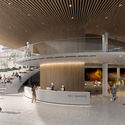
Serpentine Pavilion 2022, Black Chapel, designed by Theaster Gates. Design render, interior view. Image Courtesy of Theaster Gates Studio
American artist Theaster Gates unveiled his design for the 21st Serpentine Pavilion. Curated for the first time by a non-architect, the 2022 edition named Black Chapel, “will pay homage to British craft and manufacturing traditions”. Realized with the architectural support of Adjaye Associates, the pavilion will open to the public on Friday 10 June 2022, in Kensington Gardens.
The opening of the 20th Serpentine Pavilion, designed by South African Studio Counterspace, has been postponed to summer 2021. "Counterspace, directed by Sumayya Vally, Sarah de Villiers and Amina Kaskar, will collaborate with the Serpentine on a series of off-site and online research projects throughout 2020, which will culminate with the opening of the Pavilion in Summer 2021," the Serpentine Galleries announced.
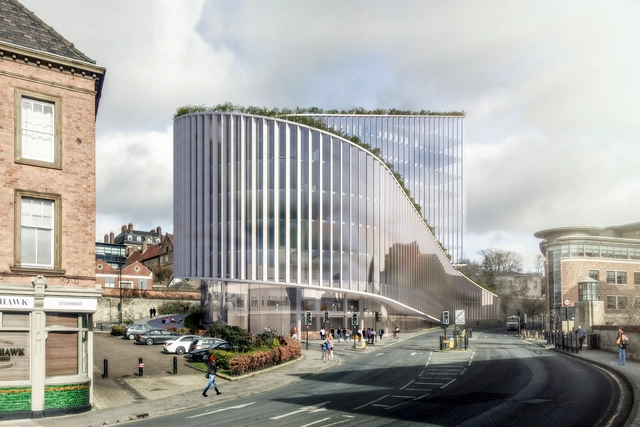
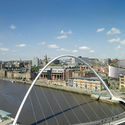
BIG has just released images of No 1 Quayside, its latest office building in Newcastle. Designed in collaboration with local studio Xsite Architecture, the project’s curvature is directly inspired by the bridges over the River Tyne and the sloping neighboring hills.
Counterspace, a practice based in Johannesburg, South Africa, has been selected to design the Serpentine Pavilion 2020. The youngest architects to be commissioned this internationally renowned program, Sumayya Vally, Sarah de Villiers, and Amina Kaskar, are an all-women team leading the collaborative architectural studio.
For those around the world unable to attend the opening of Junya Ishigami’s Serpentine Pavilion in London, photographer Nikhilesh Haval of nikreations has published a virtual tour of the structure. Similar to previous productions of Frida Escobedo’s 2018 Pavilion, BIG’s 2016 Pavilion, and SelgasCano’s 2015 Pavilion, the virtual tour allows viewers to experience the “free space” philosophy that defines the pavilion, playing with our perspectives of the built environment against the backdrop of a natural landscape.
https://www.archdaily.com/919646/step-inside-a-360-degrees-virtual-tour-of-the-serpentine-pavilionNiall Patrick Walsh
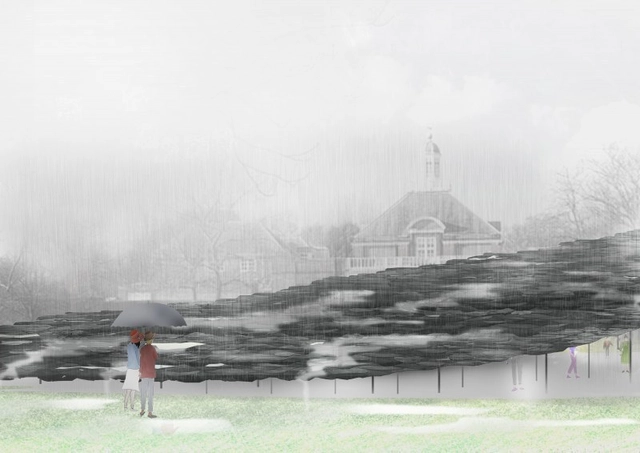
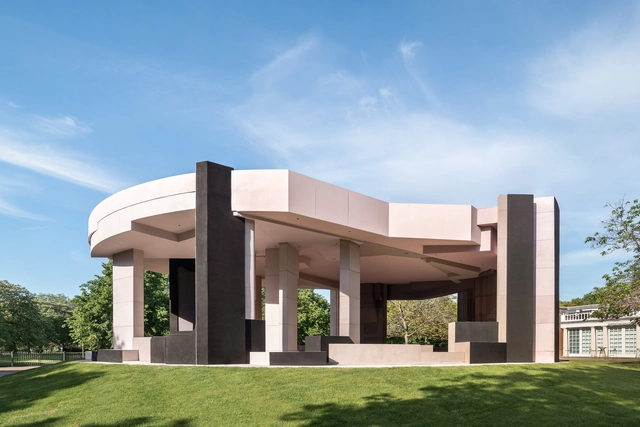
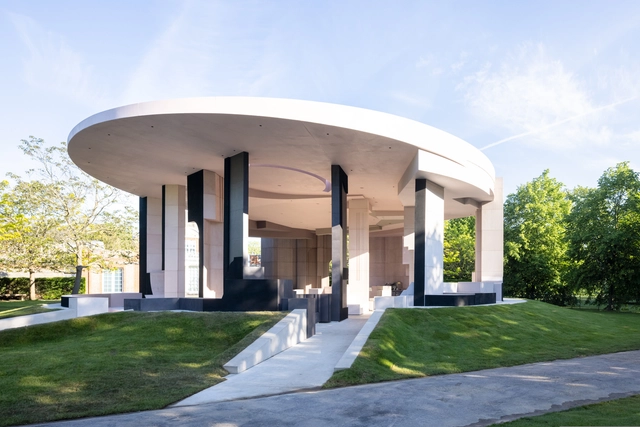
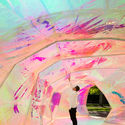
Japanese architect Junya Ishigami's 2019 Serpentine Pavilion is taking shape in London. A series of photographs by Laurian Ghinitoiu showcase the project and its flowing, free-form roof. Ishigami is the second-youngest designer of the pavilion, and his work is known for a light and ephemeral approach. The design for the 2019 pavilion takes the form of a slate sheet rising from the landscape of the park, held up by pilotis that form an interior field.
Following a controversy surrounding unpaid internships at the office of Serpentine Pavilion architects Junya Ishigami + Associates, the Serpentine Gallery has ordered the firm to pay all staff who will work on the design of the 2019 pavilion. Criticism of the working conditions of interns at the firm followed an email reportedly seen by The Architects’ Journal, with a prospective intern highlighting a lack of pay, six-day work weeks, and long office hours.
https://www.archdaily.com/913982/serpentine-bans-use-of-unpaid-interns-for-2019-pavilion-design-teamNiall Patrick Walsh
























_2655.jpg?1561371788&format=webp&width=640&height=580)
_2655.jpg?1560892327&format=webp&width=640&height=580)
_2741.jpg?1560892362 "2019 Serpentine Pavilion. Image © Laurian Ghinitoiu")
_2541.jpg?1560892289 "2019 Serpentine Pavilion. Image © Laurian Ghinitoiu")
_2605.jpg?1560892300 "2019 Serpentine Pavilion. Image © Laurian Ghinitoiu")
_2763.jpg?1560892398 "2019 Serpentine Pavilion. Image © Laurian Ghinitoiu")
_2655.jpg?1560892327)
.jpg?1556185607 "© Laurian Ghinitoiu")
.jpg?1556185648 "© Laurian Ghinitoiu")
.jpg?1556185635 "© Laurian Ghinitoiu")