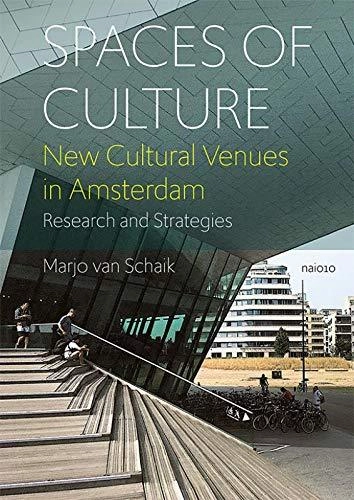
Cultural flagships, from trendy breeding grounds to iconic cultural palaces, form the core of many urban cultural landscapes. Spaces of Culture is about the new construction and redevelopment of cultural buildings in Amsterdam in the period 2000-2016.
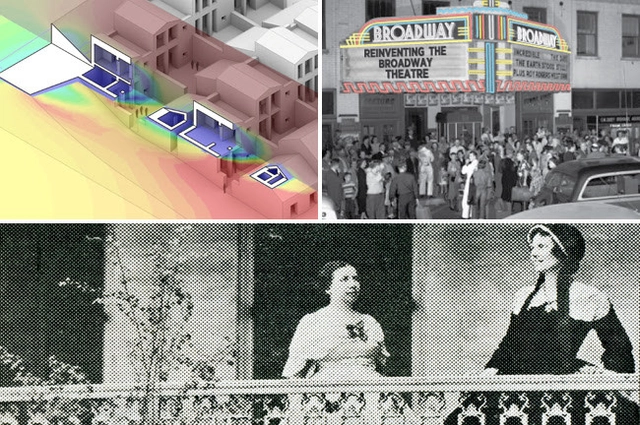
Featured work of Fellows past and present (clockwise from top left): Kress Fellow Tim Frank (2015), Blinder Awardee Rebecca Ward (2014), and Fitch Fellow Paul Kapp (2017).
Since 1989, the James Marston Fitch Charitable Foundation has been in the vanguard of historic preservation practice and theory. The mission of the Fitch Foundation is to support professionals in the field of historic preservation, and to achieve this we provide mid-career grants to those working in preservation, landscape architecture, urban design, environmental planning, materials conservation, decorative arts, architectural design and history, and allied fields.
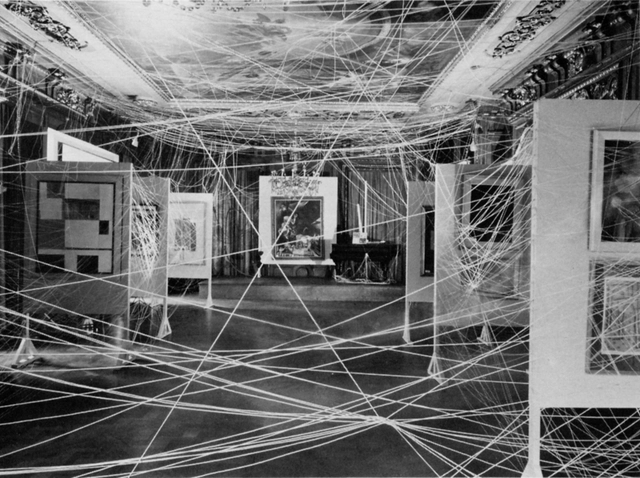
First Papers of Surrealism, 1942, New York. Installation view showing Marcel Duchamp’s Mile of String, 1942.
Are.na Grants is a new initiative to support research, writing, and other creative projects that are being developed and built on Are.na. For the first set of grants, we are especially interested in projects that address issues around the shifting nature of “knowledge work,” algorithmic governance, and networked learning, though proposals of all kinds are welcome.
The International Journal of Environmental Science & Sustainable Development (ESSD) is calling for papers for its third issue titled Environmental Sustainability: Methods for Green Energy Management.
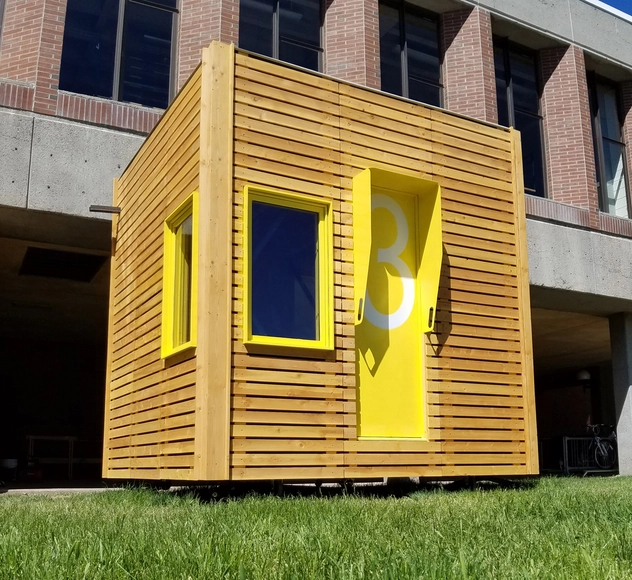
Three M. Arch. candidates at Montana State University, Jonathan Chavez, Kimball Kaiser and Adam Shilling, won an Undergraduate Scholars Programresearch grant which they used to fund their design-build project: B.O.B., the Backyard Office Box. B.O.B. is a kit of parts which, when put together, create a 150-square-foot dwelling space. The design team, also known as Tr3s, wanted their project to be adaptable to a variety of sites and users. B.O.B. can function as an additional space to already existing projects or standalone as a temporary shelter.
“How shall we hew the sun / Split it and make blocks / To build a ruddy palace?” wondered Wallace Stevens in his 1918 poem Architecture for the Adoration of Beauty. Inspired by the verse, in his essay The Room, the Street and Human Agreement, Louis Kahn paraphrased “What slice of the sun enters your room?” The great architect also spent his entire career experimenting with those dual protagonists: light and shadow. Kahn’s obsession with light, and in particular the architectural control of it, influenced countless architects, including Peter Zumthor and Tadao Ando.
Kynthia Chamilothori shares that fascination. A 2014 Architectural Engineering graduate from the Technical University of Crete, where she received the Limmat Stiftung Excellence Award, and current PhD candidate in the Laboratory of Integrated Performance In Design (LIPID) in EPFL under the supervision of Prof. Marilyne Andersen and Dr. Jan Wienold, Chamilothori’s doctoral research project focuses on how the patterns of light and shadow shape the way we perceive architectural spaces. But, while Kahn and other architects throughout history have relied on little more than intuition, Chamilothori is using far more scientific methods, working with a tool that wasn’t available to the great masters: virtual reality. Through experiments in virtual and real environments, Chamilothori investigates the impact of facade and daylight patterns on the atmosphere of a space. Her PhD is supported by a grant awarded by the Velux Stiftung Foundation.
https://www.archdaily.com/879817/how-vr-is-helping-researchers-understand-the-phenomenology-behind-light-in-architectureAD Editorial Team
As architecture students head to their final year of BArch, half-crazy from years’ worth of scraped fingers, ghastly juries, sleepless nights, and a general lack of social life, they encounter the mighty problem of choosing a thesis topic. There are many subjects to choose from, but a personal interest in a particular subject is just one of the many factors that should influence this decision. Students need to ask themselves several other questions: Is the topic significant enough? Is it expansive enough? Is the project realistically doable?
The process can be daunting, for the decision has many consequences; sometimes, the choice of topic alone can mean the difference between the success and failure of a thesis. With so many factors to consider and deadlines closing in, students easily end up making decisions that they regret later. Here are eight tips to help you make an informed choice on the matter:
For a discipline that thinks of itself as learned, scholarly research eludes the architectural profession. This is a long standing problem. “Failure,” John Ruskin wrote in his 1848 introduction to The Seven Lamps of Architecture, “is less frequently attributable to either insufficiency of means or impatience of labor, than to a confused understanding of the thing actually to be done.”
Roughly 150 years later, Harry Nilsson—surely singing to architects—opined in his song, Joy that if you’re unable to find the answer to a question, you may not have a question worth asking (and probably don’t have a problem worth solving). In between Ruskin and rock and roll, is William Peña, the author of the architectural programming guide, Problem Seeking, who nearly a half-century ago wrote that “you can’t solve a problem unless you know what it is.”
Now a one-year program with student funding, the Design Research, Writing & Criticism MA program at NYC’s School of Visual Arts empowers professionals as researchers, writers and—above all—critical thinkers.
The Council on Tall Buildings and Urban Habitat (CTBUH) is pleased to announce the “Call for Proposals” for its CTBUH 2017 Student Research Competition – culminating with an award of $20,000 to be recognized at the CTBUH 2017 Conference to be held in Sydney, Australia, from October 30 to November 3, 2017. The funding for this competition has been made possible with the kind support of Underwriters Laboratories.
Professor Alan Short of the University of Cambridge has published a book advocating for the revival of 19th-century architectural ideas to address the crippling energy use of modern skyscrapers. The Recovery of Natural Environments in Architecture proposes an end to the architectural fetish for glass, steel, and air conditioning, instead drawing inspiration from forgotten techniques in naturally ventilated buildings of the 1800s. The book is a culmination of 30 years’ research and design by Prof. Short and his colleagues at the University of Cambridge.
https://www.archdaily.com/866864/new-book-calls-for-an-end-to-our-fetish-for-conditioned-skyscrapersNiall Patrick Walsh
The Deborah J. Norden Fund, a program of The Architectural League of New York, was established in 1995 in memory of architect and arts administrator Deborah Norden. The Fund has supported a fascinating array of projects, from a study of the Cambodian modernist Vann Molyvann, to the social impact of new architecture and planning interventions in Medellin, Colombia, to the insertion of built form into fragile ecosystems in Australia, to the stereotomy of complex surfaces in French Baroque architecture.
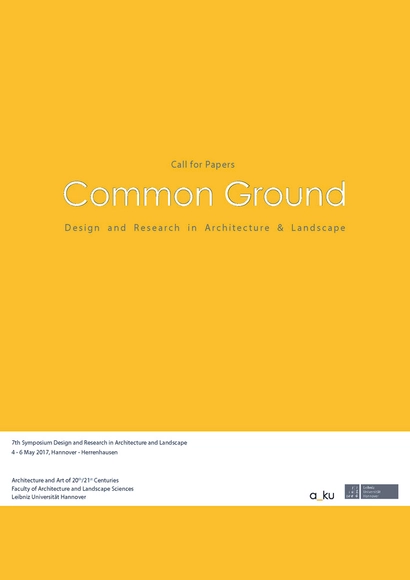
7th international Symposium + PhD PeerReview `COMMON GROUND. Design and Research in Architecture & Landscape´
`Common Ground - Design and Research in Architecture & Landscape´
4. - 6. May 2017 7th international Symposium + PhD PeerReview Faculty of Architecture and Landscape Sciences, Leibniz Universität Hannover
The symposium and PhD Review focuses on the production and communication of knowledge about architecture and landscape architecture connected with design-related research projects. The call is directed towards theorists, practicing architects, landscape architects and to PhD students or early Post Docs of both disciplines.
We all know exercise and being in close proximity to nature boosts our happiness and overall heath. However, the impact of the "environmental aesthetics" of our cities has never been studied, until now.
A new study suggests that beautiful architecture is considered just as "scenic" and beneficial to our health and psyche as "greenery."
UPDATE: The submission deadline has been changed to February 7th, 2016.
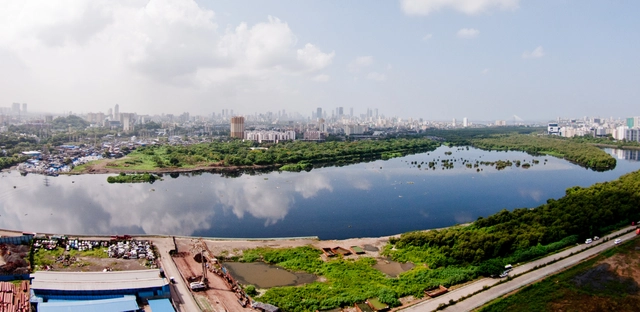
The Mumbai Metropolitan Region Development Authority (MMRDA) is looking for multi-disciplinary design teams that are capable of designing and delivering a technically demanding and environmentally sensitive makeover in the heart of India’s Financial Capital, Mumbai. There are no competition fees to be paid and all submissions will be exclusively done through the competition portal. Five shortlisted entries from the first stage will each receive Rs. 5,00,000 and the eventual winner will receive Rs. 50,00,000 as part of a contract.
CANactions School, the first school for urban studies in Ukraine, has launched an international call for applicants for STUDIO #2: “Tackling the Future of Ukrainian (Post)industrial Cities." The seminar will take place from February to May 2016.
The Urban Development Institute of Australia NSW office wants to create more affordable, connected and livable cities and it wants your help. The CityLife Project competition presents the opportunity for three organisations or research teams to partner with the UDIA NSW on research projects in exchange for cash and promotional opportunities worth up to $145,000 AUD each. As part of the CityLife Project competition, we want one research partner to work with us on liveable cities, encouraging better health and well-being.













_Paolo_Rosselli_DSC_8101.jpg?1489090441 "Professor Short argues that skyscraper design must depart from its current reliance on glass and steel, and begin to harness natural ventilation. Boeri Studio's Bosco Verticale. Image Courtesy of Paolo Rosselli")




.jpg?1451588728&format=webp&width=640&height=580)