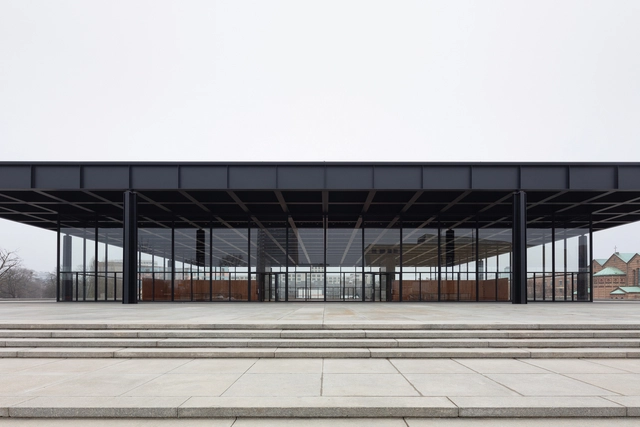
Renovation works of Mies van der Rohe’s Neue Nationalgalerie in Berlin are in their final phase. Overseen by David Chipperfield Architects, the restoration was much needed after almost 40 years. Set to reopen in the summer of 2021, the concrete, steel, and glass landmark, dedicated to culture and the fine arts, is in fact Mies van der Rohe’s only work in Germany after World War II.
How did modern architecture happen? How did we evolve so quickly from architecture that had ornament and detail, to buildings that were often blank and devoid of detail? Why did the look and feel of buildings shift so dramatically in the early 20th century? History holds that modernism was the idealistic impulse that emerged out of the physical, moral and spiritual wreckage of the First World War. While there were other factors at work as well, this explanation, though undoubtedly true, tells an incomplete picture.
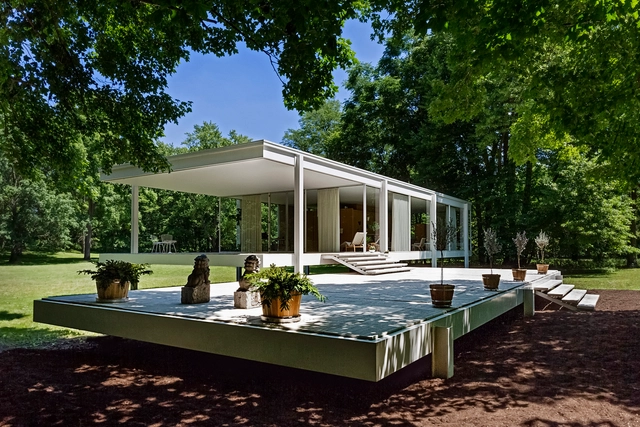
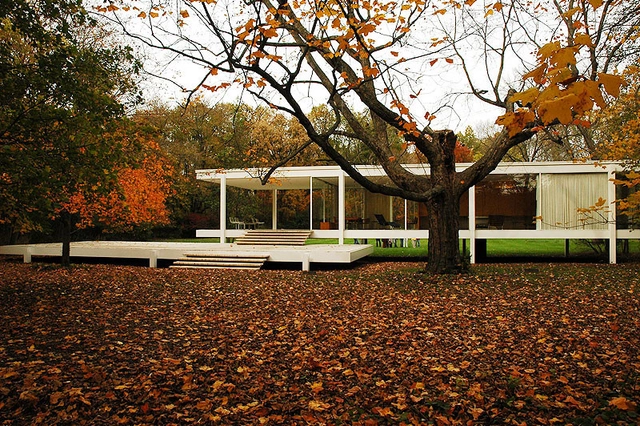
After a prolonged closure due to the COVID-19 pandemic, Farnsworth House reopens its doors with a new exhibition entitled “Edith Farnsworth Reconsidered”, a temporary refurnishing of the country house to reflect its 1955 appearance. Focusing on Dr. Edith Farnsworth’s life and times, the exhibition aims to highlight the untold story of this woman.
Built in a flood plain along the Fox River, the Farnsworth House, designed by Ludwig Mies van der Rohe is endangered again. Floodwaters are threatening the modernist house once more, as water levels are rising to reach the top of the house’s steel columns, covering its lower terrace.
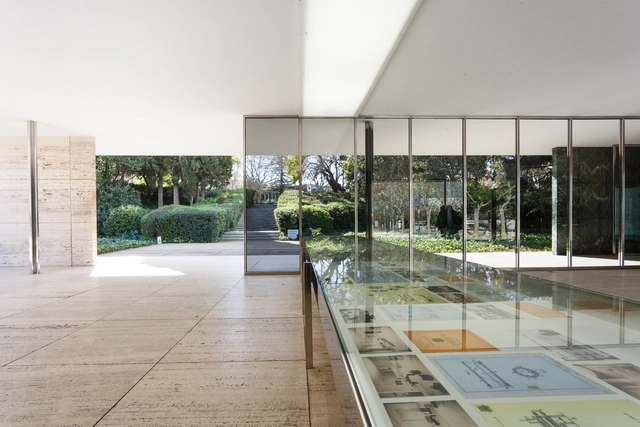
In time for Women’s Day, the artistic outcome of the first call of the Lilly Reich Grant for Equality in Architecture opened at the Mies van der RohePavilion in Barcelona. Running till the 22nd March 2020, the exhibition entitled Re-enactment, carried out by Laura Martínez de Guereñu, aims to put the spotlight on Reich’s overlooked work.
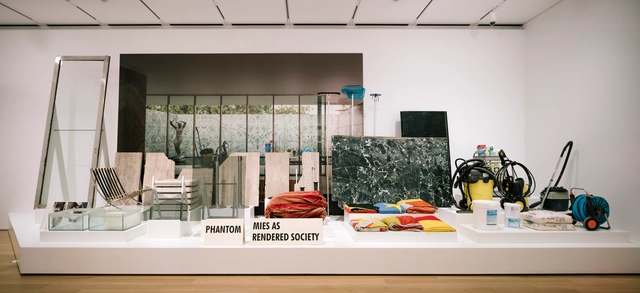
PHANTOM. Mies as Rendered Society is a provocative site-specific intervention developed by Andrés Jaque for the Ludwig Mies van der Rohe–designed Barcelona Pavilion in 2012 and recently reconceived and acquired by the Art Institute of Chicago.
This installation aims to unravel the myth of Mies van der Rohe as a solitary genius. Fundació Mies commissioned Andrés Jaque in 2012 to create a site-specific intervention in Mies’s most famous building, the Barcelona Pavilion. The original Pavilion of 1929 was reconstructed in 1986 with the fundamental addition of a basement. Jaque’s installation focused on this lower level, which was an overlooked yet significant part of the building, introducing new questions for contemporary scholarship about Mies.
The Mies van der Rohe residential building, the Bailey Hall built in 1955, at Illinois Institute of Technology will be subject to renovation works by Dirk Denison Architects. The Chicago-based firm will modernize the mechanical, structural, and interior works, modifying its original function, and introducing a new configuration to host up to 330 first- and second-year students, while the exterior will remain faithful to the original design and the ground floor lobby will still hold on to the Mies’ iconic recessed glass lobby.
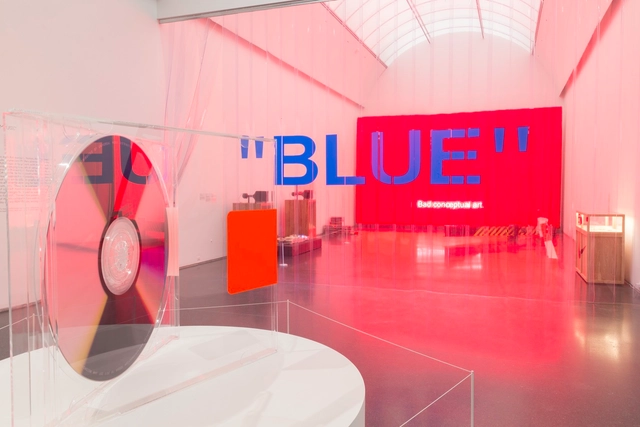
The Museum of Contemporary Art Chicago is presenting an exhibition devoted to the work of the ultra-modern, genre-bending artist and designer Virgil Abloh. Titled “Virgil Abloh: Figures of Speech” the immersive space has been curated by the Museum's Chief Curator Michael Darling, and Samir Bantal, a director at OMA’s research wing, focusing on the creative process and collaborative work of Abloh who is redefining fashion, art, and design.
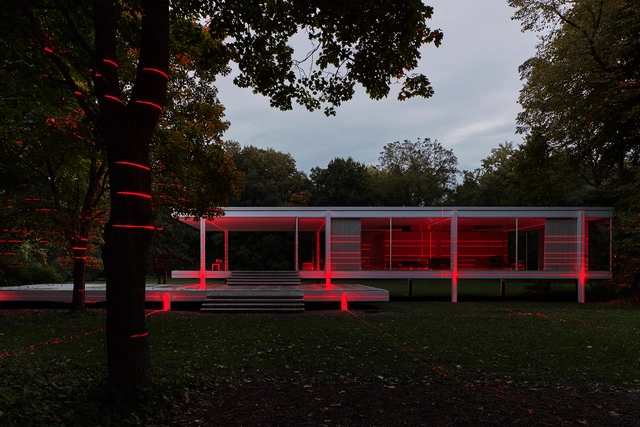
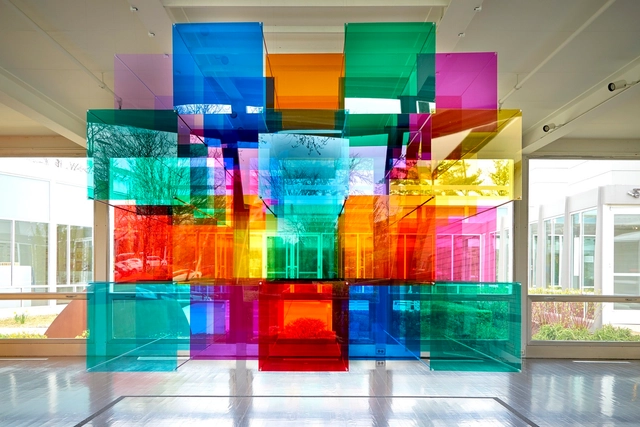
The Elmhurst Art Museum has unveiled details of a new installation taking place in the Mies van der Rohe-designed McCormick House in Chicago. Designed by Luftwerk, a Chicago-based artistic collaborative of Petra Bachmaier and Sean Gallero, the “Parallel Perspectives” installation is a site-specific exhibition that uses color and light interventions to activate and interpret the house, celebrating the use of geometry in the mid-Century prefab prototype.
UPDATE: In honor of the 100th anniversary of the Bauhaus, we’re re-publishing this popular infographic, which was originally published April 16th, 2012.
From the “starchitect” to “architecture for the 99%,” we are witnessing a shift of focus in the field of architecture. However, it’s in the education system where these ideas really take root and grow. This sea change inspired us to explore past movements, influenced by economic shifts, war and the introduction of new technologies, and take a closer look at the bauhaus movement.
Often associated with being anti-industrial, the Arts and Crafts Movement had dominated the field before the start of the Bauhaus in 1919. The Bauhaus’ focus was to merge design with industry, providing well-designed products for the many.
The Bauhaus not only impacted design and architecture on an international level, but also revolutionized the way design schools conceptualize education as a means of imparting an integrated design approach where form follows function.
Agustín Ferrer Casas has published an illustrated comic book charting the life and work of the renowned architect Mies van der Rohe. Featuring texts by Anatxu Zabalbeascoa and Norman Foster, MIES is a biopic inspired by Ferrer Casas’ reading of Mies van der Rohe: Menos es más by Anatxu Zabalbeascoa.
The presentation of the graphic novel is part of the Fundacio Mies van der Rohe's efforts to support new languages for the dissemination of knowledge of architecture that will be of interest to both professionals and those who want to learn about modern architecture through a rich, visual medium.
https://www.archdaily.com/914164/this-illustrated-comic-of-mies-van-der-rohe-features-text-by-norman-fosterNiall Patrick Walsh
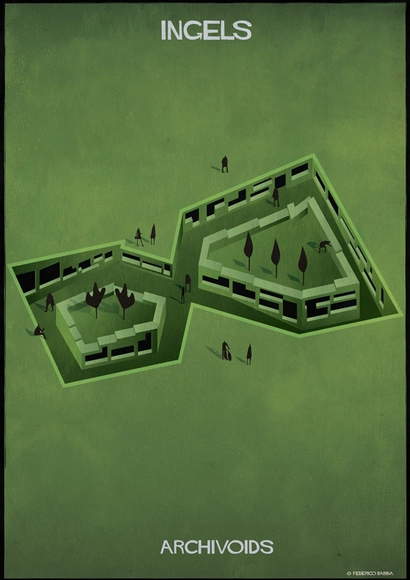
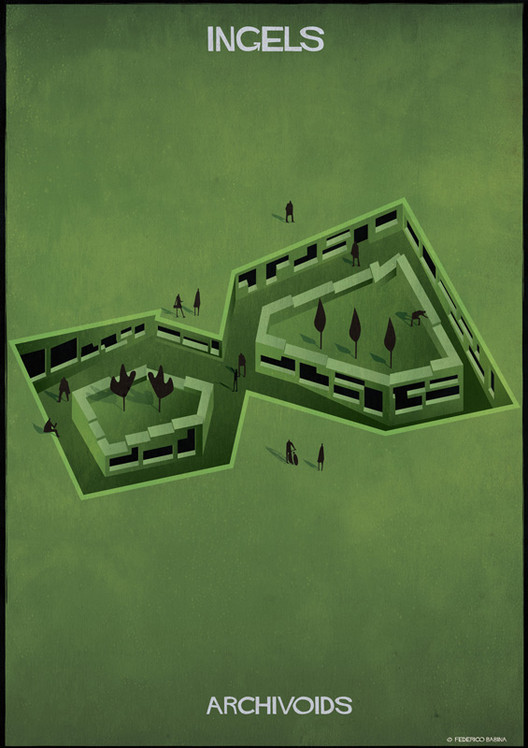
Babina’s images create an inverse point of view, a reversal of perception for an alternative reading of space, and reality itself. Making negative space his protagonist, Babina traces the “Architectural footprints” of famous architects, coupling mysterious geometries with a vibrant color scheme.
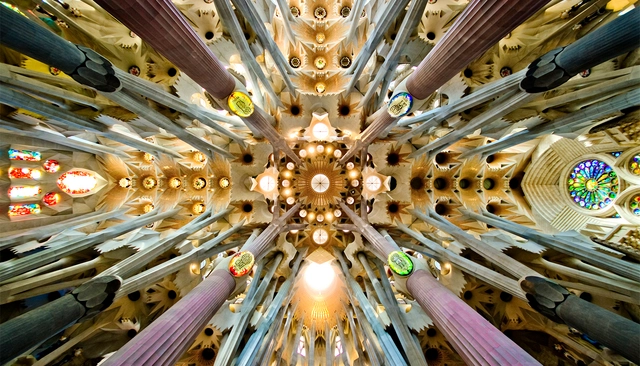
Throughout history, there have been certain architects whose unique ideas and innovative styles have influenced generations to come. Some of these pioneers introduced ideas so revolutionary that entirely new words had to be invented to truly encapsulate them. Whether they became a style embraced by an entire era, or captured the imagination of millions for decades to come, we know a Gaudiesque or Corbusian building when we see one.
Here are eight adjectives derived from the works of architects whose names are now in the dictionary: