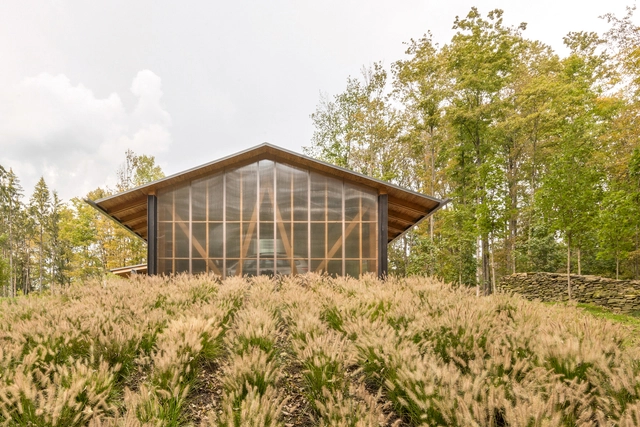
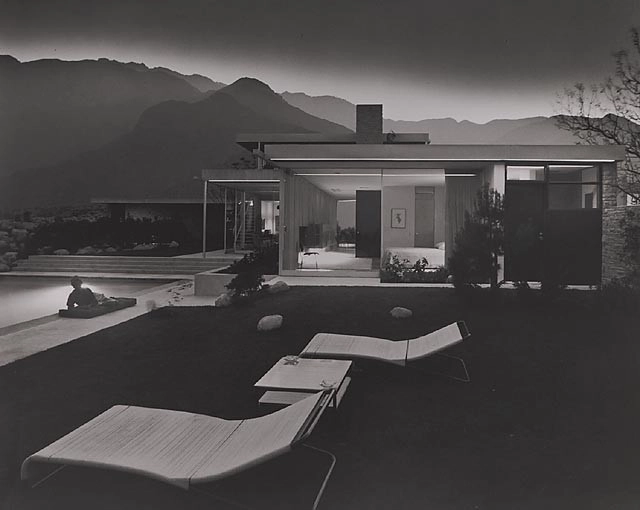
About an hour's drive from New York, the Corwin House sits in hilly woodland high above the Saugatuck River. Completed by Richard Neutra in 1956, it is one of only three houses the architect built in Connecticut. Architectural designer Aziz Osko has updated the house, revisiting details from Neutra's original design that were never built.
The commission began when Betty and Henry Corwin asked Neutra whether he could recommend an East Coast architect working in a similar style. Neutra was so taken with the wooded site above the river that he took on the commission himself.
The Mid-Century Modernist movement was more than an aesthetic or material shift in the United States, as it was a response to a rapidly changing world. Emerging after World War II, this architectural revolution rejected ornate, traditional styles of the past in favor of clean lines, functional design, and incorporation of flashy materials like steel, glass, and concrete. Modernism was a break from tradition, focusing instead on simplicity, efficiency, and a vision for the future. It reflected the optimism of a nation rebuilding itself, where technology and innovation shaped everything from cityscapes to suburban homes.
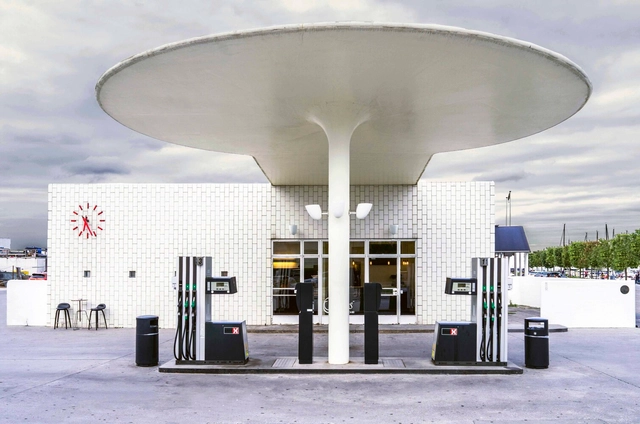
The gas station is an architectural typology that has undergone significant transformations since its inception. Initially, these structures were simple roadside refueling points designed for functionality rather than aesthetics. As automobile culture expanded, gas stations evolved to accommodate new technologies, shifting urban landscapes and changing consumer behaviors. Over time, they became more than just utilitarian stops — they developed into service hubs, integrating restaurants, motels, and leisure spaces, responding to contemporary transportation increasing demands.
By the late 20th century, however, the widespread standardization of gas stations led them to be perceived as "non-places", a concept defined by anthropologist Marc Augé to describe transient spaces that lack social or cultural significance. With uniform designs and a focus on efficiency, gas stations became interchangeable, reinforcing their role as purely functional infrastructure rather than meaningful architectural interventions. This standardization also departed from the era when fuel stations served as recognizable landmarks, contributing to a homogenized landscape devoid of local identity.
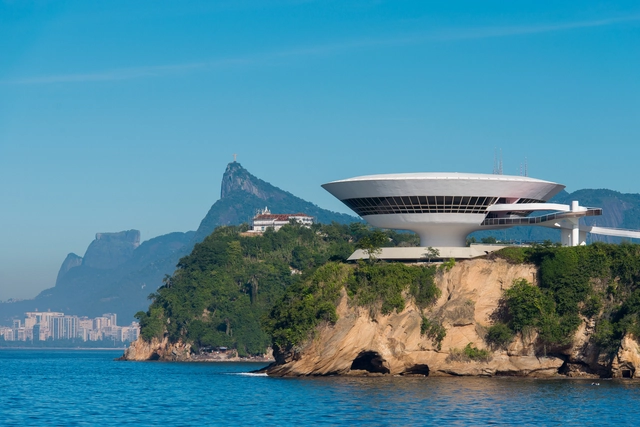
Located on the top of the Boa Viagem viewpoint in the city of Niterói, the Niterói Contemporary Art Museum - MAC was designed by architect Oscar Niemeyer. Inaugurated in 1996, it is a modern architectural masterpiece dedicated to housing a collection of Brazilian contemporary art from the 1960s to the 1990s. Rising above the cliff like a lighthouse, it appears to float in the air, resting on a water basin. Facing Rio de Janeiro’s Guanabara Bay in Brazil, its circular lines and revolutionary double-curved form stand out on the horizon, offering an open plaza of 2,500 square meters alongside a reflective pool that gives the structure a remarkable sense of lightness.
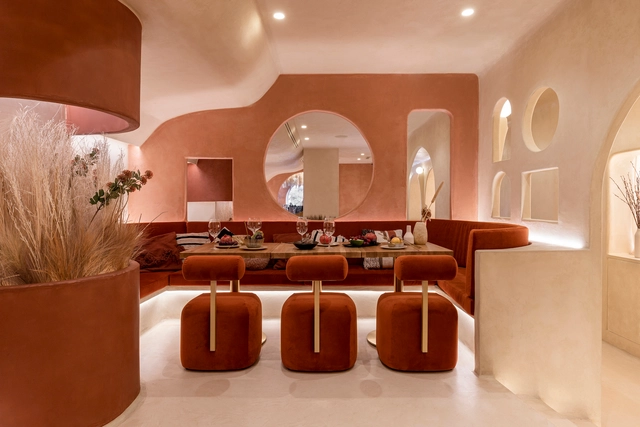
"The details are not the details. They make the design." – Charles Eames. Creating attractive spaces that anticipate the needs of users relies on several factors: scale, circulation, functionality, and comfort. However, the past few decades have proved that the visual appeal of a project is also greatly important, and can make or break the interior space. In this interior focus, we will explore the aesthetic side of interior design, looking at popular styles across the world and how architects and designers use elements such as color, furniture, accessories, and finishes to define their spatial identity.
Following the Second World War, United States veterans and citizens were seeking a fresh start, a rightful place to live out their modern American dream. With a significant housing shortage looming around and fast-growing families, solutions had to be found to provide equitable living means for all. The development of new construction techniques and propagation of easy building materials promised an age of prosperity.
https://www.archdaily.com/969231/the-evolution-of-the-house-plan-in-the-united-states-post-war-eraAgustina Coulleri, Hana Abdel & Clara Ott
The following excerpt from Sam Lubell's Mid-Century Modern Architecture Travel Guide: East Coast USA—with excellent photos by Darren Bradley—provides an introduction to the revelatory and inspiring charm of the East Coast's Mid-Century Modern masterpieces. The book includes over 250 unique projects and serves as record of one of the USA’s most important architectural movements.
Few experiences are as wedged into our psyches as the Great American Road Trip—a rite of passage chronicled by luminaries from Alexis de Tocqueville to Jack Kerouac. The Great American Mid-Century Modern Architecture Road Trip? Not famous. But that’s one of the many reasons it’s so appealing. Discovery, in this global, digital age, when few corners are mysterious, has become a rare commodity. And discovery on the East Coast of America—in the context of one of the finest collections of Modern design in the world—is that much sweeter.
The mid-century modern master, Richard Neutra was well known for his cutting edge modernism. Since Julius Shulman immortalized his houses in his iconic photographs, Neutra's bright, airy homes have widely been seen as the pinacle of modernism and desirability. One problem though, they're in high demand and it's not exactly like they're making any more Neutra buildings; in fact, quite the opposite is true and as a result they have become a pretty expensive commodity.
Read more about how to get your very own Neutra home after the break...
You have to admit it, Hollywood really seems to have a thing for John Lautner; his designs are continuously cropping up in tv-shows, films, cartoons, music videos and even video games. The occasional despondent college professor aside, his exuberant mansions are usually typecast as the bachelor-pads of various flamboyant psycho-paths, pornographers or drug-smugglers. Curbed Los Angeles have compiled this excellent video of the various Lautner-featuring scenes, so we thought that we'd take a closer look at some of his buildings, which tend to pop up in all manner of unexpected places.
Read more about Hollywood's love affair with Lautner after the break...
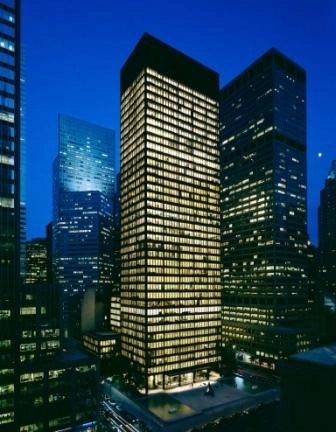
Mayor Bloomberg's controversial plans to rezone midtown New York, allowing for bigger and bolder skyscrapers, has found an unlikely ally in the form of environmentalists.
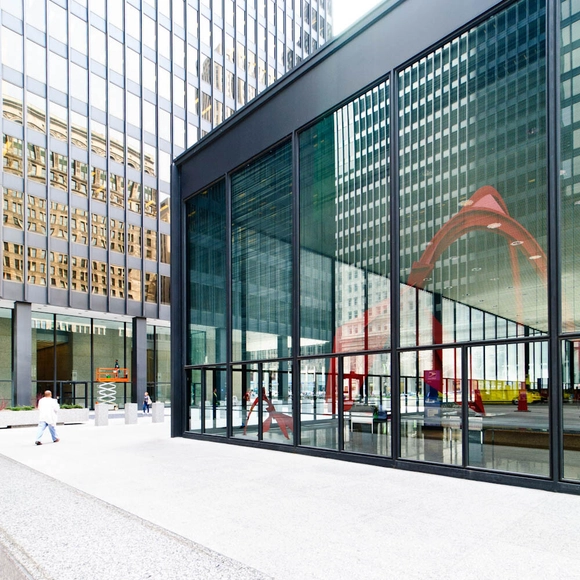
Re-zoning midtown would ultimately lead to the demolition of the corporate steel and glass skyscrapers, which preservationists argue are emblematic of the cutting edge modernism that swept 1950's America. However, landlords contest that - for the most part - they are poorly built copycats of seminal landmarks such as the Seagram and Lever buildings and are not particularly significant or suited for modern needs.
Question: What does Snoop Dogg, John Cleese, Lucy Liu and Jeff 'The Dude' Lebowski have in common? Simple, they have all, at some point in time, hung out in the living room of the space-age Sheats Goldstein Residence designed by Frank Lloyd Wright-disciple, John Lautner.