-
Architects: LIS design studio
- Area: 68 m²
- Year: 2025
-
Manufacturers: HAY, Object Therapy


This week's news compilation brings together current discussions around public and collective space, cultural infrastructure, and long-term urban transformation across diverse geographic contexts. From shared management models redefining public space ownership in cities such as Paris and New York, to large-scale event-driven initiatives linked to Milano Cortina 2026 and the World Urban Forum in Baku, the selected projects and initiatives highlight how governance, culture, and infrastructure intersect in contemporary practice. These themes are further developed through a mix of strategic planning processes, including international test planning efforts in Northern Lviv, and built projects spanning education, culture, and temporary architecture, from a new dental teaching facility in Blantyre, Malawi, to restored and newly opened cultural venues in the United States and Taiwan, and adaptive reuse interventions showcased at the Chicago Architecture Biennial. The international examples outline an architectural landscape shaped by reuse, public engagement, and the evolving role of design in responding to social, cultural, and institutional frameworks.

Maria Lisogorskaya and Kaye Song from the London-based collective Assemble, along with Lviv-based architects Anna Pomazanna and Mykhailo Shevchenko, have been announced as the 2025 Experimental Fellows at Bauhaus Earth. Selected from 120 submissions, their projects are set to explore earth as a material in contemporary architecture. The annual Bauhaus Earth Fellowship program was established in 2022 by architect Prof. Regine Leibinger. It aims to support diverse projects that explore new modes of practice across various geographies, that can contribute to ecological and social resilience. Fellows receive financial support, mentorship, and access to a network encouraging collaboration among architects, manufacturers, and local stakeholders.


An International European cultural project, U-RE-HERIT, launched an initiative to protect Ukraine’s architecture, heritage, and memory. This wide consortium of architectural institutions came together to reach a common goal of preserving Ukrainian culture. With the ongoing crisis, the project aims to address heritage as a resource for cultural, social, environmental, and economic recovery. Moreover, the project hopes to redefine local cultural identity and rebuild the city with the sensitivity of collective memory.

DAGOpen OÜ has just won the architectural competition for a standard design of Ukrainian Family houses, with their design “Hata.” The competition invited 17 designs from Estonian and Ukrainian architects to design “a standard project for modern family-type small group homes to be built in Ukraine”. The architecture of Ukraine directly inspired the winning design and addressed the spatial decisions made to attend to the crisis.

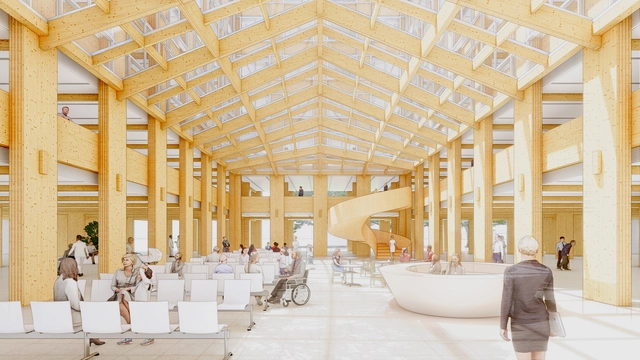
Shigeru Ban has announced the intention to collaborate with the municipality of Lviv to design an expansion of the Lviv hospital. As the largest hospital in Ukraine, this unit has witnessed an increase in the number of patients since the beginning of the war, leading to the need to increase the capacity of the institution. Shigeru Ban’s proposal uses cross-laminated wood and joints inspired by traditional wooden construction techniques to create a safe and welcoming environment for healing and recuperating.

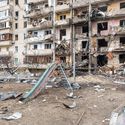
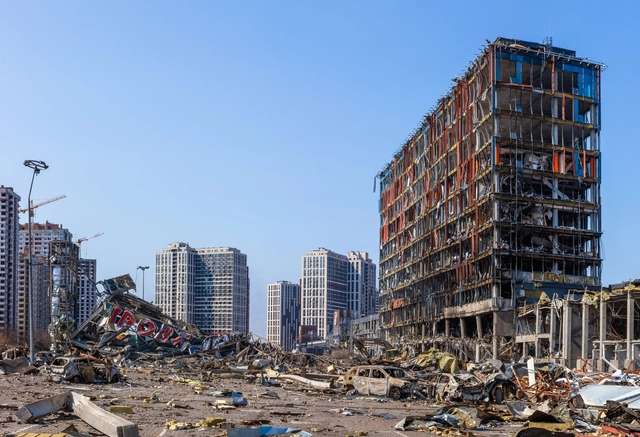
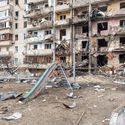
On 24 February 2022, Russia invaded Ukraine, a major escalation of the conflict dating since 2014. Now, a year later, the war is still ongoing. Both soldiers and civilians have fallen victim, while millions of others have become refugees, fleeing to safer areas across Europe or within Ukraine. What was instilled was a severe humanitarian and refugee crisis. The hostilities have also threatened Ukraine’s cultural and architectural heritage, as museums, monuments, and historical landmarks have become targets.
The implications are also reaching Europe and globally, as energy resources and food supplies become scarcer, damaging some economies. Still, Western countries remained unified in their support of Ukraine, as reported by international news outlets. Despite the economic difficulties, international support was mobilized through various initiatives in hopes of helping displaced people, protecting cultural heritage, and mapping a plan for reconstruction.

Earlier this year the unprovoked barbaric Russian invasion of neighboring independent Ukraine forced millions of people to flee their cities and the country in search of safety. I talked to one of Ukraine’s top architects, Oleg Drozdov, who was forced to relocate his practice and architecture school he co-founded in Kharkiv, to Lviv, 1,000 kilometers to the west, next to the Polish border. His staff and professors — many of them assume both roles — resumed their work just weeks after the war broke out.
.jpg?1656927557&format=webp&width=640&height=580)
One of the most urgent problems faced by Ukrainians today is the unsettled situation faced by displaced citizens, along with the challenge of returning to the cities they were forced to abandon earlier this year. Ukrainian president Volodymyr Zelenskiy has shared that efforts to rebuild Ukraine will require ‘colossal investments’, and as leaders gather to work out ‘Marshall plan’ to rebuild the country, local architects have already begun developing emergency housing, healthcare, and educational facilities in cities further away from the Russian border.
As a temporary solution to the displacement of north-eastern and eastern Ukrainians, Drozdov&Partners, together with Replus Bureau and Ponomarenko Bureau, have begun refurbishing shelters for internally displaced persons (IDPs) in Lviv and its region, using school campuses and other large-scale facilities as temporary housing.

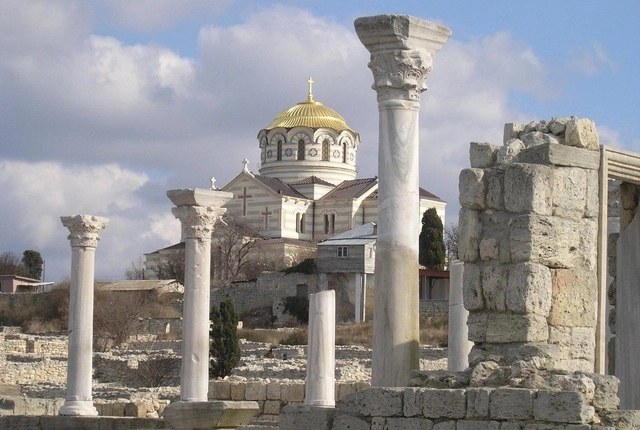
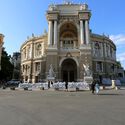
The United Nations Educational, Scientific, and Cultural Organization (UNESCO) has expressed concern over the damage caused to historic landmarks in Ukraine and called for the protection of its cultural heritage. At the same time, the organization has taken action within its capabilities to help safeguard the endangered sites. Ukraine is home to seven World Heritage sites, including the 11th-century Saint-Sophia Cathedral and the entire ensemble of the Historic Centre of Lviv. In addition, several sites in the recently damaged cities of Kharkiv and Chernihiv were on the tentative list for potential nomination to World Heritage status.
.jpg?1627000722&format=webp&width=640&height=580)