1. ArchDaily
  2. Family

Family: The Latest Architecture and News

The Spatial Agency Gap: Rethinking Public Space through Co-Designing with Foreign Domestic Workers

Subscriber Access | 

Domestic workers in Hong Kong and Singapore are the city's quiet infrastructure. In Hong Kong alone, there are a total of roughly 300,000 domestic workers, serving a portion of the approximate 2.7 million households. Their care labor sustains dual-income family routines: childcare, eldercare, cooking, cleaning, and the everyday logistics that make professional life possible. Yet the people who hold this balance together remain largely invisible in policy—and, crucially, in space.

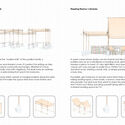
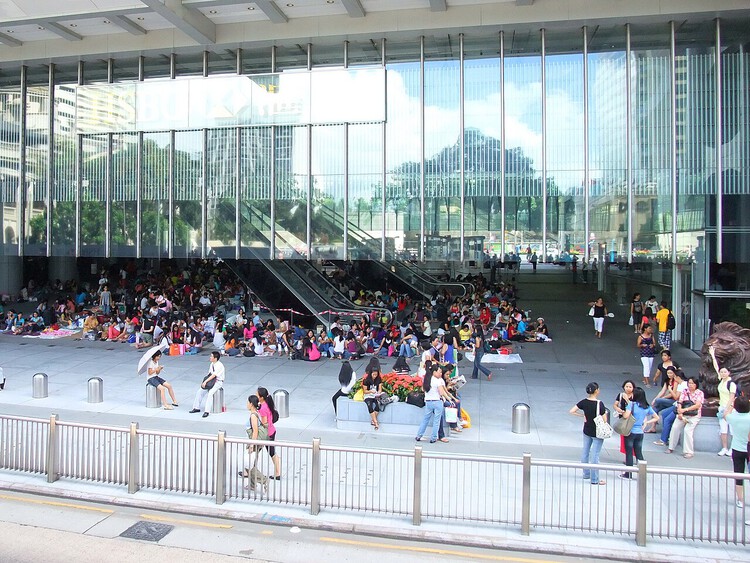
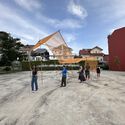
On Sundays in Hong Kong's financial district, that invisibility becomes visible. Elevated walkways and podium forecourts—underused on weekends—turn into ad-hoc commons. With cardboard mats, small tents, towels, food and water, and a music speaker or two, domestic workers assemble places to sit, rest, and socialize. These improvised rooms in the city are often their only chance to exercise spatial agency—something they rarely have in the homes they maintain or in formal public infrastructure. In the absence of sanctioned, serviced places for rest, quieter bridges and passages become practical stand-ins.

The Spatial Agency Gap: Rethinking Public Space through Co-Designing with Foreign Domestic Workers - Image 1 of 4The Spatial Agency Gap: Rethinking Public Space through Co-Designing with Foreign Domestic Workers - Image 2 of 4The Spatial Agency Gap: Rethinking Public Space through Co-Designing with Foreign Domestic Workers - Image 3 of 4The Spatial Agency Gap: Rethinking Public Space through Co-Designing with Foreign Domestic Workers - Image 4 of 4The Spatial Agency Gap: Rethinking Public Space through Co-Designing with Foreign Domestic Workers - More Images+ 17

33 Open Homes With Multiple Stories Across a Vertical Open Plan

Subscriber Access | 

For over half a century, the open floor plan has remained at the cutting edge of interior architecture, with both new-build and renovation clients choosing to splice together rooms and their functions to bring more harmonious connectivity to their homes. Families, despite busier schedules, were able to cook, talk, study, and relax together, all at the same time.

As it can force users to share their space with competing sounds, smells, and ambiances, however, many are turning away from the open plan with new concepts such as the broken plan gaining ground. Another evolutionary route for the open-plan, meanwhile, is to move upwards. In combination with double-, triple-, or even higher-story living spaces, the open-plan is given the space it needs to breathe while staying connected to the rest of the home.

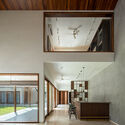
33 Open Homes With Multiple Stories Across a Vertical Open Plan - Image 1 of 433 Open Homes With Multiple Stories Across a Vertical Open Plan - Image 2 of 433 Open Homes With Multiple Stories Across a Vertical Open Plan - Image 3 of 433 Open Homes With Multiple Stories Across a Vertical Open Plan - Image 4 of 433 Open Homes With Multiple Stories Across a Vertical Open Plan - More Images+ 38

DAGOpen OÜ Wins Architectural Competition to Design Modern Family Home in Ukraine Crisis

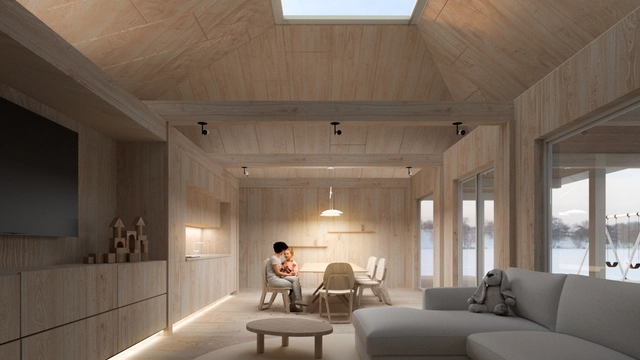
DAGOpen OÜ has just won the architectural competition for a standard design of Ukrainian Family houses, with their design “Hata.” The competition invited 17 designs from Estonian and Ukrainian architects to design “a standard project for modern family-type small group homes to be built in Ukraine”. The architecture of Ukraine directly inspired the winning design and addressed the spatial decisions made to attend to the crisis.

DAGOpen OÜ Wins Architectural Competition to Design Modern Family Home in Ukraine Crisis - Image 1 of 4DAGOpen OÜ Wins Architectural Competition to Design Modern Family Home in Ukraine Crisis - Image 2 of 4DAGOpen OÜ Wins Architectural Competition to Design Modern Family Home in Ukraine Crisis - Image 3 of 4DAGOpen OÜ Wins Architectural Competition to Design Modern Family Home in Ukraine Crisis - Image 4 of 4DAGOpen OÜ Wins Architectural Competition to Design Modern Family Home in Ukraine Crisis - More Images+ 2

5 Typologies of Multigenerational Family Homes

Rising living costs are relevant hurdles to young people, seeking a place to live, while much older generations might find it more difficult to settle into comfortable post-retirement settings. These general issues have been pushing forth a recurring solution, namely a return to multigenerational family living. 

While communal living concepts and developments had been adopted in recent years, familial involvement is proving to be a financially, legally, and emotionally viable alternative. 

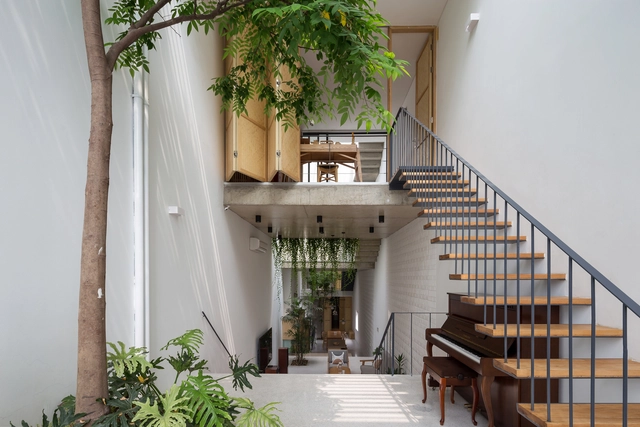
5 Typologies of Multigenerational Family Homes - Image 1 of 45 Typologies of Multigenerational Family Homes - Image 2 of 45 Typologies of Multigenerational Family Homes - Image 69 of 45 Typologies of Multigenerational Family Homes - Image 73 of 45 Typologies of Multigenerational Family Homes - More Images+ 74

“Each Project Is Like a Small City to Me” in Conversation With Glenn Sestig

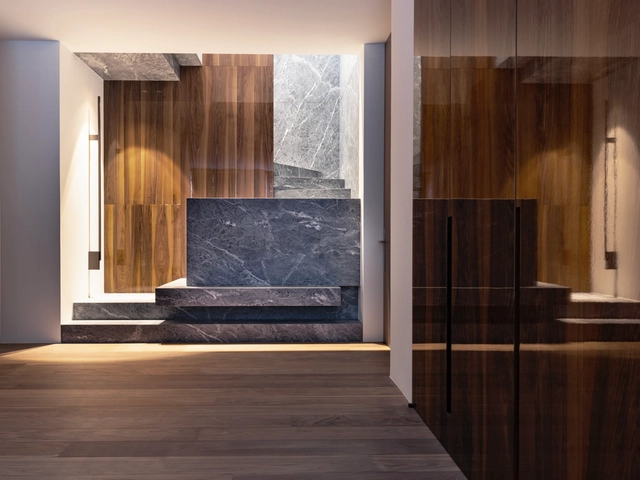
Whether an apartment building, house, storefront, office interior, or restaurant, Glenn Sestig’s architecture consistently reveals itself in tidy fragments of robust and determinately monumental geometry that tends to evoke urban qualities. His austere facades, colonnades, stair landings, and even reception desks and shelf displays appear to be quite hefty and substantial. And, in fact, every project, be it a small boutique or gallery, starts with rigorous planning – visual primary and secondary axes get established, circulation flow is laid out, and major anchors are identified before the architect moves on to addressing the appropriate materials, surfaces, and details. Every space is architecture first; its program and appearance will fit into it.

“Each Project Is Like a Small City to Me” in Conversation With Glenn Sestig - Image 1 of 4“Each Project Is Like a Small City to Me” in Conversation With Glenn Sestig - Image 2 of 4“Each Project Is Like a Small City to Me” in Conversation With Glenn Sestig - Image 3 of 4“Each Project Is Like a Small City to Me” in Conversation With Glenn Sestig - Image 4 of 4“Each Project Is Like a Small City to Me” in Conversation With Glenn Sestig - More Images+ 17

“I Followed My Father’s Advice and Did Not Design a House for My Family” in Conversation With Paul Tange

In the following interview with Paul Tange, the chairman and senior principal architect at Tange Associates in Tokyo, we discussed the relationship with his famous architect-father Kenzo Tange (1913-2005; the most influential architect in postwar Japan and the winner of the 1987 Pritzker Prize), the fate of the house Tange senior built for his first family, the decision of joining his father’s practice right after graduation from Harvard, sharing his father’s design principles, and the vision behind his first independent built work – a 50-story Mode Gakuen Cocoon Tower in Tokyo, a vertical campus that can accommodate up to 10,000 students; the project won an international competition, in which 50 international architects participated.

“I Followed My Father’s Advice and Did Not Design a House for My Family” in Conversation With Paul Tange - Image 1 of 4“I Followed My Father’s Advice and Did Not Design a House for My Family” in Conversation With Paul Tange - Image 2 of 4“I Followed My Father’s Advice and Did Not Design a House for My Family” in Conversation With Paul Tange - Image 3 of 4“I Followed My Father’s Advice and Did Not Design a House for My Family” in Conversation With Paul Tange - Image 4 of 4“I Followed My Father’s Advice and Did Not Design a House for My Family” in Conversation With Paul Tange - More Images+ 15

Drop-in Building Challenge: Designing Boston with LEGOⒸ Bricks

It is vacation week! Looking to get out of the house and build?

Will The +POOL Be The Largest Crowdfunded Civic Project Ever?

Will The +POOL Be The Largest Crowdfunded Civic Project Ever? - Featured Image
Courtesy of Family / PlayLab, Inc.

Historically, large city-changing projects have depended on the personal interests of a powerful individual: someone able to swim across both political and financial waters. But recently, projects like the High Line have shown the power and potential of projects envisioned and led by local communities.

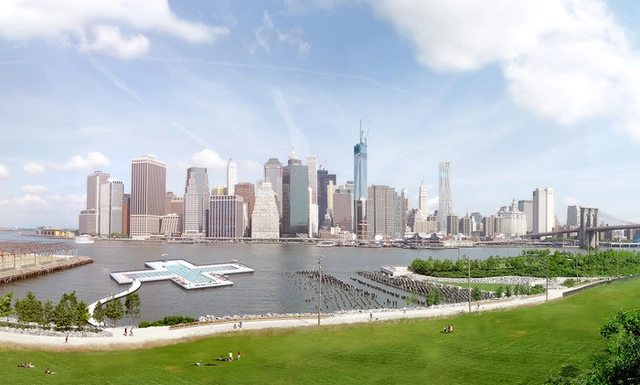
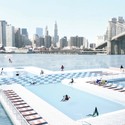
Back in 2011 we visted our friends at CASE in their West Village office and they introduced us to a small firm across the hall: Family. While the team was working hard on a model in the middle of their large table, partner Dong-Ping Wong showed us some of their recent projects. One of them immediately caught our attention. A floating pool for Manhattan. In the form of a cross, it would sit in the East River, filtering its waters into four pools. This amazing -- and seemingly crazy -- idea was tantalizing.

Four Architectural Innovations Make Time's Top 25 Inventions For 2013

Last week Time Magazine released their list of the top 25 inventions of 2013. The list covers both fun and life-changing new ideas, covering everything from the Cronut to the Artificial Pancreas - but there are also four architectural innovations that made the prestigious list. Find out more about them after the break.

+ POOL Hits Goal, Becomes Largest Civic Project Ever Kickstarted

+ POOL, the project (initiated by a duo of young architects) to float a public swimming pool in New York's Hudson River, has reached its latest kickstarter goal - making it the largest civic project to ever be crowdfunded online. As Architizer's Karen Wong reports, it's a remarkable gamechanger for architects (a profession where success often comes well into one's golden years) as well as public space in general: "It's a resounding demonstration of the public’s belief in young architects to rethink public space and manifest the untapped capital of waterways to benefit the common good." Read the full article here.

+ Pool / Family and PlayLab in collaboration with Arup

Subscriber Access | 
+ Pool / Family and PlayLab in collaboration with Arup - Featured Image
© Family, PlayLab

A 30-day Kickstarter campaign to raise funds for the continued development of + Pool is underway. From the creative minds at Family and PlayLab, + Pool is a collaboration to design a floating riverwater pool for everyone in the rivers of New York City. Beginning the next phase of the project, material testing and design, the online fundraising campaign hopefully will raise the initial $25,000 needed to begin physically testing the filtration membranes providing results to determine the best filtration membranes and methods to provide clean and safe riverwater for the public to swim in. A preliminary engineering feasibility report was initially conducted by Arup New York, which assessed the water quality, filtration, structural, mechanical and energy systems of + Pool.

Family and PlayLab launched a Kickstarter online fundraising campaign this month with the ultimate goal of generating enough support to prototype the filtration system by building a full-scale working mockup of the one section of + Pool. Research, design, testing and development will continue through the year in conjunction with permitting, approvals and building partnerships with community, municipal, commercial and environmental organizations.

Donation levels for the Kickstarter campaign range from $1 to $10,000 with the hope that everyone interested in cleaner public waterways can get involved. Donors can choose from a variety of incentives and gear up for a day at the pool. For more information about the project and the campaign or to donate click here. Or write to info@pluspool.org.

Follow the break for more details about this project and the history of floating pools in New York City, which date back to the early 19th century.

+ Pool / Family and PlayLab in collaboration with Arup - Image 3 of 4+ Pool / Family and PlayLab in collaboration with Arup - Image 8 of 4+ Pool / Family and PlayLab in collaboration with Arup - Image 1 of 4+ Pool / Family and PlayLab in collaboration with Arup - Image 5 of 4+ Pool / Family and PlayLab in collaboration with Arup - More Images+ 5