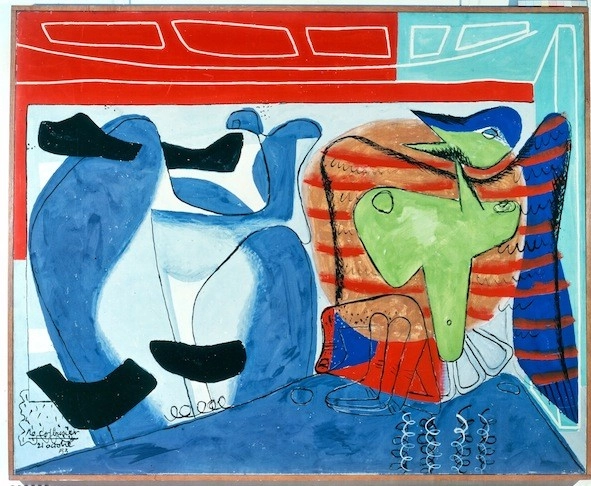
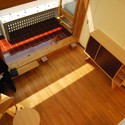
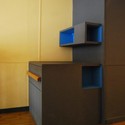
Opening October 11th to mark the re-opening of the J1 Maritime Hangar, Marseille-Provence 2013, European Capital of Culture, is presenting the Le Corbusier and Brutalism Exhibition in celebration of one of the most esteemed architects of the 20th century. The exhibition emphasizes the different facets of this unique artist-architect who along with his design work also pursued drawing, urbanism, painting, and sculpture.
Curated by Jacques Sbriglio, the renowned Marseille architect and realized in collaboration with the Fondation Le Corbusier,Le Corbusier and Brutalism covers the period from 1935 to 1965. It presents more than 250 of the architect’s works: 133 original blueprints, 54 drawings and sketches, 33 paintings, 14 sculptures, 10 enamels, 4 tapestries, and 19 architectural models, as well as close to 100 photographs taken at Le Corbusier’s building sites. The exhibition ends December 22. For more information, please visit here.
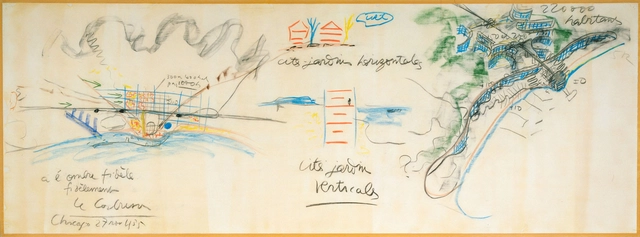
Although critiquing the exhibit for some "critical flaws" - namely the choice of theme and the lack of explanatory text - Alexandra Lange's review for The New Yorker praises the MoMA's Le Corbusier exhibit, “An Atlas of Modern Landscapes,” as a "must-see" thanks to its varied displays, which show "the terrific span of Le Corbusier's career in time, space, and scale [...] If current architects take anything from the exhibition [...] it should be the power of those big, gestural drawings, where visual and verbal argument vividly come together." Read the rest of Lange's critique at The New Yorker.
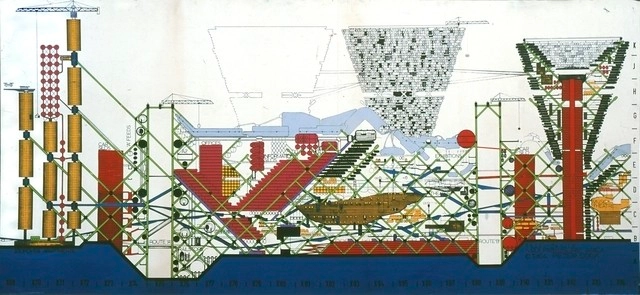
The Plug-In City by Peter Cook, 1964. Image via Archigram Archives
This AD Round Up is dedicated to unbuilt classics, a selection of projects and ideas that, although never built, contributed greatly to the canon of twentieth century architecture. In 1920, Buckminister Fuller designed the Dymaxion House, which displayed forward-thinking innovations in sustainability and prefabrication. In 1924, Le Corbusier’s radical plan for Ville Radieuse (The Radiant City) had an extensive influence upon modern urban planning and led to the development of new high-density housing typologies. In the same year Friedrick Kiesler introduced his "Endless House", the basis for his subsequent manifesto of Correalism. Eight years later in 1932, Philip Johnson and Henry-Russell Hitchcock curated the “Modern Architecture: International exhibition” at the MoMA, introducing the emerging International Style and laying the principles for Modern architecture. And finally, one of Archigram’s most famous utopian visions, the Plug-In City, proposed by Peter Cook in 1964, offered a fascinating new approach to urbanism and reversed traditional perceptions of infrastructure’s role in the city.
Alix Bossard shares this must-watch video that outlines Le Corbusier's five revolutionary principles of modern architecture. Using gorgeous motion design, the video briefly introduces us to everything from le Modulor to Villa Savoye and Les Cités Radieuses. Enjoy this two-minute recap of the career of one this century's most influential architects.
MoMA's new exhibition, Le Corbusier: An Atlas of Modern Landscapes focuses on the way in which Le Corbusier focused on the world of architecture. It explores both his most famous architectural projects, as well as the means by which he was able to realize them. Through a collection of early watercolors, drawings and photographs, curatorJean-Louis Cohen provides a peak into Le Corbusier's journeys and developments as an architect, how he explored the world and what he drew from his travels and observations.
As we've mentioned before, Irish designer Eileen Gray was undoubtedly one of the most influential, and most overlooked, designers of the 20th century. However, a new Kickstarter campaign aims to put that right once and for all. The campaign is seeking funds to help renovate Gray's seminal house, E-1027, for the production of a feature film about the architect.
Read more about the film, and find out who is slated to play Gray, after the break...
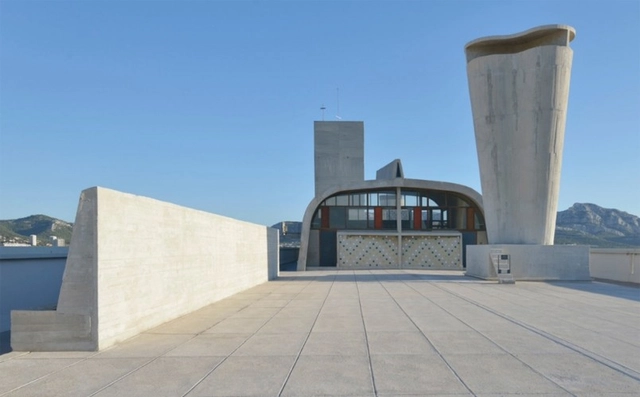
When the gym and solarium on the 20-century’s most famous rooftop terrace - elevated 18-stories above Le Corbusier’s Cité Radieuse - went up for sale in 2010, French designer Ito Morabito of Ora-ïto immediately jumped on the opportunity and purchased the space. With the support of the Foundation Le Corbusier, Ora-ïto initiated a campaign to restore the 1950‘s structure to its original state, by removing an addition that blocked the spaces 360-degree views of the city, and transform it into a contemporary art center, named the MAMO for “Marseille Modulor” - as a nod to New York’s MOMA.
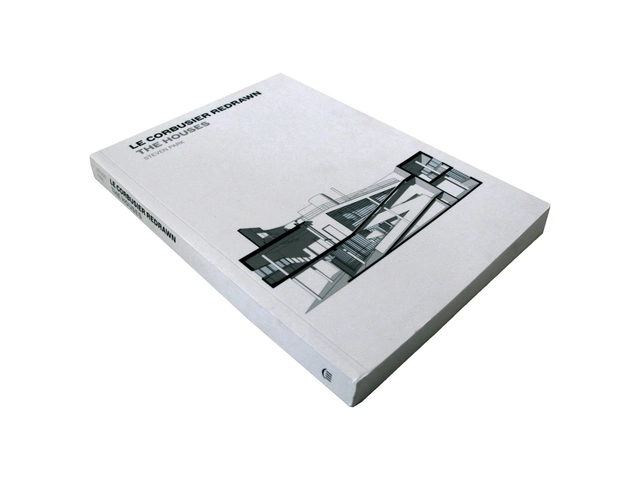
Le Corbusier (1887-1965) was the most significant architect of the twentieth century. Every architecture student examines the Swiss master's work. Yet, all too frequently, they rely on reproductions of faded drawings of uneven size and quality. Le Corbusier Redrawn presents the only collection of consistently rendered original drawings (at 1:200 scale) of all twenty-six of Le Corbusier's residential works. Using the original drawings from the Le Corbusier Foundation's digital archives, architect Steven Park has beautifully redrawn 130 perspectival sections, as well as plans, sections, and elevations of exterior forms and interior spaces.
We here at ArchDaily are big fans of Roman Mars' radio program 99% Invisible, and just had to share the latest show: "In and Out of Love." In it, Mars explores the changing face of Philadelphia's JFK Plaza (more commonly known as LOVE Park), why its Modernist characteristics made it perfect for skateboarding (although city officials certainly didn't feel that way), and why Le Corbusier truly is the patron saint of skateboarders.
And, if you like this, check out Why Skateboarding Matters to Architecture, and follow the jump for some very cool, very innovative skate-friendly homes, stores, and parks...
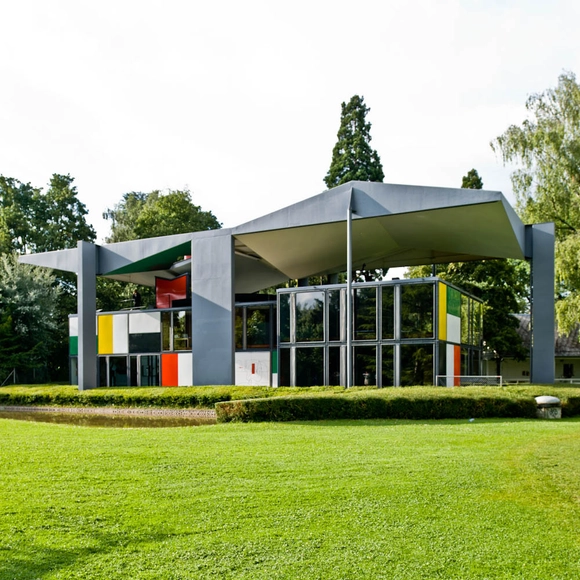
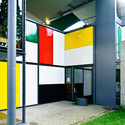
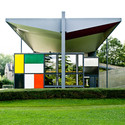
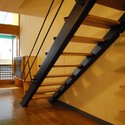
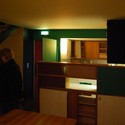
Iconic for its floating steel roof and brightly colored panels, the Pavillon Le Corbusier is the last building Le Corbusier designed before his death in 1965. Completed in 1967, the building stands as a testament to Corbusier’s renaissance genius as an architect, painter, and sculptor. It does so both intentionally, as it is an exhibition space for his life’s work, and naturally, as it is a building masterfully designed. Interestingly, the building diverges in some ways from the style responsible for his renown – concrete, stone, uniform repetition, etc. It celebrates the use of steel, with which he explored prefabrication and assembly, and a freedom through modularity, in which the plan is completely open but infinitely adaptable.
It’s hard to imagine Le Corbusier – the bespectacled legend of 20th century Modernism, known for his ultra-clean aesthetics – as living in the everyday, messy world that we all inhabit. Which is why the Fondation le Corbusier‘s decision to display rare color photographs of Le Corbusier is such a treat for us all.
The photographs were taken for the magazine Paris Match in 1953 by Willy Rizzo, a fashion photographer better known for his shots of 1950s stars and starlets. The images depict the then 66-year-old Corbusier in various spots about Paris: the Musée National d’Art Moderne, his apartment, in front of a blackboard (sporting a sketch of Unité d’Habitation).
In her Fast Company article, Kelsey Campbell-Dollaghan explains that these images give us a glimpse of the man behind the myth: “Even the way we talk about him now, as Le Corbusier, refers to an idea as much as a person. Captured 12 years before he drowned in the Mediterranean at his beloved summer home, Rizzo’s photographs give us a glimpse of the pre-sainted man–aka Charles-Édouard Jeanneret.”
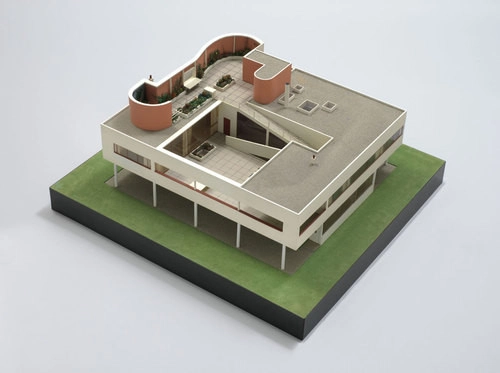
Last night, ArchDaily indulged in building our very own LEGO® Architecture Villa Savoye. As one of the most influential buildings in the International style of architecture, it is no surprise that architecture and LEGO fanatics rejoiced last month when LEGO® announcedLe Corbusier’s Villa Savoye as the newest addition to their architecture series. Now, thanks to LEGO® Architecture, five of our readers will win their very own.
We want to know what building should be the next in the LEGO® Architecture series and why. All you have to do is become a registered user at ArchDaily and leave us your answer in the comments below by Sunday, September 23rd! (More information on LEGO® Architecture’s Villa Savoye, designed by architectural artist Michael Hepp, can be found here.)
Official rules:
The five winners will be chosen at random from entries received between Monday, September 17th and Sunday, September 23rd 11:59 EST. You must leave a comment as a registered user at ArchDaily. Open to anyone in the world. One entry per person. ArchDaily will enforce verification and remove duplicated ones before choosing the winner.
Good luck!
UPDATE: And, the winners are….
Seth Ellsworth
Wonyeop Seok
Daniel Bollard
Makoto Shibuya
Mark Kitchens
Congrats! You can expect an email from us shortly.
In Upstate New York, residents are clamoring to raze down their Government Center, Paul Rudolph’s classic 1970 example of brutalist design. Ostensibly, this is due to flood-damage. But it can’t hurt that, as one resident was quoted in The New York Times as saying, it’s “a big ugly building.”
In Minnesota, city officials would rather tear down M. Paul Fiedberg’s Peavey Plaza, a “Modernist gem” completed in ’73, than spend the time, money, and effort to revitalize it.
In Baghdad, on the other hand, a gymnasium completed in 1982, suffering the signs of decades of violence, poverty, and ill-executed renovation, has sparked a small preservation movement, reawakening a country to its neglected cultural heritage.
The architect behind this Iraqi endeavor? None other than Le Corbusier himself.
Read More on the “forgotten” Le corbusier in Baghdad, after the break…
Planned for completion in 2014, the iconic United Nations Headquarters (UNHQ) is in the middle of a $1.876 billion refurbishment project, known as the Capital Master Plan, which seeks to update the aging building with a more safe, modern and sustainable work environment. Located on the 18-acre site that was donated by John D. Rockefeller in the 1950s, the Manhattan UNHQ was designed by an international team of eleven architects who worked together in a post-World War II world to create an landmark building through collaboration rather than competition.
Continue reading for more details on the Capital Master Plan.
In an article originally published on Plataforma Arquitectura, Guillermo Hevia Garcia describes his experience when visiting the Unité d’ Habitation in Marseille, France, also known as Cité Radieuse. On February 9th, the building was overcome by a large fire that was said to have been started due to a heating problem. The blaze took hundreds of firefighters nearly a day and a half to put it out. Eight residential units and four hotel rooms were destroyed, and approximately 35 other units were severely damaged by smoke or action relief. Most residents have returned home to the Unité d’ Habitation, Le Corbusier‘s thesis on domestic life, as they continue to live the communal life that the renowned architect dreamt up.
A well known architectural classic by Le Corbusier, the Notre Dame du Ronchamp, or more commonly referred to as Ronchamp, is featured very elegantly in this video by italian architect Franco Di Capua. The curved roof that peels up towards the heavens, the curving walls, and the the sporadic window placement on the walls are just a few of the architectural elements that make this project such a marvel.