Madrid-based architect Angel Borrego Cubero of Office for Strategic Spaces (OSS) has directed and produced the first documentary focused on the tense process that characterizes an architectural competition. Appropriately titled The Competition, the film captures a fascinating account on how five world renowned architects - Jean Nouvel, Frank Gehry, Dominique Perrault, Zaha Hadid and Norman Foster - “toil, struggle and strategize to beat the competition.” The premise is based on a nearly forgotten, 2008 competition for a new National Museum of Art of Andorra, a small Pyrenees country nestled between Spain and France, which has yet to be realized.
The Competition is expected to debut in late 2013. Updates will be available on OSS’s website and facebook.
As we've mentioned before, Irish designer Eileen Gray was undoubtedly one of the most influential, and most overlooked, designers of the 20th century. However, a new Kickstarter campaign aims to put that right once and for all. The campaign is seeking funds to help renovate Gray's seminal house, E-1027, for the production of a feature film about the architect.
Read more about the film, and find out who is slated to play Gray, after the break...
From Frank Lloyd Wright to Oscar Niemeyer and the 2013 Pritzker Prize laureate Toyo Ito, this short film features a series of excerpts from interviews, speeches and documentaries of the most influential Architects from the past 70 years who have shaped the notion of Architecture. As described by the video’s producer, viaViLi, “this accumulation of scenes some how expresses the condition of Architecture today - its moments of Glory and Misery.”
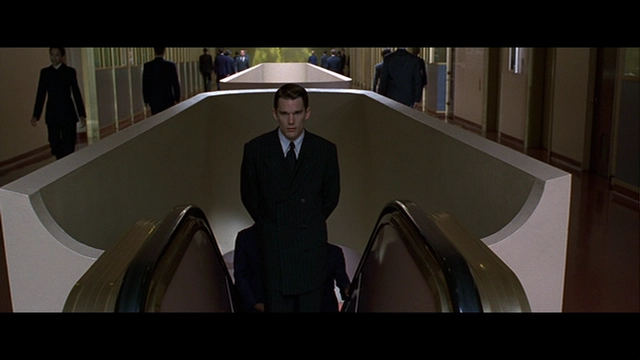
Screenshot of Frank Lloyd Wright's Marin Center in the film Gattaca. Courtesy of Columbia Pictures.
You would think that of all film genres, Science Fiction would be the one least likely to feature real buildings. It stands to reason that production designers would want to avoid connections with things so grounded in reality. But in fact, there is somewhat of a tradition of using modern architecture as a foundation for the creation of fictional film worlds.
Science fiction relies on an audience believing in the world they are presented with. Clever camera work, perspective design, and temporary materials can only do so much. What often tips the balance in favour of using real, Modern buildings - rather than a temporary set - is the authenticity and atmosphere they provide the Science Fiction genre.
Read about Modern architecture in Sci-Fi films Blade Runner, Gattaca, Aeon Flux, and more, after the break...
This article comes courtesy of Charlotte Neilson, the author of the fascinating design blog Casting Architecture. Her column, Through the Lens, will look at architecture and production design in TV and film.
The categorisation of period architecture generally remains firmly in the realm of the professional or amateur enthusiast - let’s face it, you can go through life without knowing the difference between a Corinthian and Ionic column without too much inconvenience. Oddly, however, most people are able to name a few of the main features of Art Deco architecture fairly easily - the curved corners, stylised forms, the use of bakelite and chrome, the transport motifs.
It’s interesting that this period is so much more familiar to us, considering it spanned quite a short timeframe compared to other architectural styles; the Arts and Crafts and Art Noveau movements, for example, which both occurred in a similar time frame to Art Deco, are much less known to the wider community.
It’s possible of course that Art Deco is just more omnipresent because of its universal appeal, or its uniqueness, but I think most of the credit should go to Monsieur Hercule Poirot.
Learn more about Agatha Christie’s contribution to Art Deco, after the break...
Michael Haneke, known for his cold, disturbing and bleak films, such as Funny Games (1997), Caché (2005) and The White Ribbon (2009), goes for a little compassion with his latest, Oscar-nominated film Amour (2012). The film, which explores the private life of a married couple, Georges (Jean-Louis Trintignant) and Anne (Emmanuelle Riva), is a meditation on how individuals cope with the loss of a loved one.
Haneke sets his film within a single location, a Parisian apartment, which was constructed in a soundstage. The filmmaker, who often obsesses over the sound and production design in his films, had complete freedom with the construction of this space. In The Hollywood Reporter, we learn about how specific he was with the design of the space itself. “The crew had to install and reinstall the parquet floor to make sure it creaked just right.” In lieu of shooting on actual locations, Michael Haneke recreated an entire location according to his specifications to create the space he desired for his film.
Read more about how the spaces in Amour allow for the story to unfurl, after the break...
1960’s Chicago: cars zooming down Lake Shore Drive, crowds heading into the Opera House, people observing artworks in the Art Institute, and Chicagoans laying around Grant Park on a sunny day. These are just a few of the scenes captured by amateur filmmaker Margaret Conneely in her filmThe City to See in ’63. The people, neighborhoods, and architecture of Chicago are all captured in this well-crafted 12-minute, 16mm color film taped in 1962.
Conneely captures some key architectural sites in Chicago, including the construction of Marina City. In addition, there are clips of a few buildings that no longer exist such as the Chicago Sun-Times building, demolished in 2004; White Sox Park, demolished in 1991; and the first McCormick place, wrecked in 1967.
The film also covers different neighborhoods of Chicago including Lincoln Park, Logan Square, Garfield Park, and old Maxwell Street.
As shown in the film, Chicago has always been known for its spectacular array of architecture. To see more current architectural sites in Chicago, view our Architecture City Guide: Chicago.
This article comes courtesy of our friend and cenephile Charlotte Neilson, the author of the fascinating design blog Casting Architecture, which discusses architecture and production design.
The life of a building - a few hundred years, if a building is lucky - is just a blip when compared to the billions of years required to shape the natural landscape. Even briefer is the work of a film maker: a pursuit created for momentary entertainment, which reaches completion in just a couple of hours. Strange then, that film has often stepped in to preserve buildings who have met an early demise.
With awards season in full swing, Hollywood's sparkly razamtaz occupies our television screens. But what about the unsung, architectural heros of film? What about the films that are less ‘Schindler's List’ and more ‘Schindlers Hauser’, less ‘Wrath Of Kahn’ and more ‘Louis Kahn’. We look past the panoply of stars to bring you 30 of the best Architecture Documentaries which will provoke, intrigue and beguile in 2013.
This article comes courtesy of ArchDaily friend Charlotte Neilson, the author of the fascinating design blog Casting Architecture, which discusses architecture and production design. Charlotte is not only a dedicated cinephile but also an honours graduate of the University of Newcastle, Australia.
We all know that psychopaths prefer contemporary design. Hollywood has told us so for decades. The classic film connection between minimal interiors and emotional detachment (see: any Bond adversary) or modern buildings and subversive values is well documented - and regrettable. The modernist philosophy of getting to the essence of a building was intended to be liberating and enriching for the lives of occupants. Hardly fair then that these buildings are routinely portrayed with villainous associations.
What the representation of Modernist architecture in film tells us about our society, after the break...
Cinematographer Tomas Koolhaas, son of notorious Rem Koolhaas, has shared with us his latest clips from the feature length documentary film, REM. Set to debut in 2013, the motion picture breaks away from conventional approach to filming architecture and exposes the raw, human experience of Dutch architect’s most famous projects. As Tomas describes, REM gives the audience “a rare insight into the reality of the hidden internal life of the buildings”.
ArchDaily had the chance to discuss the film with Tomas. Continue after the break for the complete interview and another small preview of the film!
The relationship between social dynamics and architecture has always been intimate. It is a constant dialogue between social norms and politics, stylistic trends and aesthetic choices, individual preferences and the collective good. The Modernist Period was a time when architecture took on the challenge of many social problems. In all the arts – architecture, design, music and film – the period was highly politicized and the choices often gave way to a utilitarian ideal that was a hybrid of efficiency, simplicity and comfort. Jake Gorst’s new film Modern Tide: Midcentury Architecture on Long Island, supported by Design Onscreen, is a message of preservation that takes us through the history of the modernist housing boom that took place on Long Island, NY in the period between the Great Depression and the 1970s.
Alred Hitchcock (13 August 1899 – 29 April 1980), who would have turned 113 today, is often known as the “Master of Suspense.” But we here at ArchDaily would like to tweak that moniker slightly, to the Master Architect of Suspense.
Hitchcock, who actually worked as a set designer in the 1920s, not only maintained meticulous control over his film sets as a director (many of which were mounted in studio), but incorporated many architectural themes into the narratives themselves.
More on Hitchcock’s use of Architecture, after the break…
Mehruss Jon Ahi and Armen Karaoghlanian combined their educational backgrounds with Interiors, an online journal that marries architecture and film.
Interiors is an online journal, published on the 15th of each month, in which films are analyzed and diagrammed in terms of space. Interiors focuses on how space is used throughout a particular scene and how the architecture of the film impacts its narratives and characters.
It has been confirmed by Studio Wim Wenders and Atelier Peter Zumthor & Partners that the news of Wim Wenders devoting his new 3D documentary film on architecture to Peter Zumthor was in fact a rumor. Although Wenders will be conducting an artistic interview film with Zumthor for the upcoming 2012 Venice Biennale, it has nothing to do with his feature documentary. The Biennale interview film and the 3D documentary on architecture are two separate projects that were mistakenly combined by the source article. We apologize for the confusion.
In ArchDaily we have mentioned films, whether because of its content closely related with Architecture, or because of the space, photography, atmosphere, or any other relevant feature to our practice that could mean a certain value through an Architect’s eyes.
From this week and on, we will propose a film for you to watch – enjoy – and comment if you want to share your thoughts about the movie with us. We have already a starting list which still open for your recommendations.
The first movie to introduce is a classic from the ’80, “The Belly of an Architect” by the British director Peter Greenaway.
Created by Reiser + Umemoto for the Hong Kong & Shenzhen Bi-City Biennale, “Manhattan Memorious” explores what Manhattan could have been. The film visualizes several unrealized projects from Manhattan, including Buckminster Fuller’s dome over Midtown, Rem Koolhaas’ City of the Captive Globe, RUR’s East River Corridor, Paul Rudolph’s Eastside Redevelopment Corridor, Morphosis’ West Side Yard and others.