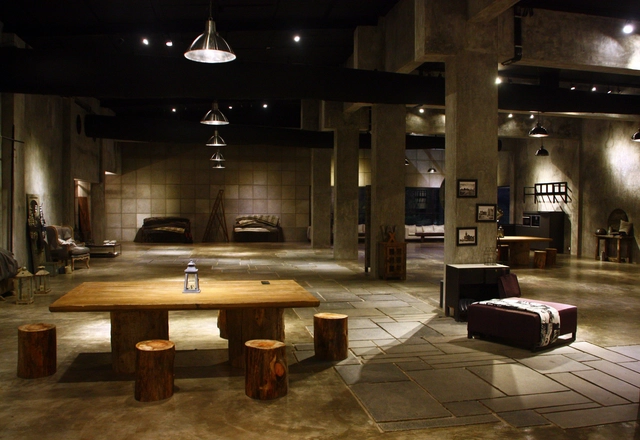
Delicately crafted models by twelve students at Eindhoven University of Technologywill be the feature of an exhibit on Rudolf Olgiati called Die Sprache der Architektur (The Language of Architect). Oligiati was a Swiss Architect of the mid-20th century whose work has been attributed to the New Objectivist Movement. His work, which largely featured single family homes, brought a modernist aesthetic to the tradition of the mountainous Grisons of eastern Switzerland.
The Bartlett School of Architecture, UCL teamed up with Roca London Gallery to create the MArch Architecture Unit 22 end of year show – ‘Bartlett Architecture Dares to Care’, which is on display until December 18. Executed through the creation of Zoetropes, their study was focused on social and environmental sustainability, and the role architecture plays in preserving and empowering vulnerable communities. Each Zoetrope depicts the daily actions of an individual belonging to a vulnerable community. By designing for the everyday tasks, consideration is given to the role the built environment plays in protecting or helping them, rather than focusing purely on aesthetics. For more information, please visit here.
Opening at 6:00pm tomorrow at the Museum of Finnish Architecture, UNBUILT HELSINKI is an exhibition about the Unbuilt City and its inhabitants as part of the World Design Capital Helsinki 2012 program. Drawn from the museum’s archive and beyond, unrealized projects in Helsinki are studied by a team of researchers who generate new relationships with local resources in order to translate the projects into architectural models. Their findings and the narratives behind the buildings are displayed in an exhibition at the museum. The event is curated by Åbäke and Nene Tsuboi and will be up until February 24. For more information, please visit here.
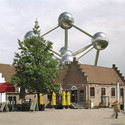
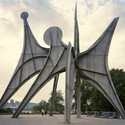
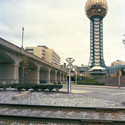
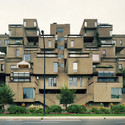
Since 1851, World Fairs have offered glimpses into specific moments in time - giving us insight into what was once innovative, high-tech, and down-right radical. But the structures, the icons of each Fair, don't always stand the test of time - no matter their architectural pedigree. In Flushing Meadows Park, New York, for example, Modernist icon Philip Johnson's 1964 New York State Pavilion now stands neglected, overgrown in ivy. Mies van der Rohe's German Pavilion for the 1929 Barcelona Expo was promptly demolished (although eventually reconstructed).
On the other hand, the Eiffel Tower, although considered "vulgar" in its day (1889), was maintained because its height made it well-suited for emitting radio signals; it's now Paris' most important tourist attraction.
The fate of World Fair Structures is the theme of New York-based photographer, Jade Doskow, who has already shot 19 former World’s Fair sites. Take a peek at Doskow's images and find out how World Fair structures have fared, some better than others, after the break...
On display until February 3rd at the HangarBicocca in Milan, the ‘On Space Time Foam’ suspended art exhibit by Studio Tomas Saraceno is composed of a transparent surface accessible to visitors, hanging at a height of 20 metres and covering 400 square metres on three layers, for a total of 1,200 square metres. Known for his surprising structures that draw the public into extraordinary spatial and emotional experiences, the large soft and floating film welcomes visitors who will thus find themselves moving mid-air between the floor and the ceiling, earth and sky, and it compels them to lose their spatial coordinates. More images and architects’ description after the break.
The Museum of Modern Art in NYC is launching an exhibit called Tokyo 1955–1970: A New Avant-Garde, that investigates the transformation of Tokyo from a war-torn nation into an international center for arts, culture and commerce. The exhibition will run from November 18 through February 25, 2012 and includes over 200 works of various media including painting, sculpture, photography, architecture, drawings, graphic design, video and documentary film.
Intercontinental Curatorial Project, which promotes the role of architecture as the vital part of contemporary culture and life, presents its ongoing traveling exhibition Colombia: Transformed. The event is to be shown November 8-9 as part of the Dialogues with the Informal City: The Case of Latin America and the Caribbean symposium. This interdisciplinary symposium seeks to connect a range of fundamental themes affecting the current conditions and future of Latin America’s growing informal cities and by extension the rising global urban population.The event will take place at the Jorge M. Perez Architecture Center at the University of Miami’s School of Architecture. The exhibition is co-sponsored by the University’s Center for Latin American Studies and the School of Architecture. For more information, please visit here.
Taking place October 26-December 2, the White Mountain Chilean Contemporary Architecture exhibition is composed of a selection of relevant works. Put on by Aedes Berlin, the event highlights the richness of the recent projects is originated and developed within its landscape. The atmospheric design of the exhibition demonstrates this significant creative moment of the Chilean buildings, often described as the continent’s most interesting today. For more information, please visit here.
Building: Inside Studio Gang Architects, is the first solo exhibition dedicated to the work of Studio Gang, which will be on view at the Art Institute of Chicago until February 24, 2013. The show immerses visitors in the energy of the studio’s creative process and the stream of ideas that connects its growing body of work. More images and information on the exhibition after the break.
Designed by TAAT (Theatre as Architecture, Architecture as Theatre) and exhibited at the World Horticultural Expo 2012, Khor I is a specific challenge to perform a play without any guidance or introduction. The dramatic situation is simply available and can be ‘filled-in’ and approached freely. The theatre installation represents a common ground between theatre, architecture and the visual arts with its monumental quality. More images and architects’ description after the break.
Andrew McGregor, Robert Miller, Raymond Bourraine, and Teresa Cacho were recently named as the second prize winner in the Sukkahville Design Competition in Toronto. Organized by the Kehilla Residential Programme, five finalists were given the opportunity to build their designs for an exhibition with the challenge to design a temporary structure constructed for use annually during the week-long Jewish festival of Sukkot. Representing many conceptual themes surrounding the essential nature of dwelling, this proposal for an innovative Sukkah design delicately balances the inherent dichotomies of new/old, open/closed, and temporary/permanent. More images can be viewed after the break.
Beginning on October 16th, 2012, Galeries Lafayette in Paris, France, will be celebrating the 100 year anniversary of the Dome designed by architect Ferdinand Chanut and glass artist Jacques Gruber in 1912. 100 years under the Dome will be held at the flagship store of the boulevard Haussmann, a true Parisian symbol. In addition, the gallery will launch an exhibition called 1912-2012. Chronicles of a Creative Itinerary by architect Rem Koolhaas and his studio OMA, along with a collaboration called Chrysalide between visual artist Yann Kersalé and Djuric Tardio – Architectes.
Join us after the break for more stunning images for the anticipated celebration.
The Graham Foundation for Advanced Studies in the Fine Arts will be hosting an exhibition on Russian Modernist Architecture starting October 11 through February 16, 2013. Featuring a wealth of rarely published material on architecture that spanned the empire of the Soviet Union, the 80+ large-scale photographs – documented by British photographer Richard Pare – provide unique insight into the movements of the Soviet revolutionary period. More photos and information after the break.
Born in Finland, Eero Saarinen (1910 – 1961) is recognized today as one of America’s most influential architects of the 20th Century. The exhibition Eero Saarinen: A Reputation for Innovation, opening tomorrow at the A+D Architecture and Design Museum in Los Angeles, will highlight his short but brilliant career bookended with two iconic buildings: the unbuilt Smithsonian Gallery of Art which was to be Washington, DC’s first museum of modern art and Dulles International Airport which was designed as the nation’s first jet airport.
What is the connection between sex, architecture and design? Opening tomorrow, September 29,Playboy Architecture, 1953-1979 explores the role of architecture in the famous men’s magazine Playboy. Colomina, along with the curators of NAiM/Bureau-Europa in Maastricht, The Netherlands, centers the exhibition around the research of Beatriz Colomina, a professor at the Princeton University School of Architecture and founder of their Media and Modernity program, who has been studying the connection for the past three years.
Playboy Architecture, 1953-1979 illustrates how cities, buildings, interiors, furniture and products have always played an important role in the fantasy world of Playboy. Ever since Hugh Hefner launched Playboy in 1952, its erotic spreads have featured the likes of Frank Lloyd Wright, Mies van der Rohe, Buckminster Fuller, Moshe Safdie, and Paolo Soleri. As Colomina’s program argues, “sexual revolution and architectural revolution are inseparable.” The exhibition reveals how Playboy reshaped masculinity with the influence of architecture and design.
Taking place September 30-March 3 at the Arp Museum Bahnhof Rolandseck in Remagen, Germany, the ‘Richard Meier. Building as Art‘ exhibition illustrates Richard Meier’s complex design process using prominent buildings and projects from his entire work history. The main focus will be on his museum buildings, as well as on the residential projects created at the start of his career in the USA. The works on display included in the exhibition explore the concept of an architecturally composed space on the basis of five aspects: site, proportion, light, route and color. The exhibition includes a selection of models, original sketches, renderings and photographs. More information after the break.
Opening October 12th, the ‘Pleated Shell Structures’Exhibition consists of a short term, site specific research prototype designed by Pritzker Architecture Prize-winning architect Zaha Hadid and her firm. Presented by the Southern California Institute of Architecture (SCI-Arc) in their gallery, the exhibit positions itself within the argument of parametric design research to focus its efforts on design methods that encompass an operative pathway from design intent to manifestation. The exhibition will be on display until December 2. More information after the break.