Earlier this week, we announced the completion of the world’s narrowest house in Warsaw, Poland. The Keret House was first conceived as a seemingly impossible vision of the Polish architect Jakub Szczesnyof Centrala, who first presented the idea as an artistic concept during the WolaArt festival in 2009. Now, three years later, the vision has become a reality and is drawing a significant amount of international attention to the city of Warsaw.
Built between two existing structures from two historical epochs, the narrow infill is more of an art installation that reacts to the past and present of Warsaw. Although the semi-transparent, windowless structure’s widest point measures only 122 centimeters, it’s naturally lit interior doesn’t seem nearly as claustrophobic as one would think.
The Keret House will serve indefinitely as a temporary home for traveling writers, starting with Israeli writer Etgar Keret.
Images and the architects’ description after the break…
The hand-drawn work of Chris Dent takes on the modern metropolis – depicting architecture in a way that is at once meticulously accurate & playfully imaginative.
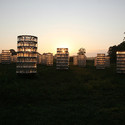
The highly anticipated “Twilight Epiphany” Skyspace, designed by American artist James Turrell, will open to the public today with a sunset light show. The abstract pyramidal structure complements the natural light present at sunrise and sunset, creating a mesmerizing light show that connects the beauty of the natural world with the surrounding campus. This experience is enhanced by an LED light performance that projects onto the 72-by-72-foot thin white roof, which offers views to the sky through a 14-by-14-foot opening. Additionally, the Turrell Skyspace is acoustically engineered for musical performances and serves as a laboratory for music school students, as it stands adjacent to the Shepher School of Music on the Rice University campus in Houston, Texas.
David Leebron, Rice University President: “The campus has to play its role in inspiring our students.”
Continue after the break to watch a sneak preview of the Turrell Skyspace light show.
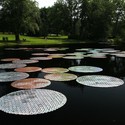
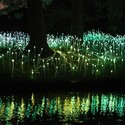
Visitors poured into Longwood Gardens this past Saturday to see 23-acres of breathtaking ‘Light: Installations’ by artist Bruce Munro. Although Munro describes the installations as simply “sketchbook jottings realized”, this “large-scale one-man-show” is anything but a simple feat. Eight large outdoor installations, two installations within the 4-acre Grand Conservatory and a collection of illuminated sculptures in the Music Room are keeping visitors mesmerized for hours.
Munro’s ‘Light: Installations’ are being shown for the first time outside of the UK. They will remain open until September 29th this year. Continue reading for more images and information.
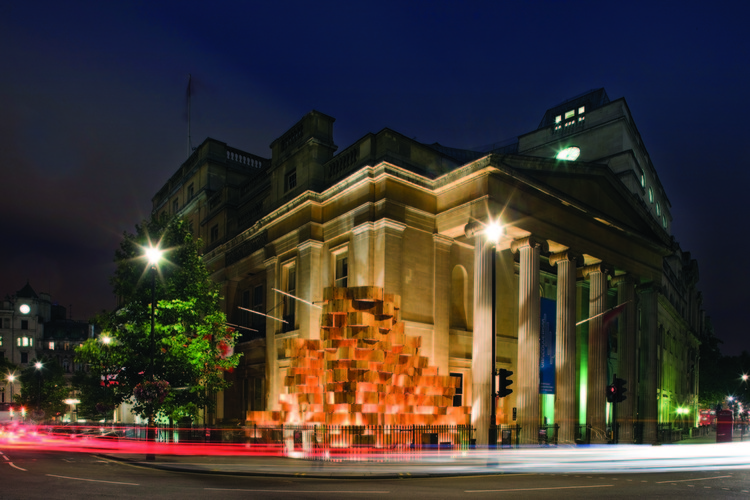
“A Thousand Traps to Escape” is a temporary installation designed by 13 students from Laval University under Olivier Bourgeois in the Magdalen Islands in Quebec, Canada. The project builds on the collaboration of themes of architecture, art, landscape and installation in the creation of space based on simple materials, the landscape and “the basic rules of construction”. The “local material” chosen for this construction is the ubiquitous lobster trap made of wood and fishnet. Its formal simplicity allowed for an basic stacking technique that produced relatively complex visual results of transparencies and opacities.
Read on for more information on the development of this project.
Vacant land is a looming problem for many cities, especially when it remains undeveloped for years or is transformed into garbage dumps and parking lots. But when designers begin to notice these voids within the activity of a city they are able to unlock the inherent potential in the land. That is precisely what “Not a Vacant Lot”, as part of DesignPhiladephia, did this October. Philadelphia’s 40,000 vacant lots are both a challenge and an opportunity for young designers, artists and architects to tranform these under-utilized spaces into experiences within the fabric of the urban environment. The focal point of the design intervention was at the University of the Arts lot on 313 S. Broad Street, just a few blocks from Philadelphia’s center. It featured a reinterpreted map of Philadelphia by PennDesign students and Marianne Bernstein’sPlay House, an 8′x8′ aluminum cube which, in its simplicity, could unlock the potential of this particular lot. But this engagement of vacant land was just one such intervention in a series artist installations throughout Philadelphia. Another such intervention, GroundPaper, was designed by two collaborating artists, Mike Ski and KT Butterfield. The site of their choosing was along the banks of the Delaware River in Fishtown, a neighborhood of Philadelphia.
Read on to see what artists can accomplish with no budget, a vacant lot and an inspired idea.
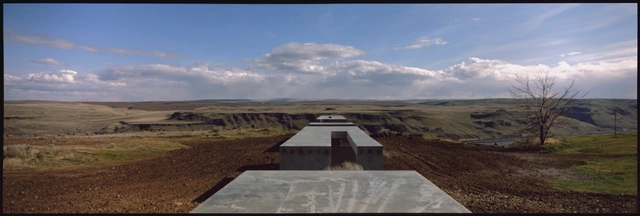
Controversial artists Christo and Jeanne-Claude – known for making large-scale architectural interventions in urban and rural environments – have finally gotten approval from the Bureau of Land Management to construct their most recent project “Over the River”, which will stretch along 5.9 miles along the Arkansas River in Southern Colorado.
Read on for details of the project and more images!
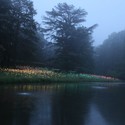
In the summer of 2011, Joakim Kaminsky and Maria Poll, of Kjellgren Kaminsky Architecture, went into the deep forests of Medelpad in northern Sweden. With them they brought 15 meters of mirror coated fabric aiming to create an installation that would interpret the life cycle of this pine forest. More images and architects’ description after the break.
Joel Pirela of Miami based studio Blue Ant Studio has ingeniously reinterpreted the traditional ophthalmology exam to suit the refined tastes of designers. More after the break.
Most design and building processes relay on pre-determination and accuracy, plus an efficient coordination of data input leading to a physical realization representing previously conceived ideas as closely as possible. Parametric and generative design add an extra element of “objective” formulae playing role of legitimizations of designer’s intentional design, while the choice of data pools, algorithms or auto-generative formulae is in fact another intentional element.
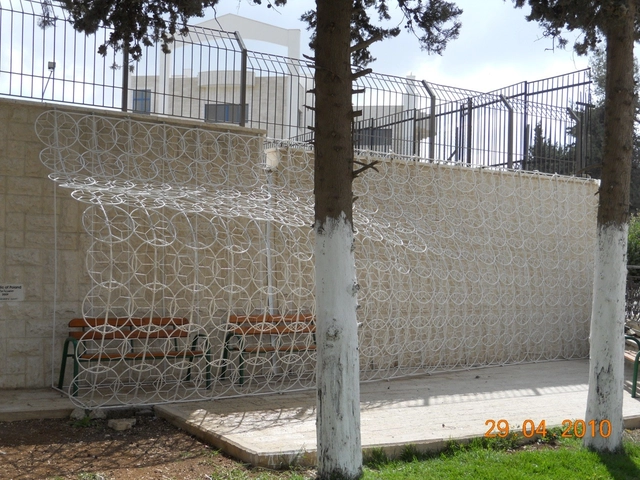
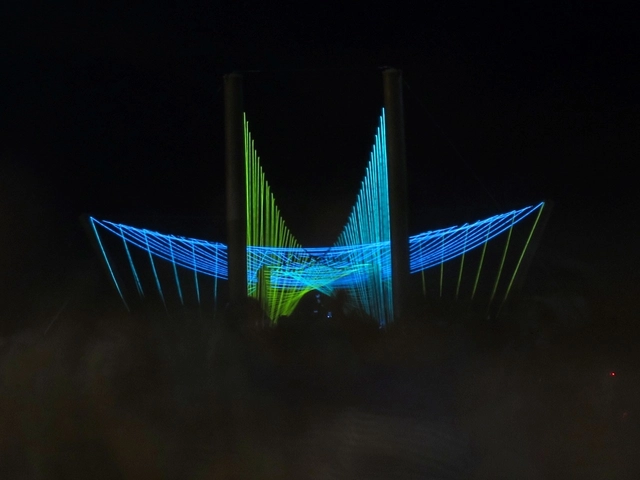
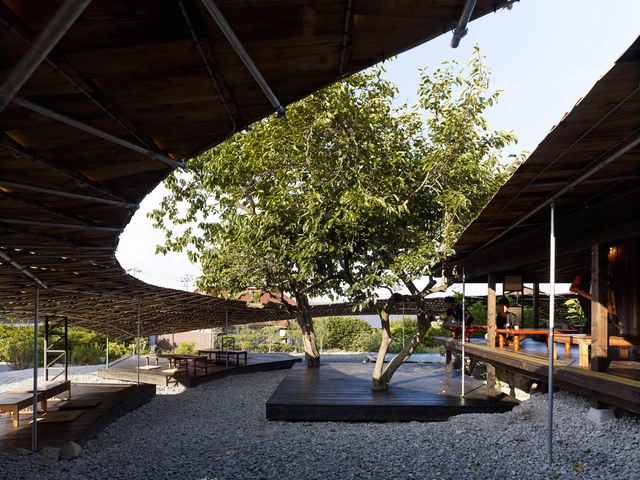
Architect: Centrala Location: Schloss Solitude, Stuttgart, Germany Designer: Jakub Szczęsny Assistant: Helmut Dietz Project Year: 2011 Photographs: Rolf Wohrle, Hagen Betzwieser and Jakub Szczęsny
https://www.archdaily.com/153044/stretched-pavilion-centralaChristopher Henry
Steven Holl Architects just shared the news that the firm has won the commission for the new Institute for Contemporary Art for Virginia Commonwealth University with BCWH Architects. The 32,000 square-foot building will provide gallery spaces for traveling and school exhibits, classrooms, offices, art storage spaces and an auditorium, and accommodate a sculpture garden and a café. Joseph H. Seipel, Dean of the VCU School of the Arts, exclaimed, ”We are honored to have Steven Holl, internationally recognized as one the most inspired and significant architects of our time. With Holl leading this endeavor, I am confident the ICA is destined to become an iconic building for VCU and the city of Richmond and will find its place as a prominent example of Steven Holl’s contributions to the history of architecture.” As the selection process was organized to find an architect-led team, and not a specific design, we will keep you posted on the progress of the project.
The Los Angeles design collaborative, SPORTS, has sent us their most recent project, a gallery installation in Hollywood, California. A description of the project and additional images are after the break.