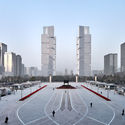
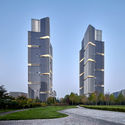
Suhewan Skyscraper. Image Courtesy of Foster + Partners
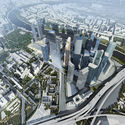
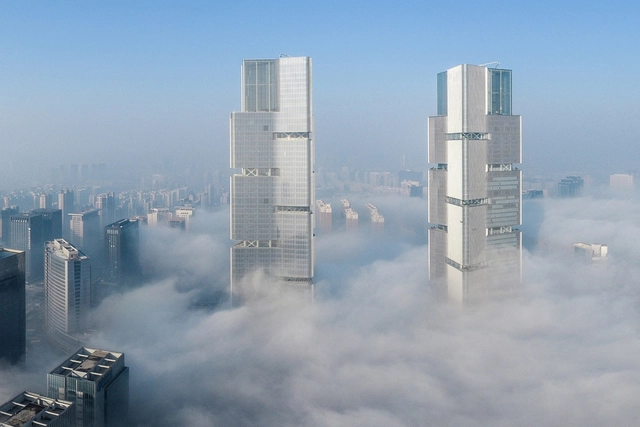
Work has begun on Foster + Partners' 200-meter-high Suhewan Skyscraper in Shanghai. Designed as part of a larger regeneration plan, the 42 story tower will be built for property development company China Resources Land. The first office tower in the residential district, the project is part of a larger move to make Shanghai a top financial and technology center by 2020. Designed as a landmark development in the Suhewan East Urban Complex, the skyscraper will open up to views of Pudong, Bund and the Huangpu River.
Auckland Tower. Image Courtesy of Zaha Hadid Architects
The international design competition to create a new high-rise tower in central Auckland has announced five finalists. The five teams include Warren and Mahoney, Cox Architecture, Zaha Hadid Architects, Elenberg Fraser and Woods Bagot. The landmark tower competition is run by Melbourne-based property development company ICD Property. Each of the teams were asked to complete two versions of their design, one following current city Unitary Plan rules and one version that could be built given more open planning parameters.
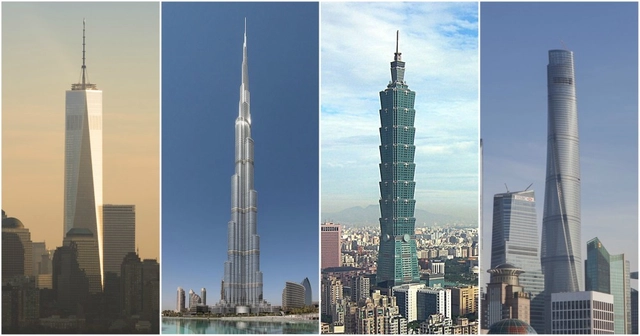
Two years ago over 100 supertall buildings had been constructed worldwide. Last year, 15 more supertall skyscrapers were built, each towering over 300 meters tall. These narrow towers are prevalent in high-density areas with limited land availability and demand for luxury residences. The Council on Tall Buildings and Urban Habitat is the authority on official heights of tall buildings and determines which building receives the title of the Tallest Building in the World. To celebrate International Skyscraper Day, we're exploring a round up of skyscrapers that aim to redefine supertall construction.
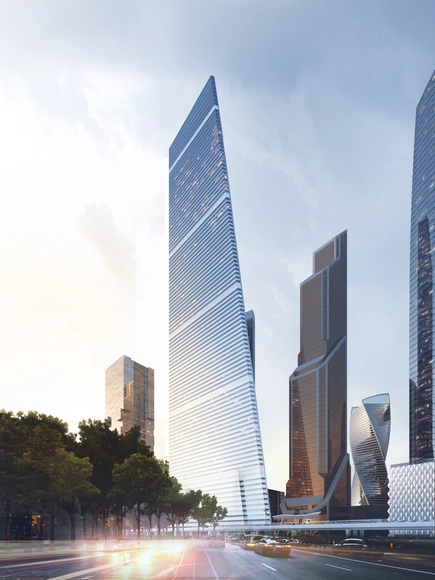
High-rise Residential Complex. Image Courtesy of Sergey Skuratov Architects
Moscow officials have approved a new supertall building that will become the city's tallest skyscraper. Rising 404 meters (1,325 feet) in height as part of the Moscow City commercial district, the tower is designed by Sergey Skuratov Architects. The unnamed structure will be a multifunctional residential complex with 109 floors. The new skyscraper will break Moscow's current tall building record set by Federation Tower at 373-meter-tall (1,226 feet) tall. Construction is scheduled to begin next year.
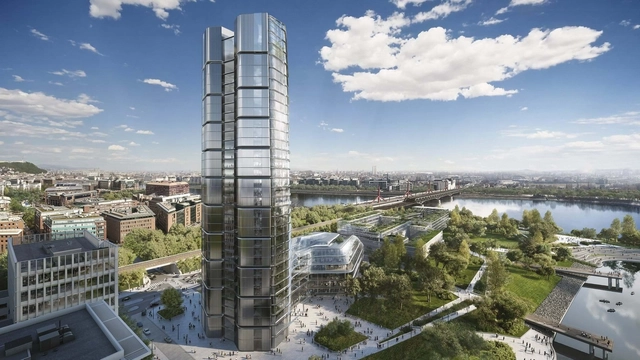
The Hungarian government is introducing a new skyscraper ban in the hopes of preserving the Budapest skyline. Gergely Gulyás, minister of the prime minister's office, recently stated that the ban will affect all new buildings in Budapest over 90 meters tall. The ban will not limit projects already approved with planning permission, including Foster + Partners' MOL Campus Tower, a high-rise being built as part of the new headquarters for the MOL Group. The 120 meter tower will be exempt because it has already won planning permission.
Dubai Trade Centre. Image Courtesy of Shutterstock
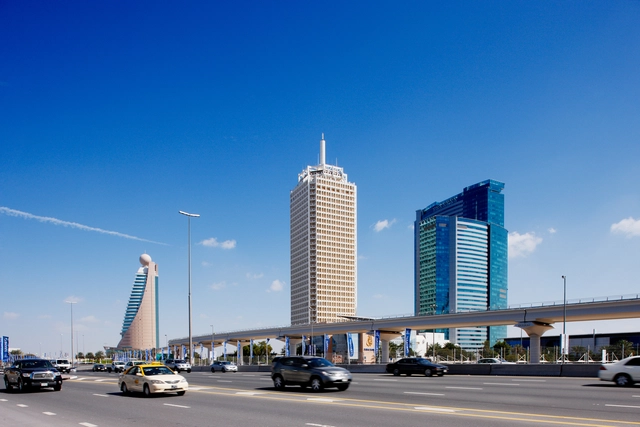
Dubai Municipality has announced that the city is planning to preserve its landmark buildings from the 1960s and 70s as part of a new initiative called Modern Heritage. Jointly launched by the Planning Department and the Architectural Heritage Department, the initiative aims to save the first footprints of Dubai. The initiative would protect some of the most significant buildings constructed when the city was first beginning its rapid development. The plan includes the preservation of the Dubai Trade Centre, a 149-metre-high tower regarded as the city's first skyscraper.
A speculative project, the “New York Super Slender” created by RB Systems, is a futuristic skyscraper that presents a potential new tower typology. With ever-diminishing land space in major cities and a vastly growing population, the project rises to the challenge of optimizing occupancy in a constrained and dense city center.
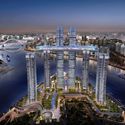
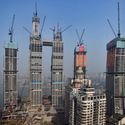
Currently under construction in Chongqing, China, Moshe Safdie's Raffles City Chongqing features an extraordinary engineering feat of erecting a 300 meter long “horizontal skyscraper” above four 250 meter high towers. An extensive urban district set at the meeting point between the Yangtze and Jialing rivers once constructed Raffles City Chongqing will hold the world record of the highest sky bridge linking the towers.
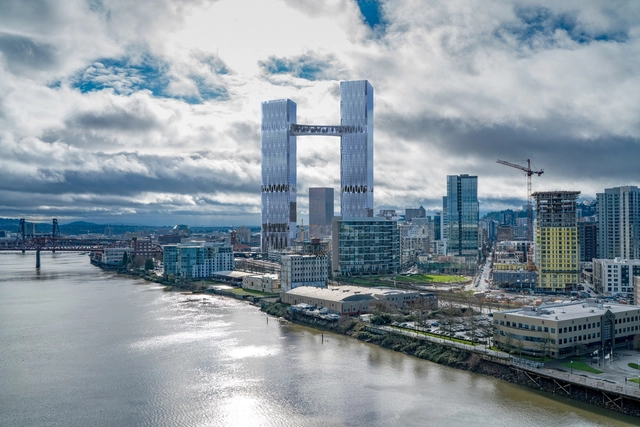
New renderings have been revealed of Kaven + Co. and William / Kaven Architecture’s plans for the new Broadway Corridor in Portland, showcasing the full masterplan for the first time. Conceived as a new mixed-use district and transportation hub connecting Union Station and the Pearl District, the Broadway Corridor will feature the city’s new tallest and one of the west coast’s tallest buildings.
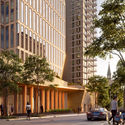
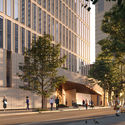
Snøhetta has unveiled the design of a new residential skyscraper to be built in Manhattan’s Upper West Side that will feature a unique, multi-level amenity terrace carved from the tower’s form. Located at 50 West 66th Street just steps from iconic New York City landmarks including Lincoln Center and Central Park, the tower aims to sensitively respond to the historic architecture of its context through its intricate form and refined material palette.
William / Kaven and Kaven + Co. have unveiled plans for a bridged mixed-use skyscraper development that, if built, would become the tallest building in Portland, Oregon.
The project would replace the city’s soon-to-be-demolished USPS headquarters with a new 5-million-square-foot development consisting of multiple high-rise buildings containing facilities for retail, office, residential and a hotel.
The plan is organized around two central skyscrapers, the taller of which would top out at over 970 feet – more than foot feet taller than the city’s current tallest building, the Wells Fargo Center. The two skyscrapers would be linked at 680 feet high by a 236-foot-long glass-walled bridge housing a skygarden and offering unparallelled views of the city and the surrounding landscape.
This silent film, ‘The Skyscrapers of New York’ bears rare footage of the construction of a skyscraper from over one hundred years ago, shared by the Library of Congress as part of their ‘Early Films of New York’ collection. The first scenes include real work crews and the early construction methods that made the first skyscrapers possible; the steel framework the men can be seen clinging onto was a technical innovation that provided the strength and stability for buildings to be built over twenty floors high. It is startling to imagine their lack of concern for health and safety as the men are pictured dangling off a crane line in the sky.
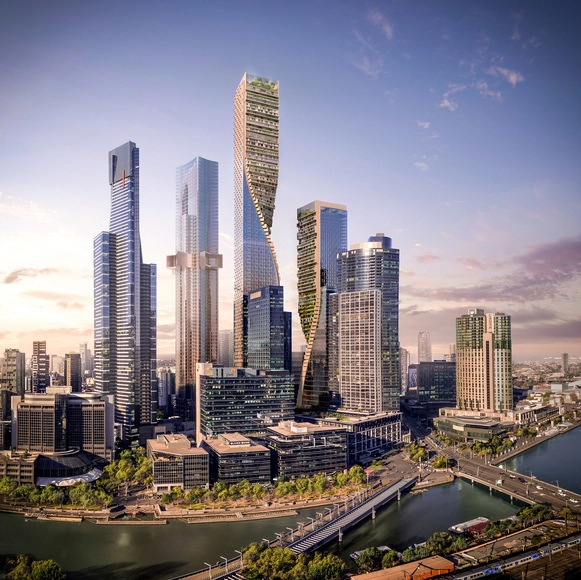
Büro Ole Scheeren has revealed the design of a landmark new development for Ho Chi Minh City that will feature three skyscrapers rising from a mountainous landscape of vegetated terraces and vibrant public spaces. To be known as “Empire City,” the development aims to embody “a symbiotic vision of nature and living” within the space of Vietnam’s capital city.
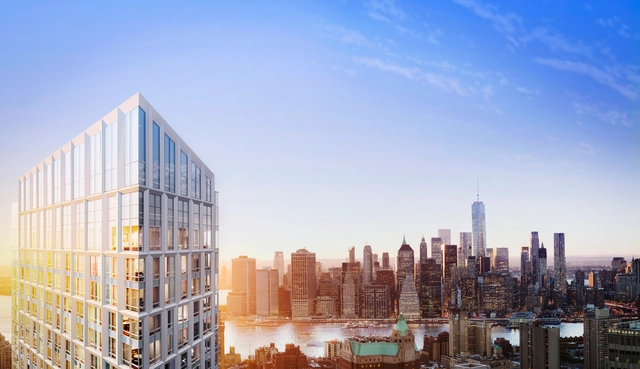
Brooklyn Point by Kohn Pederson Fox will hold the title of Brooklyn’s tallest building - although for a short while as the downtown developer craze competes for the next top spot. The mixed-use skyscraper is the final step in the City Point mega-development and is the first of Extell Development Company in the borough
After being in the design process for the past three years, construction of Brooklyn Point began this summer; it is only now that Extell is releasing the details of the tower in a new render that displays the extent of the façade.
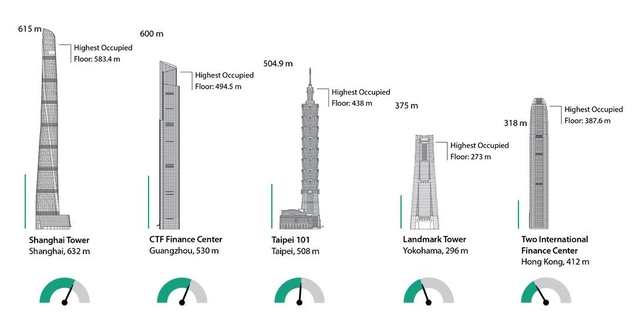
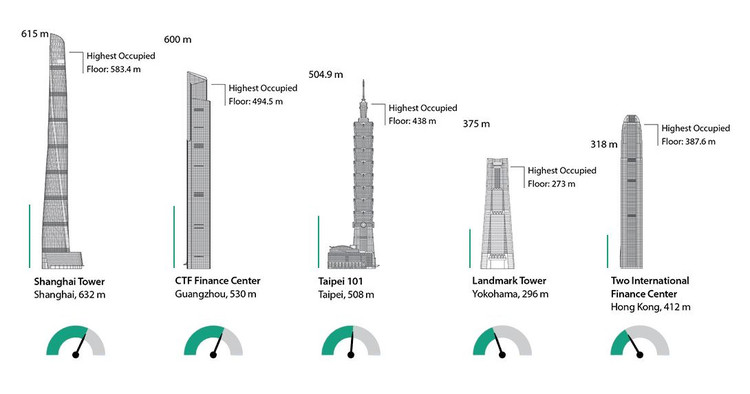
How do we determine the actual height of a building? Where do we place the dimension line? The history of measuring skyscrapers dates back to 1885, way before AutoCAD or Revit dimensions, when the Home Insurance Building in Chicago was among the first to boast of being the world's tallest building, but the Council on Tall Buildings and Urban Habitat (CTBUH)—or the Joint Committee on Tall Buildings, as it was originally called—wasn’t formed until 1969. Recognized by many as the foremost authority on tall buildings, the CTBUH is often cited in determining the world’s (or country’s or city’s) tallest building. However, the CTBUH is not the only organization with a stake in measuring buildings; the global building information database Emporis is also a major player. Between them, these two organizations provide 10 different ways to determine a skyscraper's height, which we have summarized below.
The targeted maximum wait time in office building elevators is 20 seconds—it just feels like 2 minutes when you’re in a rush. But how quickly are the elevators actually moving?
The fastest installed elevator reaches speeds of 67 feet per second (20.5 meters per second), or 46 miles per hour (73.8 kilometers per hour) in the Shanghai Tower. Not only does the Gensler-designed Shanghai Tower boast the fastest elevator, but also the longest continuous run of 1,898 feet of the 2,073-foot tower (578.5 of 632 meters), as revealed in a recent study by the Council on Tall Buildings and Urban Habitat (CTBUH). At these speeds, you can reach the 119th floor in 55 seconds.
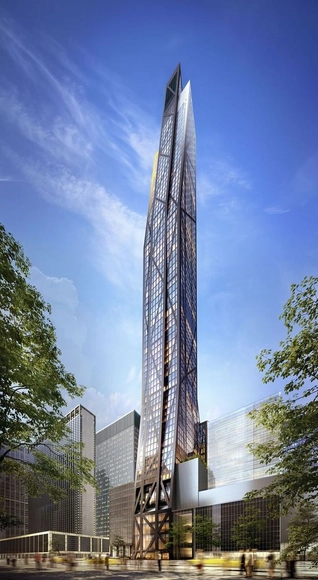
The latest rendering for Pritzker Prize-winning architect, Jean Nouvel's 53W53 has been released in anticipation for its completion next year as construction reaches the 58th floor out of the proposed 82. Capturing the entire design of the new landmark, the render provides a look to the tapering structure distinguished by its sculptural quality and the three floors of gallery space in the tower’s base adjoining the Museum of Modern Art as part of their expansion.
As 53W53 grows in front of New York’s eyes, the concrete skeleton currently standing forms the basis for the exposed structural system referred to by Nouvel as ‘diagrid’ as the tower’s silhouette is an ode to the iconic buildings that already grace the horizon in New York.