Courtesy of the coronavirus, universities are closed around the world, and classrooms are now entertained over video conferencing. This is not overly dramatic as this temporary arrangement will eclipse after cases are contained, and classes will resume soon after. However, the impacts on the university ecosystem and on the urban fabric will require immediate renovations in higher education that will shape the architectural syllabus for years to come.
https://www.archdaily.com/939423/how-covid-19-will-shape-architectural-educationZaheer Allam, Gaetan Siew and Felix Fokoua
The annual QS- Quacquarelli Symonds ranking for top universities has been unveiled. Based on academic reputation, employer reputation, and research impact, the ranking highlights every year the best universities for each profession. In the 2020 Architecture/ Built Environment division, the list reveals that the Massachusetts Institute of Technology (MIT) is back on top.
The Best Architecture Masters (BAM) platform presented the second edition of its ranking of the best architecture master programs in the world in the year 2019.
The Harvard Graduate School of Design has relaunched its free online course entitled “The Architectural Imagination.” Directed by the school’s Eliot Noyes Professor of Architectural Theory, K. Michael Hays, the course seeks to teach students “how to understand architecture as both cultural expression and technical achievement.”
The free 10-week program runs until July 2019 and is carried out through the online edX platform, a Harvard/MIT system that specializes in high-quality massive open online courses. During the course, students will engage with the social and historical contexts behind major works of architecture, basic principles to produce drawings and models, and the pertinent content for academic study or a professional career as an architect.
https://www.archdaily.com/910644/harvard-gsd-relaunches-free-online-architecture-courseNiall Patrick Walsh
Architectural students of my generation—the last of the baby boomers, starting college in Europe or in the Americas in the late 1970s—had many good reasons to cherish architectural history. Everyone seemed to agree at the time that the Modernist project was conspicuously failing. Late Modernist monsters were then wreaking havoc on cities and lands around the world, and the most immediate, knee-jerk reaction against what many then saw as an ongoing catastrophe was to try and bring back all that 20th-century high Modernism had kicked out of design culture: history, for a start. I drew my first Doric capital, circa 1979, in a design studio, not in a history class (and my tutor immediately ordered me to scrape it, which I did).
Three SCI-Arc graduates became the recipients of the first Woods Bagot Prize, an award that recognizes the top design portfolios and academic achievements from students in the undergraduate and graduate programs on September 9. The prize-winners were awarded USD $20,000 along with an offer for a position at any of the international firm’s 15 studios. From a pool of over 50 applicants, the prize-winners Mikiko Takasago from Japan, M.Arch 1, José Carlos García from Mexico, M.Arch 2, and undergraduate Luciano Meghini from Italy, B.Arch, were selected.
Office Ou, a Toronto-based landscape design firm, in collaboration with INOSTUDIO Architects, has designed a new public school for the historic Smíchov district of Prague. The initial competition, organized by the Centre for Central European Architecture, chose the Office Ou & INOSTUDIO design out of 66 anonymous submissions. This school would be the first new public school built in Prague's urban center in close to 100 years.
https://www.archdaily.com/898457/the-foster-plus-partners-led-trailblazer-apprenticeships-bring-overdue-relief-for-disenfranchised-architecture-studentsNiall Patrick Walsh
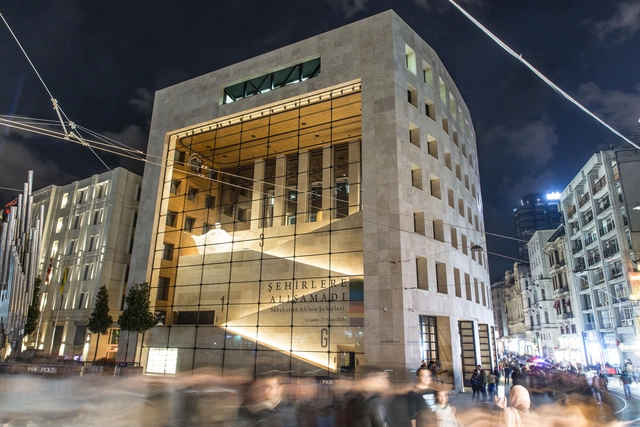
“Today, design has become a form of inquiry, power, and agency,” say Jan Boelen and Deniz Ova, curator and director of the 2018 Istanbul Design Biennial. “It has become vaster than the world itself, permeating all layers of everyday life.” Their curatorial statement for the 4th Istanbul Design Biennial, which opens later this year themed with the title “A School of Schools,” seeks to explore how design education, and education in general, can evolve and adapt in a new age of artificial intelligence.
The team is determined that the Biennial should not read as a two-year scheduled event, but should “reinvent itself and become a productive, process-orientated platform for education and design to research, experiment, and learn in.” The team is undoubtedly well equipped for the challenge.
https://www.archdaily.com/894670/jan-boelen-and-deniz-ova-curators-of-the-2018-istanbul-design-biennial-discuss-the-future-of-design-educationNiall Patrick Walsh
Global higher education analysis firm Quacquarelli Symonds (QS) has revealed its rankings of the world’s top universities for the study of Architecture / Built Environment for 2018. The eight edition of the survey compared 2,122 institutions across the globe offering courses in architecture or the built environment, narrowing down the list based on criteria including academic and employer reputation.
For the fourth straight year, MIT has topped the rankings, once again coming out ahead of the Bartlett School of Architecture and the Delft University of Technology (TU Delft) in 2nd and 3rd respectively. Read on for the full rankings.
The issue of how we educate our architects of the future is a divisive one. With the capabilities of our technology advancing rapidly, new mediums of Virtual Reality, robotics, and artificial intelligence are all changing the architectural profession at a fundamental level. This creates the question of whether architectural pedagogy is keeping up with the times and educating students to be ready for both professional practice and an uncertain future.
The Harvard Graduate School of Design’s popular free online course, The Architectural Imagination, has returned for 2018, again offering anyone across the globe the opportunity to study the fundamentals of architecture from one of the world’s foremost design schools at absolutely no cost.
Led by professors Erika Naginski, Antoine Picon, and K. Michael Hays, alongside PhD student Lisa Haber-Thomson, the 10-week course will cover topics ranging from learning to “read” buildings as cultural expression to technical drawing and modeling exercises.
Columbia Graduate School of Architecture, Planning and Preservation (GSAPP) has launched the United States’ first-ever Ph. D in Historic Preservation. GSAPP is ranked within the top 10 architecture graduate schools in the US in the latest figures for 2017. It’s leadership in learning and experimental practice is about to be further enhanced by the introduction of the course.
Videos
Shahadra Park proposes to bring life back to part of the Yamuna River. Situated in-between dense urban fabric, this highly vegetated, expansive mandi creates a new ground over the drains. Courtesy of UVA School of Architecture / Brittany Duguay
The University of Virginia’s School of Architecture Dean Ila Berman recently announced her intention to launch the NEXT CITIES INSTITUTE, an interdisciplinary design and research platform focused on the rapidly changing dynamics of global urban futures. With an aim to forecast and shape the vital urbanism of this century, the NEXT CITIES INSTITUTE will be a university-wide initiative, led by the School of Architecture and coalescing expertise throughout the University of Virginia, with partners in its Schools of Law, Leadership and Public Policy, Engineering, and Arts and Sciences. Dean Berman spoke about the NEXT CITIES INSTITUTE, its mission, and how it will transform the way students of architecture and its related fields will approach the design of future cities.
18 June 2015: Denmark has a new right wing government. A couple of months later, despite student protests in front of city hall, the new government declares a decision to cut 8.7 billion Danish kroner (over $1.2 billion US) from education in Denmark, effectively cutting nearly 30 million kroner (around $4 million US) from the Danish Royal Academy of Fine Arts Schools of Architecture, Design and Conservation (KADK).
The result? 31 employees have been laid off this month; the student body is to be reduced by 30% over the coming years; 4 masters courses in architecture are being discontinued within the next 4 years; and 6 bachelor programs, 7 special programs and one entire institute in the Design School are being terminated. Teaching is being refocused towards technology and the professional sphere, but will this really improve the prospects of fresh architecture graduates, as they claim? Is it more important to challenge, or to adapt?
Postgraduate Master in Curatorship of Architecture and Design
The role of the Curator requires a comprehensive and multifaceted training that allows them to move in different contexts and platforms. The contemporary Curator investigates and identifies relevant issues and their relationships to, then, launch through exhibitions a narrative capable of catching the audience’s interest. A Curator’s work, therefore, encourages reflection and promotes new ways of perceiving and understanding architecture and design. The Master in Curatorship of Architecture and Design at IUAV (Venice, Italy) aims to train professionals capable of developing curatorial projects with a solid foundation in theory and critical thinking, coupled with a strong knowledge of strategies in exhibition making.



.jpg?1564581679&format=webp&width=640&height=580)

.jpg?1549019229&format=webp&width=640&height=580)









.jpg?1519827682&format=webp&width=640&height=580)



.jpg?1518089499 "© CODE + Johannes Belz")


.jpg?1516300417&format=webp&width=640&height=580)


.jpg?1479663581 "© Ariana Zilliacus")


.jpg?1479934170)
