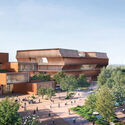
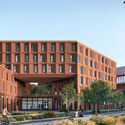
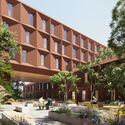
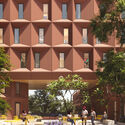
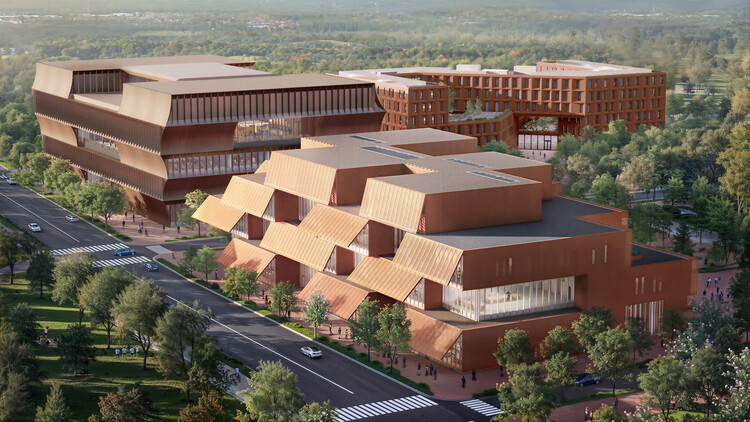
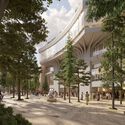
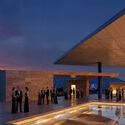
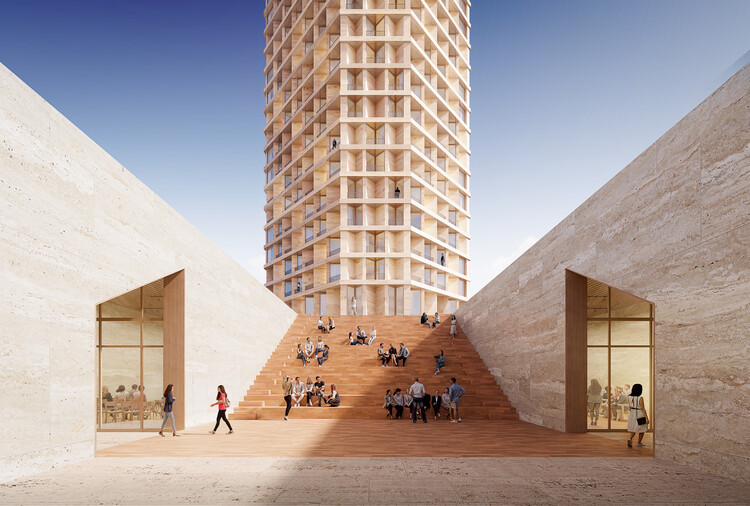
BIG–Bjarke Ingels Group was selected to design the campus of a new STEM university in Arkansas, United States, on a site located near Bentonville's downtown, formerly home to Walmart's headquarters. The project comprises three buildings occupying two city blocks and was designed in collaboration with Polk Stanley Wilcox Architects, who will serve as the Architect of Record. The campus comprises around 422,000 square feet (nearly 39,200 square meters), including green spaces, public squares, an academic building, a makerspace, and a student residence. While the project was recently unveiled, the university intends to welcome its first class of students in 2029.
The context of the ongoing war marks Ukraine's place in the international consciousness. Architecture, however, most often transcends the span of a human life and can therefore be a tool for imagining the future. The practice of architectural design, whether speculative, conceptual, or practical, serves as a means of bringing to life ways of living and interacting beyond our current realities. In this selection of conceptual projects submitted by ArchDaily readers, we see material, spatial, and symbolic strategies that seek to address contemporary contexts in the residential, educational, and commercial sectors.
As the line of conflict has been relatively static since late 2023, Ukrainian cities continue to be subject to new architectural and urban development projects. In this article, we have compiled a selection of unbuilt projects in the cities of Vinnytsia, Lviv, and Kyiv. The selection includes residential, commercial, and mixed-use architectural designs, as well as an educational complex. Two residential projects have also been designed as prototypes without a specific location, as a potential response to the loss of infrastructure and unstable conditions in the region.
As one of the host cities of the 2026 FIFA World Cup, Toronto is preparing to welcome fans from across the globe. The Canadian city, the fourth largest in North America, has become a cosmopolitan center with its renowned business district and cultural venues that come alive during the summer and early fall nights. Toronto offers a beautifully diverse urban setting, with shimmering high-rises and smaller brick houses, intertwining residential and vibrant commercial areas, public parks, and even beaches. All become part of the city's striking skyline, crowned by the iconic CN Tower.
Toronto's ongoing sprawl and constant urban development are evident as new projects spread through the city, weaving themselves into existing buildings, from 19th-century landmarks such as the Gooderham Building to major contemporary works like the Aga Khan Museum. These new constructions include increasing adaptive reuse and retrofitted projects throughout the city as more efforts and incentives are provided to reduce carbon emissions.
Sunlight House / HEIN-TROY Architects. Image Courtesy of VELUX
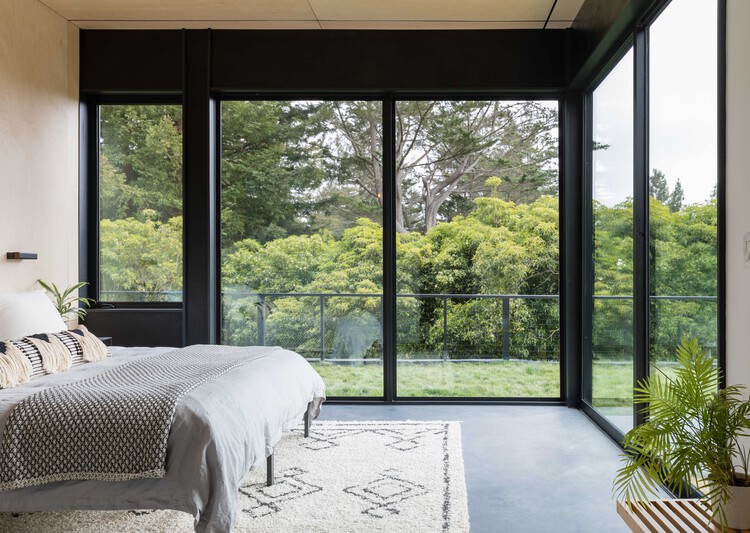
Can architecture shape comfort before mechanical systems enter the equation? As buildings account for nearly 40% of global energy consumption and people spend close to 90% of their time indoors, thermal performance has become one of architecture's most urgent concerns. Yet despite often being associated with insulation values, energy ratings, or mechanical systems, thermal performance begins with spatial decisions made long before technical equipment is introduced. Orientation, airflow, daylight, and the placement of openings all influence how a building absorbs, retains, and releases heat throughout the day.
Thermal performance is not only about reducing energy demand but also about maintaining comfortable indoor conditions in response to climate. Closely tied to thermal comfort—the way occupants experience temperature, airflow, humidity, and radiant heat—it influences health, well-being, and productivity as much as it does operational efficiency. Research suggests that healthy indoor environments can improve learning ability and productivity by up to 15%, reinforcing the growing relationship among environmental performance, resilience, and space quality.
Covering a broad array of subjects, this week's headline stories have reflected the wide scope of architecture's practice: its potential to respond to the climate crisis, the construction and renovation of cultural infrastructure around the world, and events that promote contemporary disciplinary reflection. This does not preclude questions about the contradiction between the technical and creative skills demanded by the discipline and the role it has come to occupy in today's market. Alongside these reflections, this week we feature projects that reinforce architecture's cultural significance in preserving knowledge, hosting collective entertainment, and supporting new forms of living: a comic book museum in Taiwan, a membership club for families in London, and the renovation of a landmark stadium in Riyadh.
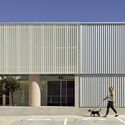
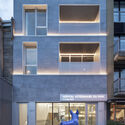
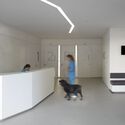
In 2025, the global animal health market was valued at approximately $70 billion, and projections suggest it could double by 2033. Behind this figure, however, lies a quieter transformation of the built environment, exemplified by the veterinary hospital. A building type that for decades occupied the back rooms of improvised clinics and pet shops is increasingly developing its own architectural language and identity. It is the spatial consolidation of a bond that has endured for more than 15,000 years.
Between the moment a material is specified in a project and the moment it is installed, there is an invisible layer that plays a decisive role in the final outcome: fabrication, logistics, and coordination. These factors shape timelines and costs, but more critically, determine whether the original design intent is preserved or diluted in execution. Cladding systems, especially those that function as visible and expressive components of the building envelope, make this gap particularly evident, as they are the most outward-facing layer of a project.
Selecting a cladding system is never a purely aesthetic decision. It activates a chain of dependencies: profile availability, fixing systems, tolerances, sequencing, and compliance with local codes. When elements are misaligned, the fallout is rarely subtle. Integrated cladding systems—those that anticipate assembly as much as appearance—tend to close this gap, embedding coordination into their logic and reducing the need for on-site improvisation.
What architecture leaves in the ground outlasts what it puts in the air. A demolished building disappears from the skyline in a matter of days, but its foundations remain embedded in the soil for generations. The contamination caused by an industrial complex does not clear when the complex is torn down. The legal boundaries inscribed across colonial territory do not dissolve when the colonial administration ends. The ground holds what architecture quickly forgets.
This is what makes soil so uncomfortable as a subject. The discipline tends to orient itself upward, toward the form, the façade, the spatial experience of inhabitation. The ground is where architecture begins and, in a certain sense, where it ends: the point at which building becomes geology, legal title becomes territorial claim, and construction becomes extraction. Treating soil as a medium rather than a datum means acknowledging that the acts of building carry consequences that run deeper than the visible object above grade.
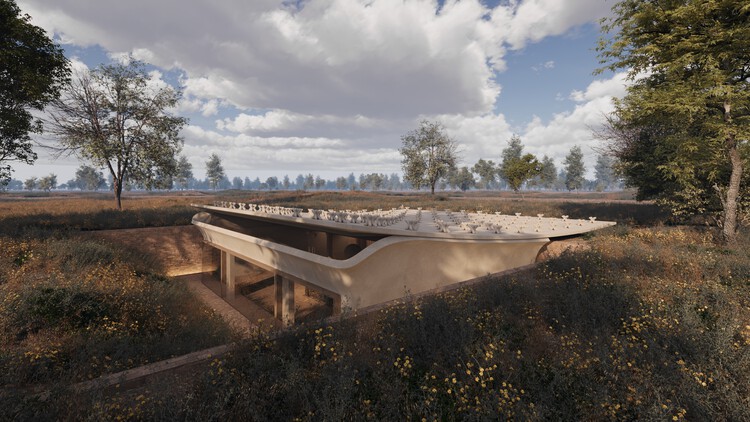
Buildner has announced the results of its Museum of Emotions Competition Edition 7. The Museum of Emotions is an annual international design competition that tasks participants to explore the extent to which architecture can be used as a tool to evoke emotion.
The brief calls for the design of a conceptual museum with two exhibition halls: one designed to induce negative emotions; the other designed to induce positive emotions. Participants are free to choose any site of their liking, real or imaginary, as well as choose the scale of the project. The meaning of 'positive' and 'negative' is up for interpretation: What two emotions might a designer consider contrasting? How might an architect conceive spaces which elicit fear, anger, anxiety, love or happiness?
Moving from the drafting table to the computer screen, the digitization of drawings and documentation marked the first phase of digital transformation in architecture firms. The second introduced BIM, connecting project information through cloud platforms and collaborative workflows. Nowadays, a new phase is emerging, defined by artificial intelligence, automation, and more specialized software ecosystems. The paradox is that while previous phases were dominated by a small number of tools, today's landscape offers an abundance of highly specialized, AI-enabled, and often overlapping solutions competing for attention. While purchasing new software is often the easiest part of digital transformation, the greater challenge lies in changing established workflows and behaviors, which is why many new tools struggle to achieve lasting adoption.
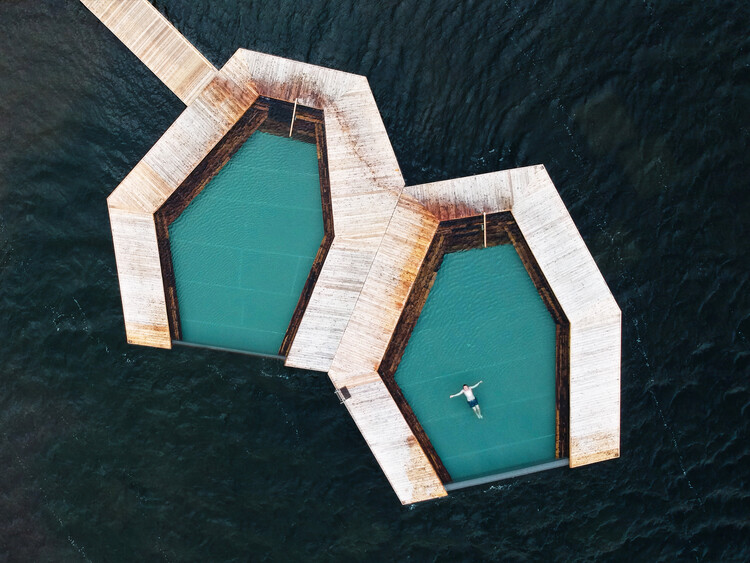
The Icelandic Pavilion at the 20th International Architecture Exhibition – La Biennale di Venezia will present SOAK: Rituals of Collective Belonging, an exhibition examining Iceland's bathing culture through the lens of architecture, public space, and social interaction. Commissioned by Halla Helgadóttir, Iceland Design and Architecture, the project is curated by Marcos Zotes, partner at Basalt Architects, and developed through a multidisciplinary collaboration between Basalt Architects, design studio Gagarin, and artist Rán Flygenring. SOAK marks the second Icelandic participation in the Architecture Biennale selected through an open call process, following Lavaforming by s.ap architects, which represented Iceland at the 2025 edition.
The Palace of Congresses renovation project. Terrace staircase render. Image Courtesy of Herzog & de Meuron
On June 3, 2026, Herzog & de Meuron was selected to revitalize the Palace of Congresses building in Tirana, Albania. The project was designed along with collaborators Julian Beqiri, Marsela Demaj, Michel Desvigne Paysagistes (MDP), ARUP, LDK, Gentian Shkurti, SUEB Industries sh.p.k., The Space Factory Ltd, MBBM, and KLAR sh.p.k. The Palace of Congresses (or Pallati i Kongreseve) was built during the People's Socialist Republic of Albania and opened in 1986 to host the Congresses of the Party of Labour of Albania and other official activities. The International Competition for the Redevelopment of the Palace of Congresses, carried out by the Albanian government, called for a comprehensive transformation of the building while preserving its historical identity. The project should address serious infrastructural issues and bring the Palace to contemporary standards in terms of technology, functionality, and quality of spaces.
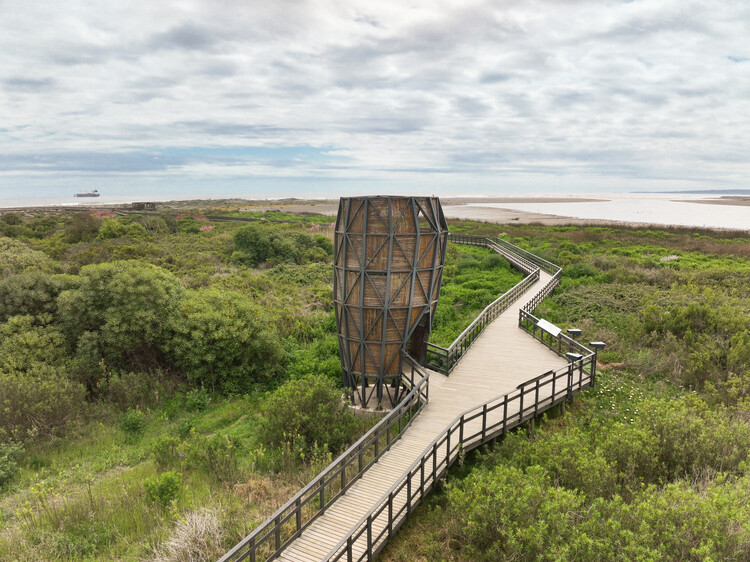
Siete Colores Observation Tower. Image Courtesy of Fundación Cosmos
How can architectural design become an active tool for conservation? By considering nature as an inexhaustible source of inspiration, a harmonious connection with it frames the countless interrelationships that exist among humans, living organisms, and natural cycles. Designing with the landscape means learning to coexist with its temporal dynamics without controlling its processes. Traditions, ecology, and the past and present of a place all contribute to creating spaces that interpret their communities. Landscape architecture can draw inspiration from birds, plants, and other natural elements to shape the complex, dynamic network of ecosystems and human activities that make up the environment.
What makes a home resilient? Extreme weather events are becoming increasingly frequent around the world. From power outages, hurricanes, and earthquakes to wildfires, floods, and droughts, the world is experiencing a process of transformation and adaptation that requires collaboration among diverse disciplines. The role of architecture in the built environment reflects an opportunity to rethink how homes perform under changing environmental conditions—not only by anticipating the unexpected. Designing for resilience means thinking holistically, considering material choices, energy systems, landscaping, and construction details that anticipate disruption and help homes recover quickly. It involves creating architecture that evolves with the environment, is worth preserving, and endures for years and generations.
Architects are accustomed to being credited for buildings long after construction ends. Names remain attached to projects through photographs, publications, and histories, often decades after the original drawings were produced. Buildings, on the other hand, rarely remain faithful to that narrative for long. Families grow, technologies change, businesses emerge, and daily life introduces demands that no plan can fully anticipate. Over time, architecture accumulates modifications, repairs, additions, and improvisations that gradually distance it from its original form.
Architectural schools usually leave lasting marks on their students, shaping their style and critical inquiry long after formal education has ended. For example, SCI-Arc, founded in 1972 and based in downtown Los Angeles, is an institution recognized for its culture of experimentation, critical investigation, and creative independence, building a reputation based on the idea that architecture should be understood as a field open to dialogue with art, technology, design, and contemporary culture. The diversity of trajectories of its alumni demonstrates how this environment can generate distinct professional approaches, but united by the same willingness to explore new possibilities.
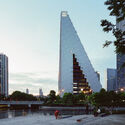
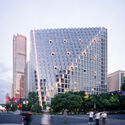
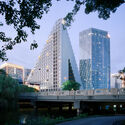
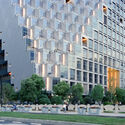
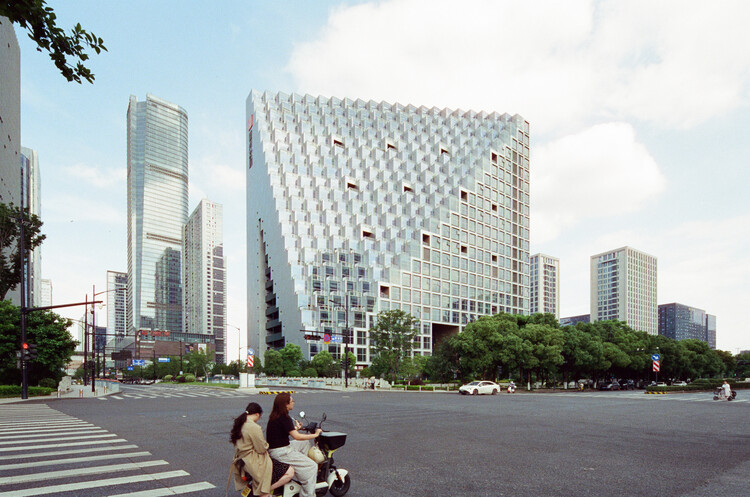
OMA has completed the Hangzhou Prism, a large-scale mixed-use development in Hangzhou's Future Tech City district, China, following a design and development process that began in 2016. Commissioned by Xinhu Real Estate Group and led by OMA Partner Chris van Duijn, with Michael Hadjistyllis serving as project architect, the project combines residential units, a hotel, offices, commercial spaces, and public amenities within a single building volume. Marking OMA's first completed project in Hangzhou, the development occupies a central site within one of the city's emerging innovation and business districts.
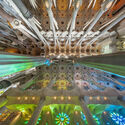
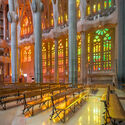
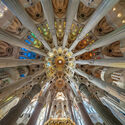
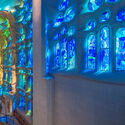
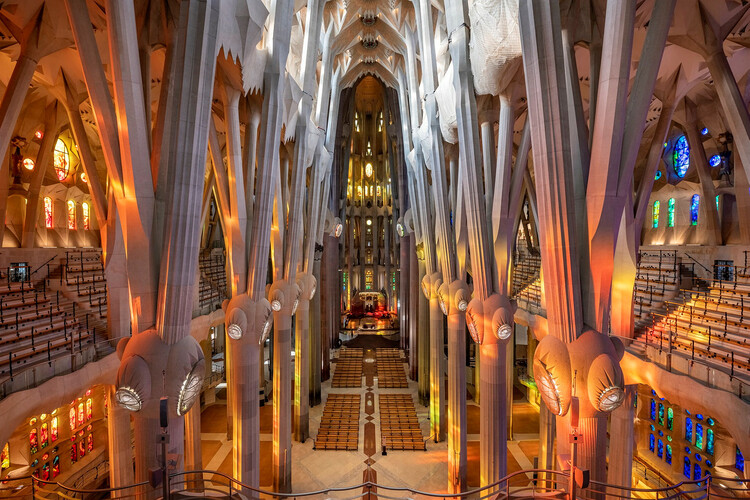
It is afternoon in the summer, and the nave of the Sagrada Família is saturated with warm colors. Shafts of amber and crimson sweep across the stone floor, shift as a cloud passes over Barcelona, then deepen again. Around you, visitors slow without quite realizing it. Some raise their phones — not to capture the architecture, but to step into the light itself, positioning themselves in a pool of orange or gold as if the colours were something you could wear.
They are, without knowing it, doing exactly what Gaudí intended: surrendering, however briefly, to the sensation of being bathed in something larger than themselves.
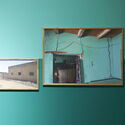
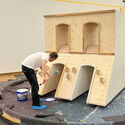
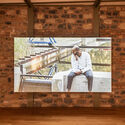
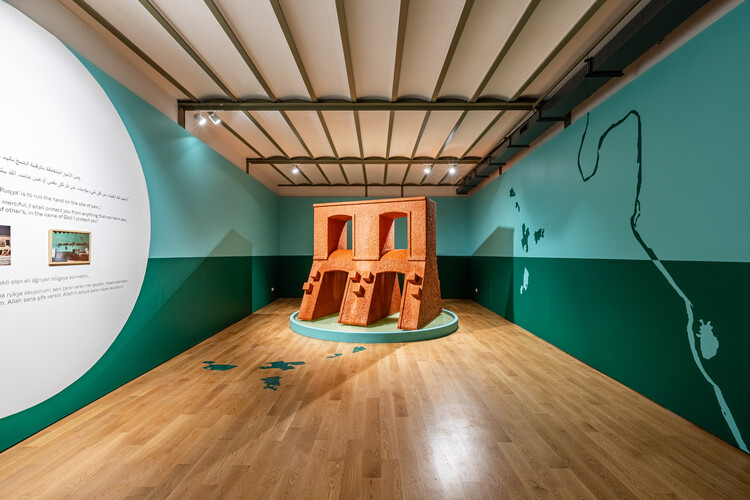
Tell the Water What the Clay Kept Secret. Image Courtesy of Ola Hassanain
Ola Hassanain is a Sudanese architect and artist operating in the Netherlands, and will be exhibiting at the Pan-African Architecture Biennale in Nairobi, Kenya, later in 2026. All three locations tell stories of the built environment's relationship with water. These illustrate the continuous battles between the amorphous forces of nature that are the rivers and seas, and human attempts to shape and control them. In most cases, they are attempts at extraction. Catastrophes happen as a result of the overreach of these attempts or of their mismanagement, or both.
As the technical requirements of building envelopes have evolved, fire performance has become a key criterion in the design of ventilated facades. Given this situation, analyses no longer focus solely on the individual reaction of materials, but also on the joint response of the entire building envelope under possible scenarios of external fire propagation.
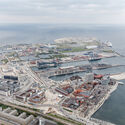
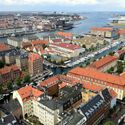
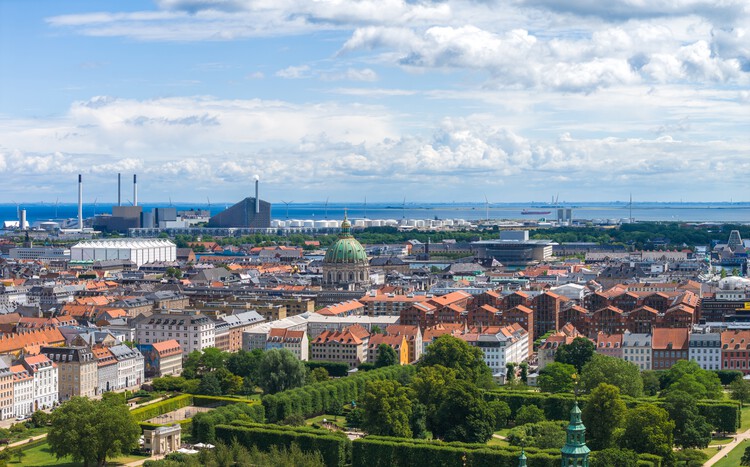
From June 10-12, 2026, 3daysofdesign returns to Copenhagen with a city-wide program of exhibitions, installations, talks, and showroom presentations organized around the theme "Make This Moment Matter." Taking place across eight Design Districts throughout the Danish capital, this year's festival brings together design brands, cultural institutions, studios, and practitioners to explore contemporary questions shaping design and the built environment. As part of the program, Cobe and ArchDaily will host the public launch of a guest-edited edition of Cobe Notes, under the theme Thresholds, at the Cobe Bookcafé, Nordhavn on June 10.
Australian artist, director, and BAFTA-nominated producer Liam Young creates imaginary worlds as a way of thinking through the futures we fear, desire, and are already making. As a creator and designer of atmospheres, he proposes speculative landscapes reflecting the possibilities of a world to come, whether ideal or truthfully unsettling. In his worldbuilding practice across the film, television, and video game industries, fiction becomes a tool for navigating the environmental urgencies of the present. He is considered a "futurist" working across design strategies, technological scenarios, and collective imaginations, grounded in his academic research yet reaching a wider audience in exhibitions such as "In Other Worlds" at the Barbican Centre in London and "Age of Nature" at the Danish Architecture Center in Copenhagen. In February 2026, he was interviewed by Marc-Christoph Wagner for Louisiana Channel, where he shares his visions of our future: from architecture consolidating as a boutique industry to the need for a new kind of planetary punk at the scale of the climate crisis.