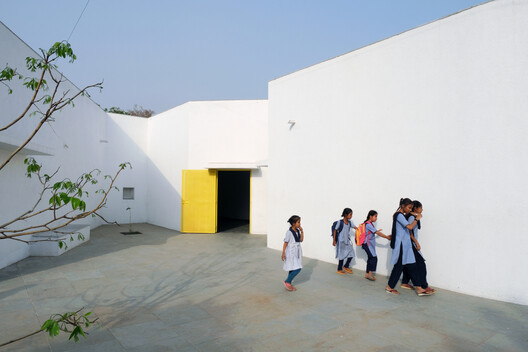
Founded in 2015 in Ahmedabad by Anand Sonecha, SEAlab is a practice shaped by a slow, contemplative engagement with place, proportion, and participation. Recognized as one of the winners of the ArchDaily 2025 Next Practices Awards, the studio builds with simple materials and local techniques, pursuing environments that are experienced as much as they are seen. This ethos became particularly tangible in Gandhinagar, where the School for Blind and Visually Impaired Children did not begin as a purpose-built institution. The school had been operating from an existing primary school building, with classrooms stacked above dormitories and twelve children sharing a single room. Space was limited, and so were growth opportunities. The new academic building was required to expand capacity, improve living conditions, and support greater student independence.
When SEAlab took on the project, it began with a question about perception: how spatial knowledge is formed when vision is partial or absent. "We were confronted with a fundamental question: How do we design a school for users who do not primarily depend on vision, and who experience the world in their own unique way?" recalls Anand Sonecha. The studio had no prior expertise in designing for visually impaired users, which meant the process began not with formal proposals, but with time spent on site, observing how students moved, paused, gathered, and navigated the existing campus.

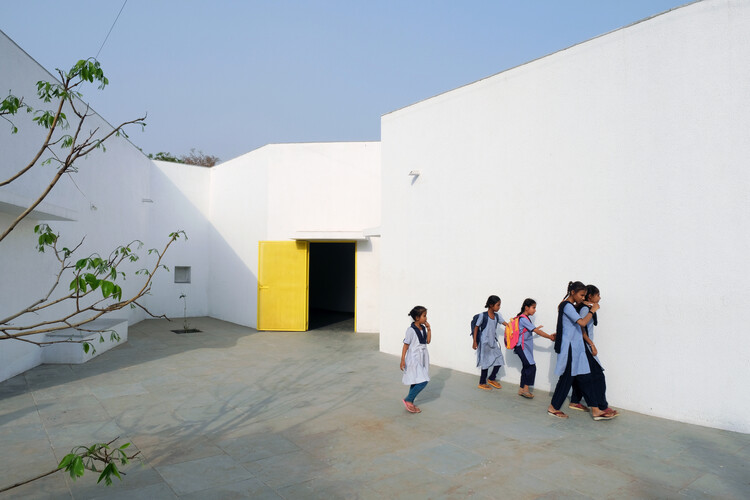
Those observations shaped the plan of the new building. Located to the west of the original structure, the 750 m² academic block houses ten classrooms of five different types arranged around a central courtyard. The geometry is deliberately simple: a contained plaza circled by a corridor, with classrooms plugged into it as smaller cells. This typology allows students to construct a mental map anchored by a consistent spatial center. The courtyard operates as the building's spatial anchor, allowing movement to recalibrate around a constant center. From any classroom or corridor segment, one can return to this shared void, a fixed reference point in daily movement.
Related Article
20 Practices Shaping the Future of Architecture: Winners of the ArchDaily 2025 Next Practices AwardsYet legibility is not achieved through plan alone. The corridor subtly changes in width and height as one moves through it, producing distinct acoustic conditions. At the entrance, it measures 3.66 meters in height and width; deeper inside, the roof slopes down, compressing the passage to 2.26 meters in height and 1.83 meters in width. The resulting shift in echo allows students to identify their location through sound. As Sonecha explains, the team began "exploring alternative ways of perceiving and navigating space," considering hearing, touch, smell, and residual vision as equally valid spatial tools.


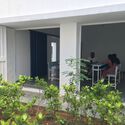
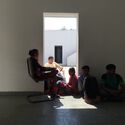
Light, in this context, required particular care. Many students have low vision and are sensitive to glare. Direct sunlight can cause discomfort, so each classroom is connected to a private courtyard planted with trees and aromatic vegetation. Daylight enters indirectly, filtered before reaching the interior. In the so-called "special classrooms," roof skylights introduce controlled light from above, marking entrances with a subtle flare of brightness. Doors, furniture, and switchboards are painted in contrasting colors to assist those who can perceive tonal differences. Each gesture is calibrated, down to the degree of glare and the degree of tonal contrast. "Even small gestures, through sound, texture, scale, or material, can make spaces more inclusive, legible, and comfortable for different users," Sonecha reflects.
Touch operates at an equally fundamental level. The flooring throughout the building is Kota stone, but its finish varies. Rough stone marks the entrance to each classroom, while circulation areas remain smooth. Since some students walk barefoot and many do not use canes, the surface had to be identifiable without being abrasive. Walls, too, become navigational devices. Five distinct plaster textures differentiate spatial zones: horizontal grooves along the longer corridor walls, vertical ones on the shorter sides, and semi-circular textures facing the courtyard. These textures were developed through mock-ups tested by students of different ages, ensuring they were legible to children between six and eighteen years old. Here, precision determines whether a surface guides confidently or causes hesitation. The scale of a groove or the roughness of a surface could determine comfort or confusion.


The landscape extends this multisensory logic. More than 1,000 shrubs, plants, and trees across 37 species populate the campus. Aromatic vegetation near classrooms provides olfactory cues that aid orientation while simultaneously offering shade in Gujarat's hot climate. Environmental strategies are woven into the sensory framework: a traditional Khambhati Kuva, a 10-foot-diameter, 30-foot-deep percolation well, harvests rainwater and recharges groundwater, absorbing up to 60,000 liters per hour. The building itself was designed to be incremental, capable of expanding in phases as funding permits. Rainwater harvesting, phased construction, and planting density are integrated into the campus layout and long-term growth strategy.
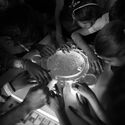
Participation shaped these decisions from the outset. Initial cardboard models proved insufficient for communicating interior spatial complexity, prompting the team to develop tactile drawings and 3D-printed models coded with textures and Braille markings. These tools allowed students and teachers to physically engage with the proposal and provide meaningful feedback. "Architectural authorship and user participation were not separate or opposing positions," Sonecha notes. Instead, they formed "a fluid and intertwined process, not always a frictionless one, in which user insights continuously shaped the work".


Before construction, a full-scale layout was marked on site so trustees, professors, and students could walk through the spaces. During construction, texture samples were tested by the students themselves. The building's clarity is therefore the product of dialogue rather than unilateral authorship.
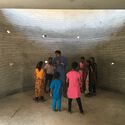
After occupation in 2021, the school began to reveal behaviors that drawings could not predict. In winter, students gather in the central courtyard to sit in the sun, and teachers conduct storytelling sessions at the threshold between the corridor and courtyard, where warmth and enclosure meet. A circular seating element in the garden, almost eliminated during design, has become one of the most cherished spaces. Slightly offset from the corridor and shaded by a Champa tree, it allows small groups to converse intimately while remaining acoustically connected to nearby activity. Such moments reinforced for the architects that success cannot be declared at completion. "It is only over time, through how people inhabit it, how it ages, and how it continues to serve its users, that we begin to understand whether it has truly worked," Sonecha reflects.

Ultimately, the project challenges architecture's habitual reliance on the eye without turning the critique into abstraction. It does so through measurable dimensions, tested textures, calibrated light, and planted courtyards. In Gandhinagar, the school proposes that spatial dignity here emerges from legible circulation, controlled acoustics, tactile distinction, and autonomous movement. As Sonecha concludes, "A building should be beautiful whether it is seen or unseen, because beauty is not only seen, but felt".

This article is presented by Buildner. As sponsor of ArchDaily's 2025 Next Practices Awards, Buildner—the world's leading architecture competition organizer—helps architects get what they enter competitions for: recognition, opportunity, and progress.
Exercise your creativity now: the Buildner UNBUILT Award 2026 is open to all, with a €100,000 prize fund. Submit your unrealized designs and celebrate your creativity now