By exploring the art of robotics in construction, advances in architectural technologies are increasingly shaping multiple aspects of human life. From robotic arms and drones to robots that move across large surfaces and even 3D printing robots, their use in construction is accelerating research and the development of new working methods, as well as structural and material experimentation. In collaboration with multiple disciplines and spanning various facets of architecture, the role of robots in the contemporary landscape demonstrates a potential that extends beyond merely automating processes or reducing construction times and costs. This raises the question: Are we building architecture to serve technology, or technology to serve architecture?

When viewed through the lens of performance, precision, and efficiency, robotic technology is often associated with reducing costs, timelines, and production processes. According to the International Federation of Robotics (IFR), an industrial robot is defined as "an automatically controlled, reprogrammable, multipurpose manipulator, programmable in three or more axes, which can be either fixed in place or fixed to a mobile platform for use in automation applications in an industrial environment." Based on their autonomy, industrial robots can be classified into different types, ranging from fixed or variable sequence robots to playback and numerical control robots, among others.
In the field of architecture, many modern robots are designed to address challenges related to construction and on-site fabrication. By rethinking traditional construction methods and introducing new manufacturing techniques, robots can handle masonry and paving tasks that are highly repetitive. In addition, the use of robots can enhance operator safety by assisting with demolition work, operating underground in confined spaces, and performing other tasks. As Alexander Dubor states, "Robots and humans will work together," strengthening human–machine interaction to create futures adapted to each specific context and workflow.
Related Article
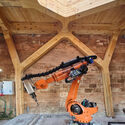
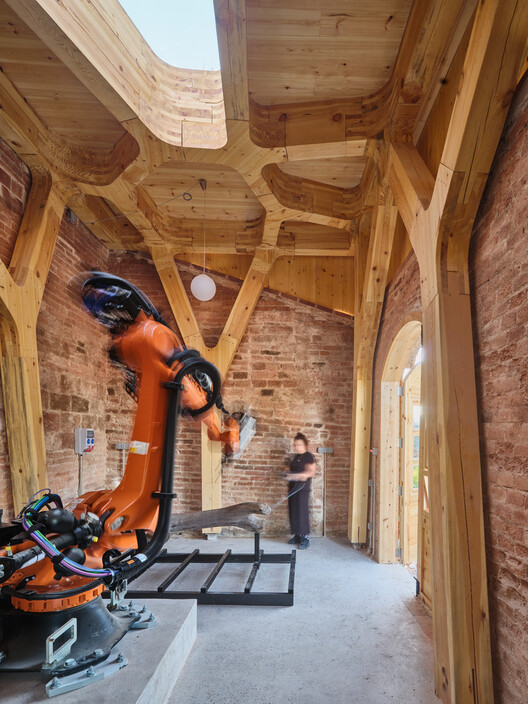
Will Robots Ever Replace Architects? Why Designs of the Future Won't Ever be Fully AutomatedBut can technology adapt to a space, or should the space adapt to the technology? Depending on the priorities and needs of each project, there are cases such as CORA Installation, developed by an international team of students from the Institute of Advanced Architecture of Catalonia (IAAC), that are conceived with the aim of serving a specific technology. Named the Cathedral of Robotic Artisans, the students designed and built a fully functional laboratory for a KUKA industrial robot—a versatile tool capable of milling, cutting wood, and performing other precision tasks. Honoring both craftsmanship and technology, the project created a space dedicated to housing and operating this six-axis industrial milling robot, incorporating the necessary spaces, services, and infrastructures to support robotic operations and human interaction.
However, robotics in architecture is also demonstrating a shift in the traditional way of building, with applications that extend beyond masonry to include assembly and installation, welding and cutting, casting, demolition, and more. Material manipulation and experimentation are opening the door to new ways of reducing on-site waste and minimizing the amount of debris generated, while also incorporating innovations such as 3D printing to create faster, more cost-effective solutions without formal limitations. Below, explore a series of contemporary projects that combine technology and material experimentation in architectural structures.
Moss
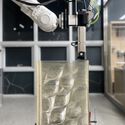
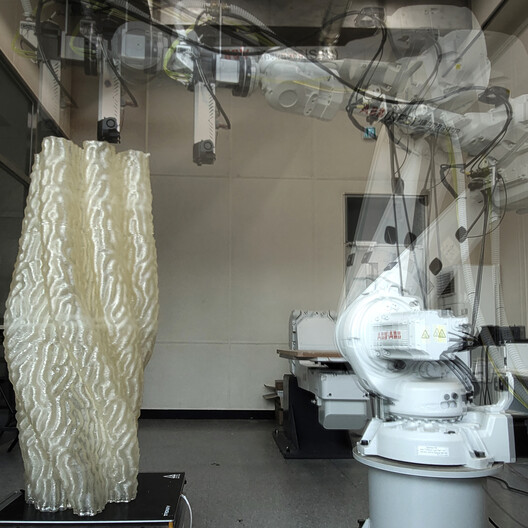
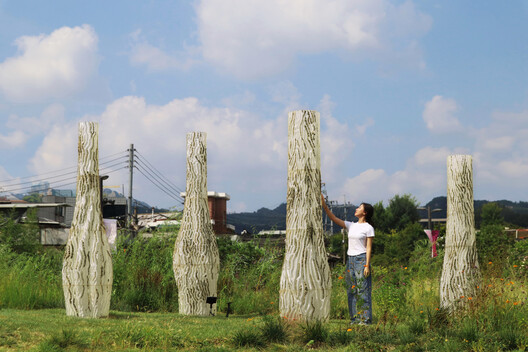
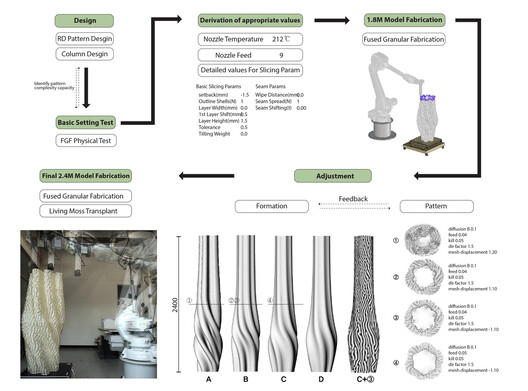
Through its Moss Columns project, Yong Ju Lee Architecture explores how living organisms can be integrated with architecture. Chosen as the primary plant for these experiments, moss carries a non-vascular nature—meaning it does not grow tall like other plants and uses its roots only for anchoring rather than nourishment. In this way, geometry is manipulated and generated through computational design tools, while advanced construction technology supports the creation of complex forms. Using a large-scale 3D printer equipped with an industrial robotic arm, an overall vertical form is produced in which the moss merges with the structure. The project employs Fused Granulate Fabrication (FGF), which utilizes an extruder mounted at the end of a six-axis robotic arm with a 2 mm nozzle for PLA pellets. This vertically stacking fabrication process becomes a design constraint, influencing the development of a customized workflow.
Mycelium
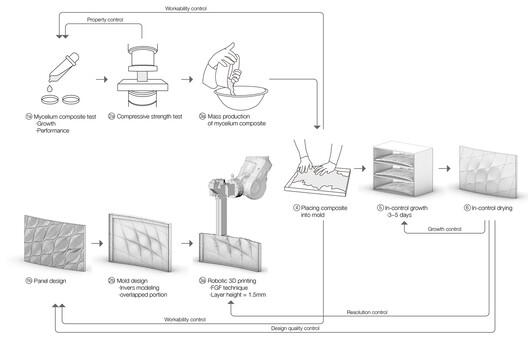
By experimenting and working with mycelium, Mycelial Hut Pavilion reinterprets the concept of eco-friendly architecture and explores the potential of bio-integrated fabrication methods that align growth, decay, and design within a single process. Through custom molds produced using robotic 3D printing, industrial robotic arms were combined to integrate digital processes with natural growth systems. The project resulted in a structure that embodies the coexistence of computation and biology, demonstrating new possibilities for architecture.

Clay
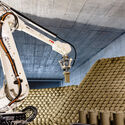
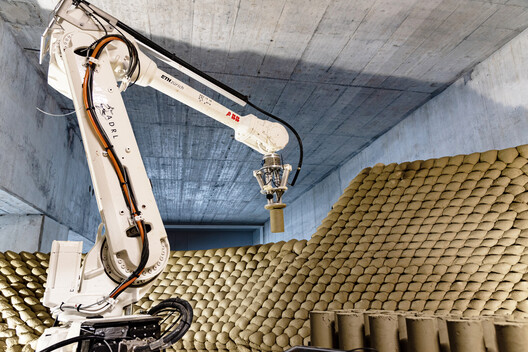
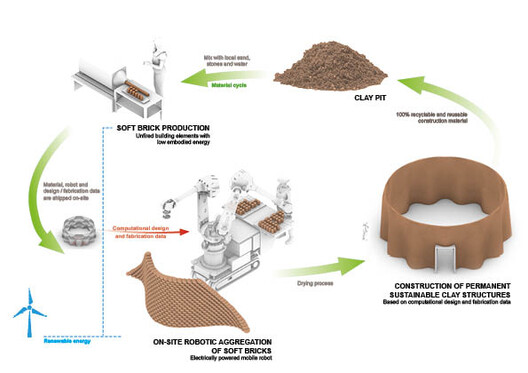
Clay Rotunda is a free-standing earth-based cylindrical structure that forms the soundproof enclosure of the SE MusicLab, a music auditorium built inside the Gurten Brewery in Bern. By combining clay with computational design techniques, Gramazio Kohler Research constructed the structure on site using a mobile robotic system that assembled more than 30,000 soft clay bricks over the course of 50 days. The computational model that controls its geometry was developed by considering the engineers' structural models, the material properties of the clay, and the sequence of the construction process. The limited reach of the robotic arm, along with the material's shrinkage during drying, required the implementation of specific strategies for horizontally and vertically segmenting the structure into matching trapezoidal units. As a result, the computational model became essential for carrying out the robotic process, containing all the fabrication data needed to create a structure precisely adapted to its geometry.
Concrete
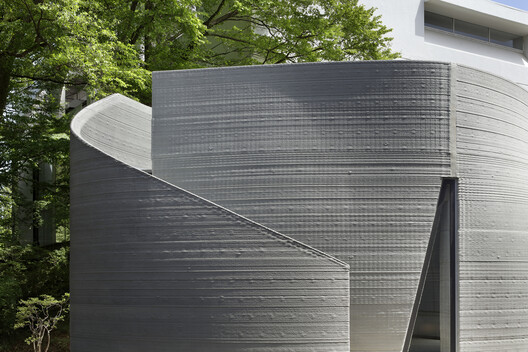
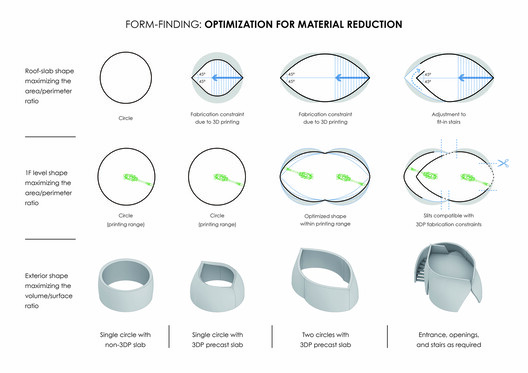
Obayashi, one of Japan's largest general contractors, developed 3dpod, an earthquake-proof 3D-printed installation in Tokyo. To evaluate the durability and structural and environmental performance of 3D printing—while also promoting its technological advancement—3dpod was printed using a special mortar that serves as both the interior and exterior finished surface, as well as the framework for the load-bearing structure made of high-strength, steel fiber–reinforced concrete known as "SLIM-Crete®." A robotic printer was installed on-site to print the mortar formwork directly onto the foundations. The roof slab formwork was printed as a prefabricated element at a nearby facility, then placed on top of the walls and filled with SLIM-Crete®, creating a shell structure.
Wood
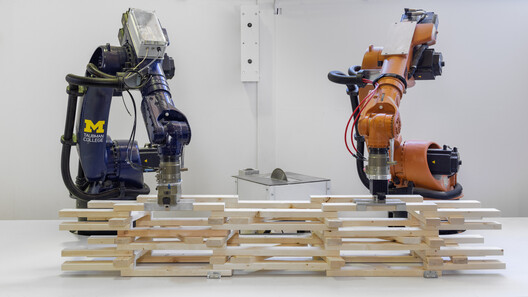
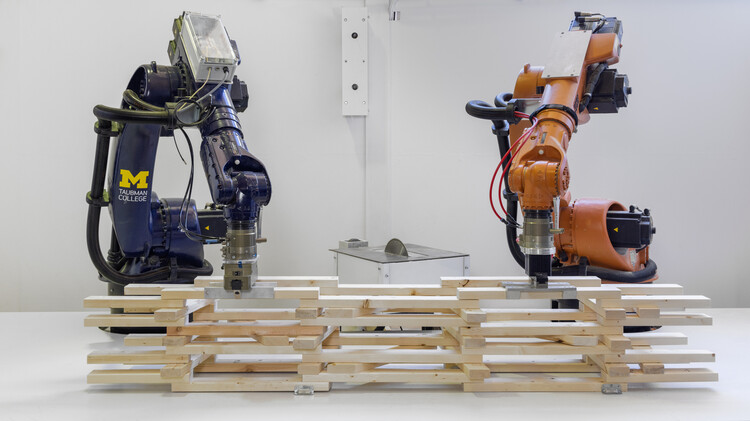
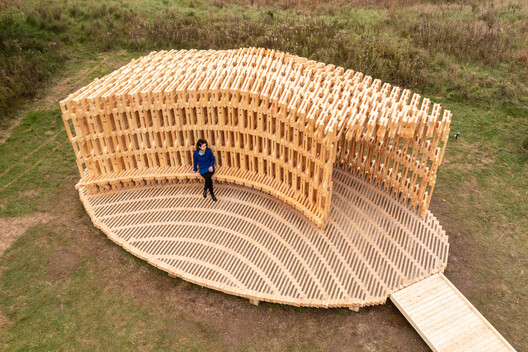
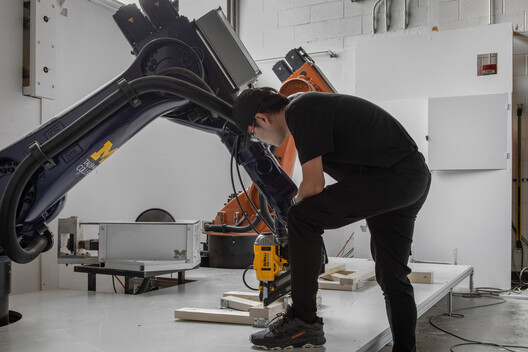
The wooden pavilion Robotically Fabricated Structure was robotically constructed to explore responsible and precise methods that contribute to sustainable, low-carbon building practices. Through the use of custom algorithms and collaborative human–robot construction technology, the structure was designed using industrial robotic arms to process and assemble elements into intricately layered modules. Designed and fabricated by the ADR Laboratory, research assistants, and students of the University of Michigan's Taubman College MS in Digital and Material Technologies program, the combination of custom algorithms and robotic fabrication enabled the production of bespoke building components. The integrated digital design and construction process reconsidered the use of materials, labor, and environmental impact, supporting an architectural approach that advances research into collaborative human–robot construction beyond the laboratory setting.
Just as 3D printing will not replace traditional architectural construction, robots will not replace the work of architects. In the midst of an ongoing debate shaped by differing perspectives, recognizing the added value of new technologies in the construction industry highlights the opportunity to optimize creative, production, and building processes. By fostering sustainability, experimentation with new materials, and collaboration across disciplines, the growing influence of the technosphere on the built environment challenges the limits of architecture, expanding the conversation about how to inhabit a planet in constant evolution and transformation.
This article is part of the ArchDaily Topic: The Technosphere: Architecture at the Intersection of Technology, Ecology, and Planetary Systems. Every month we explore a topic in-depth through articles, interviews, news, and architecture projects. We invite you to learn more about our ArchDaily Topics. And, as always, at ArchDaily we welcome the contributions of our readers; if you want to submit an article or project, contact us.


