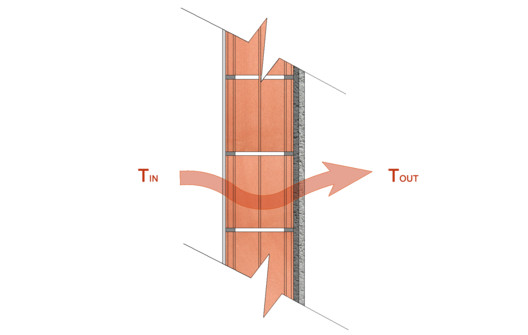
Much more than merely as a protective skin, the building envelope functions as a thermal regulator that influences operational energy demand, indoor comfort, and long-term efficiency. And before renewable systems or mechanical strategies are introduced, performance begins in section. The way walls, roofs, windows and floors are layered determines how much heat is lost in winter, gained in summer, and ultimately how much energy a building consumes. At the center of this evaluation lies a fundamental metric: the thermal transmittance, or U-value. Understanding how to calculate it is essential for assessing whether an envelope conserves energy or allows it to escape.
Conceptually, thermal transmittance relates heat flow to both surface area and temperature difference. It expresses how much energy crosses one square meter of envelope for each degree of thermal gradient between its two faces.
If we divide 1 m2 of our envelope by the temperature difference between its faces, we will obtain a value that corresponds to the thermal transmittance, also called U-Value. This value tells us a building's level of thermal insulation in relation to the percentage of energy that passes through it; if the resulting number is low we will have a well-isolated surface and, on the contrary, a high number alerts us of a thermally deficient surface.
Expressed in W/m²·K, the U-Value depends on the thermal resistance of each of the elements that make up the surface (the percentage in which a building element is opposed to the passage of heat), and this, in particular, obeys the thickness of each layer and its thermal conductivity (ability to conduct the heat of each material). Let's review the formulas necessary to calculate the thermal transmittance of our envelope.