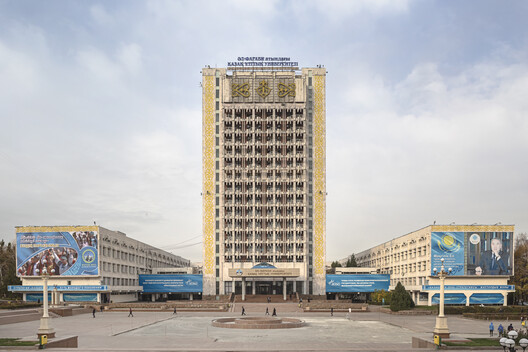
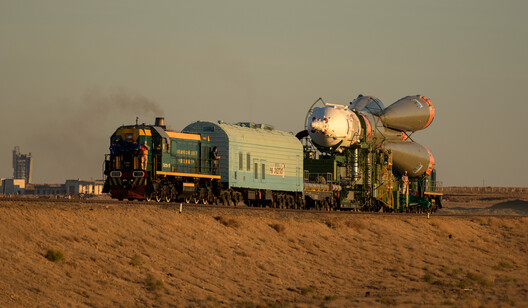
Practically every history book records 1961 as the year man first reached space, an achievement that placed the Soviet Union at the center of the space race. What not everyone knows is that Yuri Gagarin's journey began in a seemingly unlikely place, more precisely in Kazakhstan. From the Baikonur Cosmodrome, Gagarin set off beyond Earth, inaugurating not only a new era of space exploration but also a history of technology and ambition that would transform this landscape.
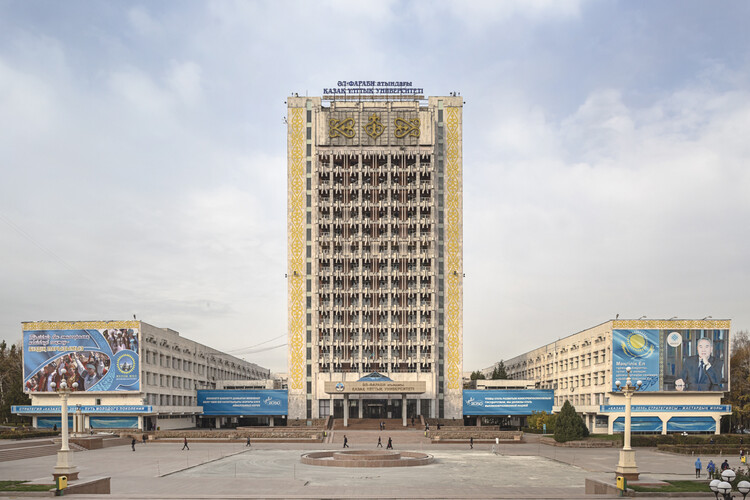
At the time, Kazakhstan was one of the republics that made up the Soviet Union and occupied a strategic position at its southern edge, stretching across a vast area between Europe and Asia. Its territorial size and low population density made the region particularly important for large Soviet projects, which found there extensive areas available for military, industrial, and scientific facilities. The Baikonur Cosmodrome itself became virtually a planned city built in the desert.
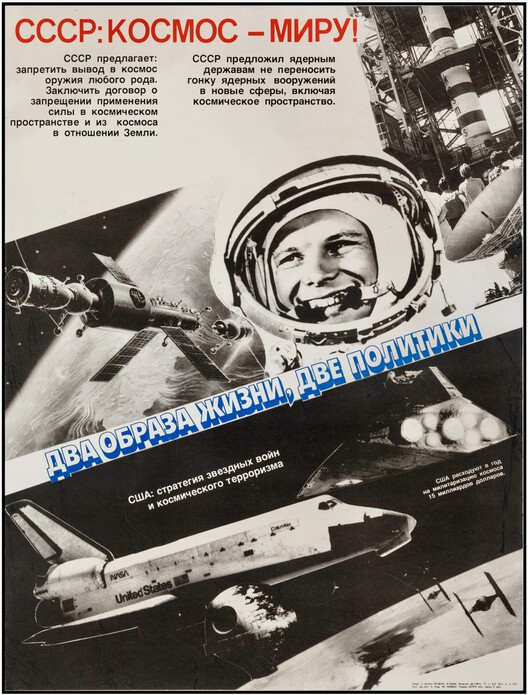
The transformation of this territory, however, was part of a much broader project. It was about constructing — and selling to the world — a particular idea of the future, conceived by the Soviet regime around the ideals of a modern socialist society. This vision of the future found expression in different spheres, including architecture.
Buildings, monuments, and spacecraft, through their monumentality, each contributed in their own way to constructing this image; if the Soviet state was capable of sending a man into space and erecting grandiose structures, it was also capable of commanding the world around it.
Architecture and the Imaginary of the Future
But, within architecture, what exactly did this future that the Soviet Union sought to project mean? It was not simply about imagining what cities or technologies might look like in the decades to come, but about creating the sense that a new era was already beginning, and that it would belong to the USSR.
It is within this imaginary that architecture takes on a particular role. Futurism emerges in iconic volumes that break with tradition, large-scale structures, and avant-garde construction solutions. This language also finds an interesting parallel in space exploration. Domes, circular volumes, monumental structures, and unconventional geometries can, when viewed today, evoke machines, spacecraft, or other elements associated with the conquest of space. This does not necessarily mean that these buildings were intended to represent rockets or flying saucers, but rather that they participated in the same imaginary of the future, in which formal boldness and technical capability signaled a society that sought to remain ahead of its own time.
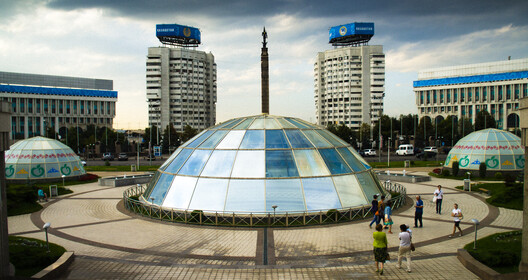
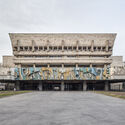
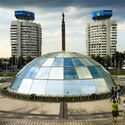
In Kazakhstan, this connection can be seen in buildings such as the Kazakh State Circus and Republic Square, both in Almaty, whose circular forms and domes may, to a contemporary eye, resemble objects that have landed on the city. At the same time, elements inspired by yurts, ornamental patterns, and references to Central Asian visual traditions coexisted with this radically modern-looking architecture. The result was a landscape in which different temporalities came together.
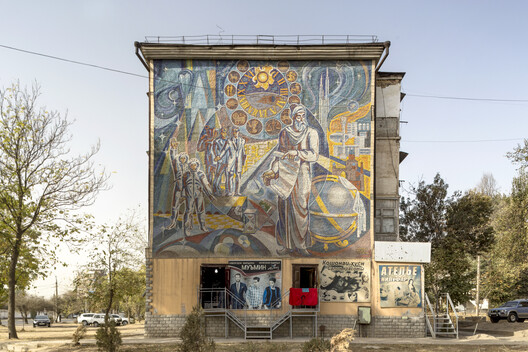
This combination was not exclusive to Kazakhstan. In different Soviet republics, space exploration became part of a broader visual repertoire, appearing in murals, monuments, and public buildings. A mosaic in the Tajik capital, Dushanbe, for example, depicts Avicenna, the great Persian philosopher, alongside Soviet cosmonauts, all contemplating the star-filled cosmos. This carefully constructed visual narrative was conceived to place national history within the context of a progressive socialist future.
Engineering and Futuristic Solutions
The futurism of Soviet architecture in Kazakhstan was not only expressed in its forms, but also in the technology behind them. Large-span structures, domes, reinforced concrete, and experimental construction systems made it possible to create buildings that, for their time, seemed to anticipate future architecture. Engineering itself became part of visual language; what had previously remained hidden within the structure was now revealed.
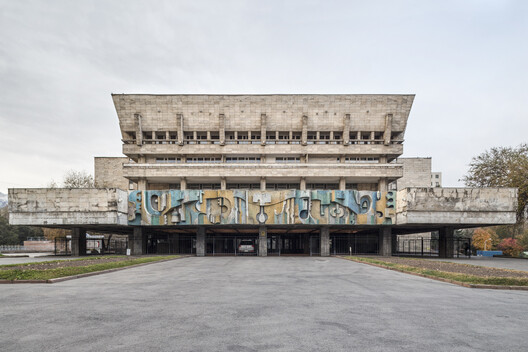
Seismic conditions, for example, led to important experimentation in Almaty. Rather than simply reproducing rigid urban models, architects and engineers had to develop structural systems capable of absorbing ground movements. Stepped towers, interconnected volumes, and more complex geometric configurations became part of the landscape.
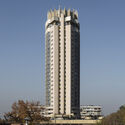
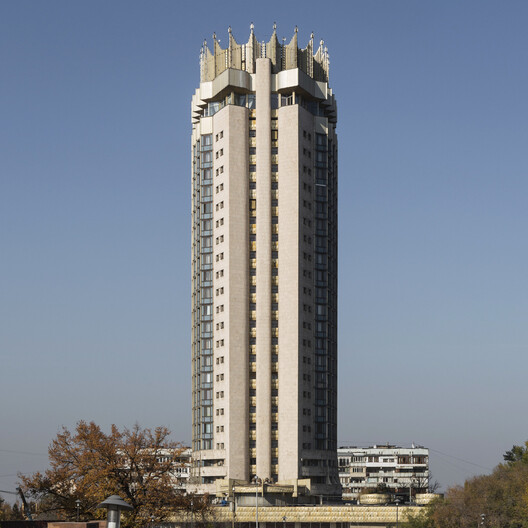
An emblematic example is the Hotel Kazakhstan, completed in 1977. Built in one of the city's most seismically active areas, the building uses a monolithic reinforced-concrete core and structural systems designed to increase its resistance. The very possibility of constructing a tower of this scale in a territory subject to strong seismic activity represented, at the time, a testament to the capabilities of Soviet engineering.
A Future That Remained
The end of the Soviet Union did not necessarily mean the end of this imagination of the future. In independent Kazakhstan, the idea of creating a landscape capable of representing modernity and progress remained present, but now under a different political and economic project. If, during the Soviet period, this vision was shaped by the socialist state, its architects, and its engineers, in the new Kazakhstan it would also be projected through major international firms and megaprojects capable of rapidly transforming the urban landscape.
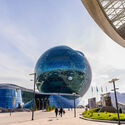
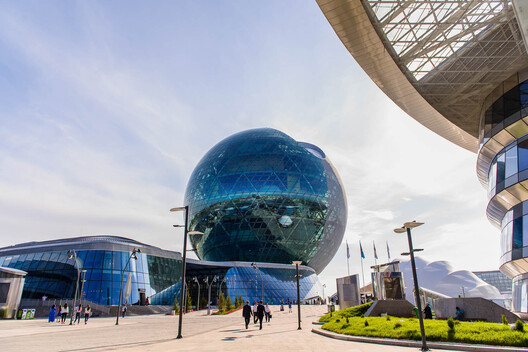
The relocation of the capital to Astana, beginning in 1997, became one of the clearest expressions of this vision. Within a few decades, the city had been transformed into a kind of architectural laboratory in the middle of the steppe, bringing together monumental buildings and deliberately extraordinary forms. Structures such as the Khan Shatyr, a gigantic translucent tent, and Nur Alem, the glass sphere built for Expo 2017, described as "reminiscent of space objects," revive characteristics that were already present in the Soviet architectural imagination, such as large scale and structural experimentation.
This shows that, even in a different political, economic, or technological context, the belief remains that an extraordinarily constructed landscape can function as a symbol of a country seeking to present itself as modern and technological, in a constant effort to anticipate the future.
This article is part of the ArchDaily Topic: The Lure of Escapism in Architecture and Alternative Worlds. Every month we explore a topic in-depth through articles, interviews, news, and architecture projects. We invite you to learn more about our ArchDaily Topics. And, as always, at ArchDaily we welcome the contributions of our readers; if you want to submit an article or project, contact us.


