
The National Council of Architectural Registration Boards (NCARB) has released the 2026 edition of its annual NCARB by the Numbers report, presenting data from 2025 on architectural licensure and demographics in the United States. The latest figures show a gradual increase in diversity among those pursuing licensure, while the demographic composition of the licensed architect population remains considerably less diverse than the current candidate pool. The report also examines attrition along the path to licensure, revealing differences in who ultimately reaches professional registration.



The number of licensed architects in the United States increased by 6% in 2025, recovering from the previous year's decline, while the number of candidates actively pursuing licensure fell by 1% to just over 39,000. Nearly 3,500 candidates completed the requirements to become architects, a 6% decrease from 2024. The average time to complete the path to licensure also fell to 12.3 years, approximately four months less than the previous year.
The path from architectural education to professional registration encompasses academic training, professional experience, and examinations, with each stage introducing different requirements and potential points of departure. Among individuals who started an NCARB Record in 2012, 46% had become licensed by 2025, while 17% were still actively pursuing licensure and 37% had stopped pursuing a license. Of those who became inactive, 39% left after completing either the Architectural Experience Program (AXP) or the Architect Registration Examination (ARE), while another 25% stopped after graduation but before beginning either program.

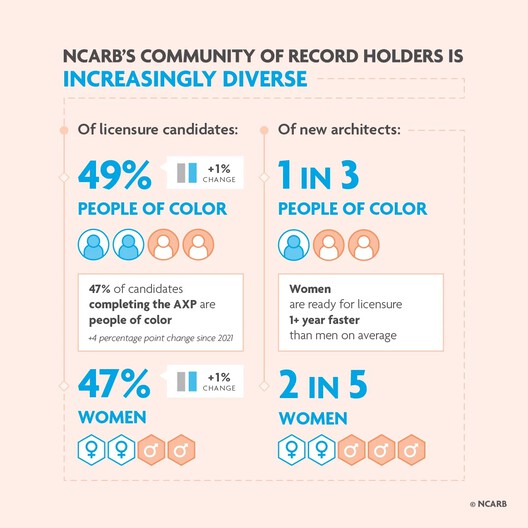
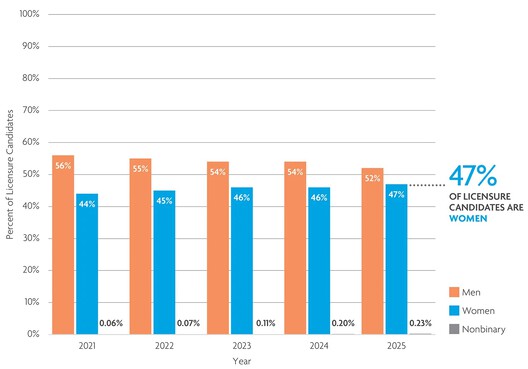
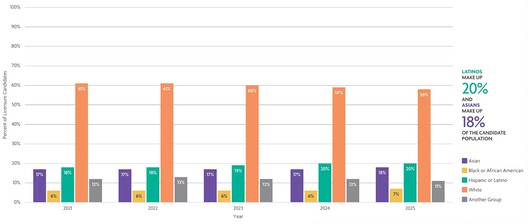
The demographic composition of the candidate population presents a notably different picture from that of the overall architect population. In 2025, 49% of licensure candidates identified as people of color, the highest level of racial and ethnic representation NCARB has recorded among candidates. Women represented 47% of the candidate population, while 53% of new NCARB Record holders were women, bringing the earliest stages of the pathway closer to gender parity.
By comparison, people of color represented 21% of the overall architect population in 2025, an increase of four percentage points over the past five years. Women accounted for 28% of architects, up one percentage point from 2024 and three percentage points from 2021. White men remained the largest demographic group, representing 60% of all U.S. architects, while white women accounted for 21%. The difference between the candidate and architect populations suggests that demographic change is occurring more rapidly among those entering the profession than among those who have already obtained a license. More than two in five new architects in 2025 were women, while more than one-third identified as people of color.
Differences also emerge in the time required to complete the pathway. Women who became licensed in 2025 took an average of 11.7 years to do so, more than a year less than men. Asian candidates completed the path in an average of 11.3 years, while Hispanic or Latino candidates took approximately 13.5 years. NCARB notes that completion times for smaller demographic groups can fluctuate more significantly from year to year.
Recent changes to the licensure process, including the retirement of the five-year expiration period for passed ARE divisions and adjustments to experience-reporting requirements, have contributed to shorter completion times in the short term. NCARB is increasingly framing these changes around accessibility rather than simply reducing the number of years required to become an architect. The latest figures reinforce that distinction: while the pathway is becoming more diverse, the gap between those entering it and those reaching licensure remains significant.

The 2026 NCARB by the Numbers report therefore points to a profession gradually changing through its newer cohorts. Women and people of color now represent substantial portions of those pursuing licensure and an increasing share of newly licensed architects, but their representation remains considerably lower among architects as a whole. The data therefore point not only to a changing demographic profile, but also to the importance of understanding what happens between entering the path to architecture and reaching professional registration.
In other related news, recent federal discussions in the United States over the professional classification of architecture degrees have renewed attention on the role and structure of accredited architectural education. Highlighting the international presence of women in architecture this year, Lesley Lokko OBE has been recognized with the African Cultural Icon Award for her contribution to promoting African culture and heritage on the global stage, while architect Barbara Buser has received the 2026 Jane Drew Prize for her contribution to the profession.