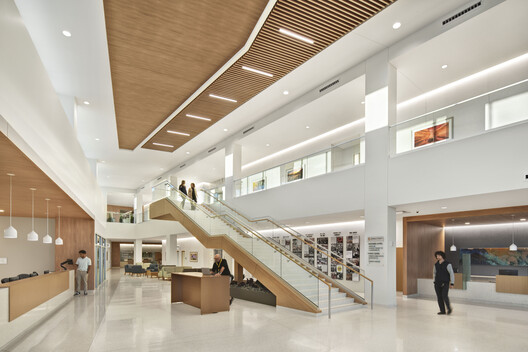
Before we rationally understand a space, we perceive it sensorially. Light, proportion, texture, color, and materiality all influence how the body interprets an environment, shaping whether it feels welcoming, cold, intimate, or impersonal. Visual and chromatic elements can directly affect the perception of depth, atmosphere, and scale within interiors, particularly in contemporary buildings characterized by large spans and continuous surfaces. Among the architectural elements that shape this experience, the ceiling may be one of the most underestimated, despite its profound influence on how space is perceived and inhabited.
As a surface where multiple infrastructures converge, the ceiling influences light propagation, the perception of scale, acoustics, and even the psychological sensation of proximity and comfort. In large spaces, particularly within healthcare, education, hospitality, or collective-use programs, overly neutral overhead surfaces can reinforce atmospheres that feel distant or impersonal. This is where materials with richer visual texture and tonal warmth begin to play an important role.
The immediate architectural instinct is often to turn to natural wood to counterbalance this condition. Wood's tonal warmth, texture, and visual rhythm have long been associated with environments that feel more intimate and connected to the human scale. However, in high-traffic or technically demanding environments, specifying raw wood can introduce significant challenges related to maintenance, durability, hygiene, dimensional stability, and long-term performance.
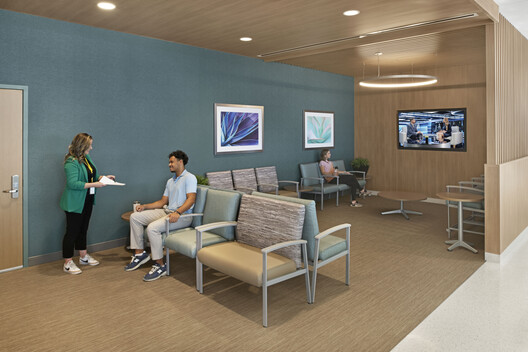
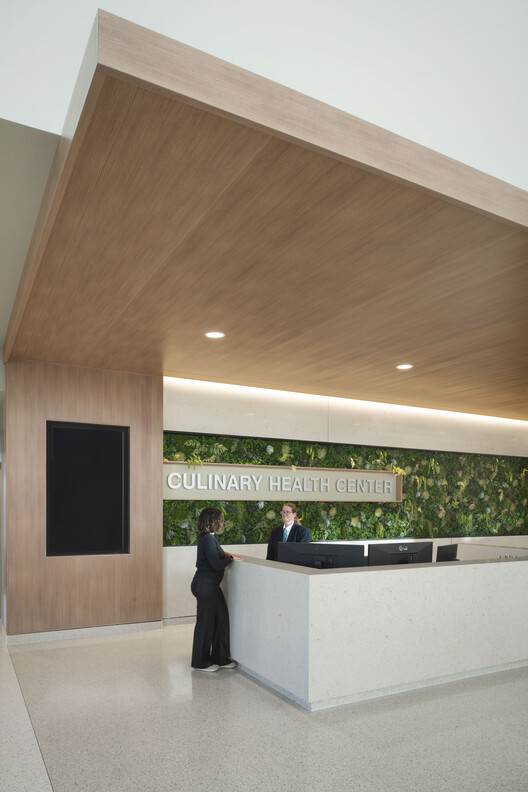
This pushes architects toward systems capable of reproducing some of wood's sensory qualities while responding more effectively to contemporary technical requirements. Linear metal ceiling systems with wood-look finishes emerge within this context, as hybrid architectural solutions that reconcile perceptual comfort with operational performance. At the Culinary Health Fund project in Las Vegas, Nevada, this balance becomes evident. In a high-use healthcare environment where durability, hygiene, and long-term maintenance are critical, natural wood would require intensive upkeep and careful environmental control. Instead, the architects utilized aluminum ceiling systems by Longboard Architectural Products to achieve a space that maintains a sense of warmth and visual comfort while performing with the precision and resilience required in healthcare settings.
The system combines 6" Smooth T&G Planks and 1x4 Link & Lock linear profiles distributed throughout circulation and gathering areas. Applied across the interior spaces, the aluminum wood-look surfaces help soften the neutrality frequently associated with healthcare environments, introducing texture, tonal depth, and visual continuity across the upper plane of the interiors.
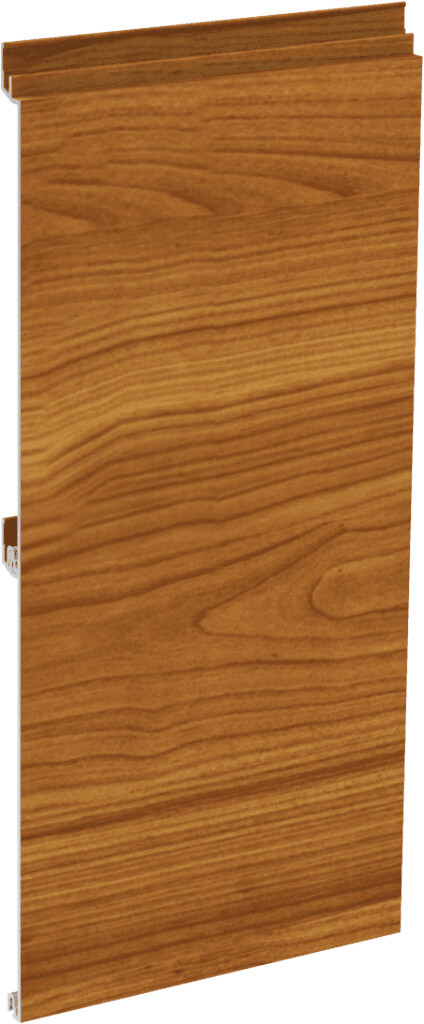
It also responds to the technical demands typical of high-use environments, where natural wood would often require more intensive maintenance and long-term upkeep. The durability of aluminum, combined with low maintenance and modular precision, allows technical performance and perceptual comfort to coexist within the same architectural solution.
Longboard Architectural Products' linear ceiling systems, composed of modular aluminum profiles available in different dimensions and finishes, make it possible to create continuous surfaces capable of introducing rhythm, depth, and texture into interior environments. The linear repetition of the panels helps visually organize space and direct movement, while the wood-look finishes soften the perception of large or excessively institutional environments.
The use of aluminum also addresses relevant practical demands in contemporary architecture. Its lightness, dimensional stability and durability make the system particularly suitable for high-traffic programs like healthcare buildings, airports, corporate spaces, and public facilities. The modularity of the profiles also facilitates integration with lighting, acoustic systems, and technical infrastructure, allowing the ceiling to move beyond the role of a finish material and operate instead as an active environmental layer within the spatial experience of the project.
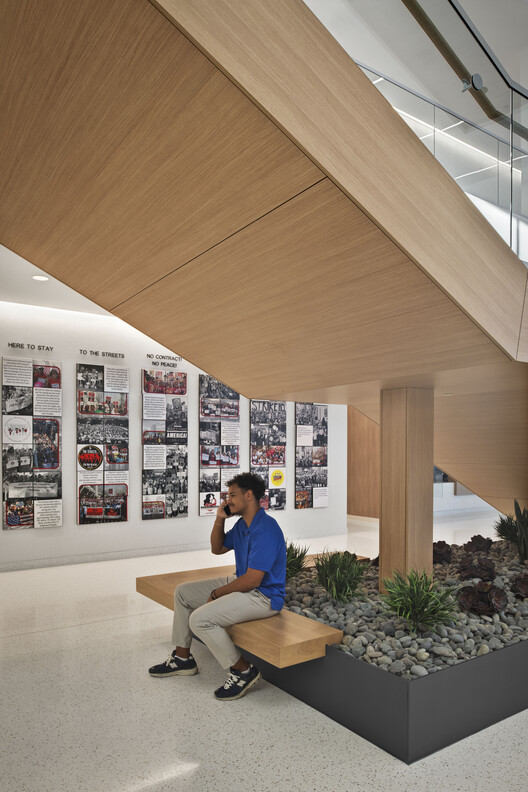
In contemporary architecture, materiality is no longer evaluated solely through the authenticity of raw materials, but through performance, maintenance, lifecycle, and spatial experience. Integrating lighting, technical systems, and acoustic solutions further expands the role of these surfaces, transforming the ceiling into a true spatial infrastructure rather than merely a finishing element.
Perhaps the most relevant question is not whether a material is "natural" or "industrial," but how it contributes to the construction of everyday experience. Contemporary architecture thrives on hybrid systems in which technical performance and sensory quality become complementary dimensions of design.


