1. ArchDaily
  2. Simulation

Simulation: The Latest Architecture and News

First-Ever Earthquake Simulation in a 10-Story Mass Timber Building

Subscriber Access | 

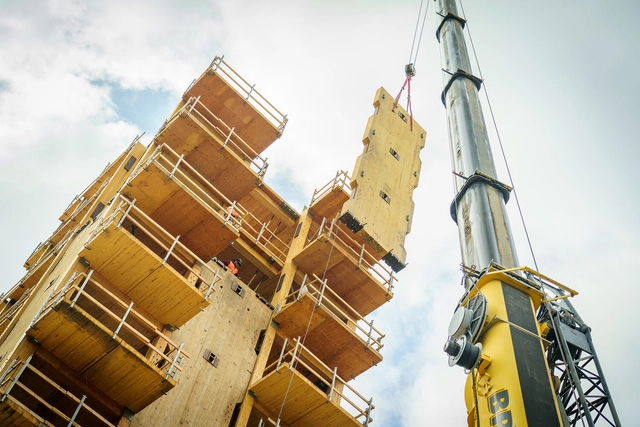
When it comes to seismic resistance, there are a number of myths that question the ability of wood to adequately perform in the event of an earthquake. However, its ductility allows it to deform plastically without breaking, absorbing and dissipating the energy generated by movement and vibration. Furthermore, unlike steel or concrete, wood is a lightweight material with a good strength-to-weight ratio, enabling it to withstand seismic forces without adding excessive load to the construction. This has been extensively verified in smaller-scale structures around the world, but how does a high-rise mass timber building behave in the face of an earthquake?

To dispel doubts, the Tallwood Project recently erected a 10-story building made of cross-laminated timber (CLT) at the University of California, San Diego (UCSD). The structure was tested on a shake table that simulated the 1994 Northridge earthquake in Los Angeles, magnitude 6.7, and the 1999 Chi-Chi earthquake in Taiwan, magnitude 7.7.
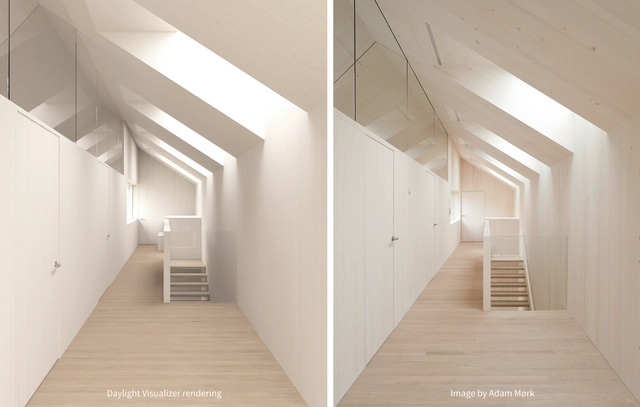

Climate-based Daylight Simulations with VELUX Daylight Visualizer

Daylight is core to realizing healthy and sustainable buildings, but its dynamic nature and the complex ways in which it interacts with its environment make it a difficult discipline to master. The new version of VELUX Daylight Visualizer makes climate-based daylight modeling more accessible than ever, empowering architects to make the best use of daylight anywhere in the world.

5 Emerging Careers in Architecture Technology to Look Out for in 2018 and Beyond

Subscriber Access | 

Even with tech like virtual reality, augmented reality, 3D printing, computational design and robotics already reshaping architecture practice, the design community is just scratching the surface of the potential of new technologies. Designers who recognize this and invest in building skills and expertise to maximize the use of these tools in the future will inherently become better architects, and position themselves for entirely new career paths as our profession evolves. It is a uniquely exciting moment for architecture to advance through innovative use of technology. Even just a decade ago, designers with interests in both architecture and technology were essentially required to pursue one or the other. Now, with architecture beginning to harness the power of cutting-edge technologies, these fields are no longer mutually exclusive. Rather than choose a preferred path, today’s architects are encouraged to embrace technology to become sought-out talent.

With much written about how technology is changing the way architects work and the products we can deliver to clients during a project’s lifecycle, there has been less focus on how technology is changing career opportunities in the profession. Architecture companies are now hiring roles that didn’t exist even three years ago. Here’s a look at five emerging career paths design technology will make possible in 2018 and the immediate future.

New Study to Investigate Skyscraper-Induced Depression and Motion Sicknesses

Have you been experiencing motion sickness, depression, sleepiness, and even fear, as you gaze out of your window from the 44th floor? If so, you may be prone to “Sick Building Syndrome” – the informal term for side effects caused by swaying skyscrapers, according to experts at the Universities of Bath and Exeter, who are launching a £7 million ($8.6 million) study into their causes and prevention through testing simulations.

“More and more people are living and working in high-rises and office blocks, but the true impact of vibrations on them is currently very poorly understood,” explained Alex Pavic, Professor of Vibration Engineering at the University of Exeter. “It will for the first time link structural motion, environmental conditions, and human body motion, psychology, and physiology in a fully controllable virtual environment.”

Open Call: Digital Design Methods Competition

A very exciting opportunity is presented to architects and students worldwide for your work to be showcased in an international documentary film, alongside some of the greatest living architects of our current time.

10 Things The “Cities: Skylines” Video Game Taught Us About Modern Urbanism

Subscriber Access | 

Ask a random person in the street about their favorite hobbies, and it’s unlikely that they’ll say “urban planning and traffic management” - yet when video games began to take off in the late 1980s city-building was one of the first breakout hits, in the form of MaxisSimCity series. The huge success of the “Sim” series in general drove conversations about the value of simulation, as part of the general 1990s optimism about virtual worlds being the future. Sim games became the subject of academic critiques of their philosophy of the world, while city builders became a lot more than a game: in 2002, SimCity 3000 was used as a semi-serious test for mayoral candidates in Warsaw.

After a slump caused by a difficult transition to 3D graphics, city builders are back in vogue. Following what is widely considered as a disappointing SimCity reboot in 2013, Finland’s Colossal Order recently released Cities: Skylines to critical and financial success. But simulations require assumptions; they are, after all, written by people who have their own conscious and unconscious views on how and why cities work. The limitations around designing a video game - the fact that each asset must be modeled and textured, and that each transport option requires a huge amount of work to simulate - mean that Cities: Skylines is as stripped down and streamlined an articulation of urban philosophy as Le Corbusier’s Ville Radieuse or the New Urbanists' models, and just as interesting. We investigate 10 things this game tells us about 21st century urbanism, after the break.

Light Matters: Can Light "Cheat" In Simulations?

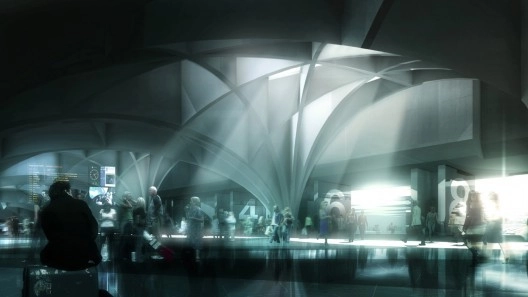
In recent years the use of CAD and simulation programs has resulted in a new understanding of light in architecture. The drawing board and its lamp have given way to the self-illuminating monitor. The result is that concepts in architecture are now made of light from the very first mouse click. In the visualisation process, luminous space now predominates.

However, this begs the question: has the luminous impression (part and parcel of the perfect, rendered setting) become more important than the engineering or architectural concept itself? With the improved interplay of shades, contrast, and brilliance, can lighting actually obscure the point of a realistic simulation?

More Light Matters, after the break…