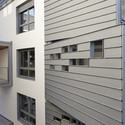
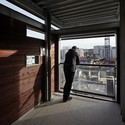
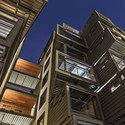
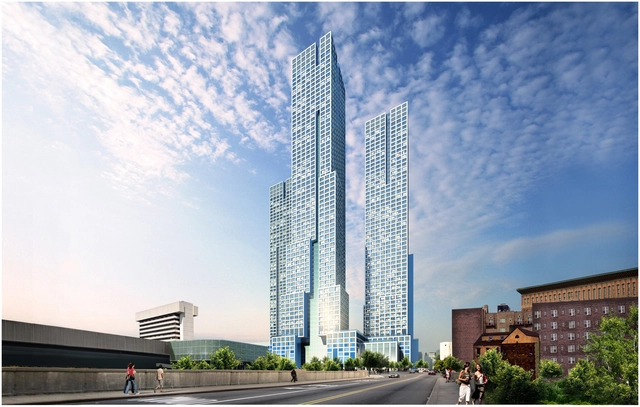
Jersey City’s Journal Square will soon reach new heights, as Hollwich Kushner (HWKN) and Handel Architectshave broken ground on what will be the tallest building in New Jersey: Journal Squared. The transit-oriented urban renewal project will be completed in three phases; the first, which will add 540 residential units to the area, is planned for completion in mid-2016. Once the 2.3 million square foot project is complete, three metal panel clad towers will dominated the skyline, ultimately totaling in 1,840 units and reaching up to 70 stories.
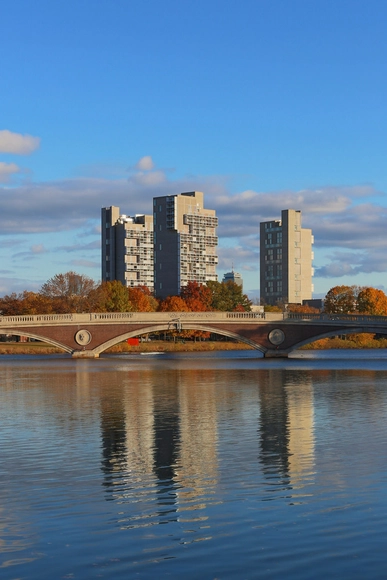
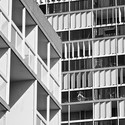
Built in 1964 during his tenure as Dean at the Graduate School of Design, Josep Lluís Sert’s Peabody Terrace provides housing for almost 1500 Harvard graduate students and their families. One of several projects Sert designed for Harvard’s campus, it is a manifestation of his vision for the ideal neighborhood. Many elements such as the negotiation of scale, mixed use program, shared open space and design aesthetic were influenced by but represent a departure from earlier modern housing projects.
Peabody Terrace is a prototypical example of a twentieth-century project heralded by the architectural community as an exemplar of progressive modern ideals, but lambasted by neighbors and members of the general public for being unattractive, cold and imposing. This project and others like it highlight the disconnect that can occur between the architectural intelligentsia and the communities in which they build.
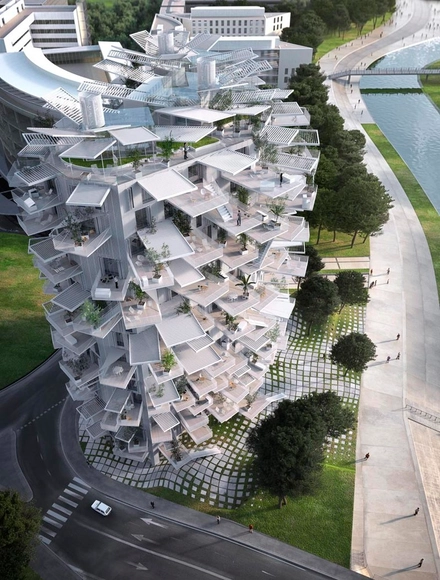
The City of Montpellier has chosen Sou Fujimoto Architects, Nicolas Laisné Associés and Manal Rachdi Oxo architects’ “White Tree (L’Arbre Blanc)” as winner of the "Architectural Folie of the 21st Century" competition. Inspired by the city’s tradition of outdoor living, and the efficient properties of a tree, the mixed-use residential tower will feed off locally available natural resources as it rises 17-stories and connects the new and old districts of Montpellier.
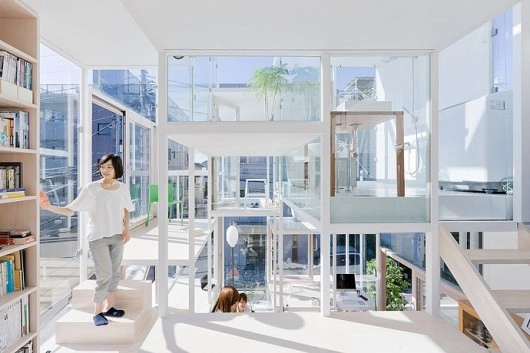
The Vertical Glass House (2013), built at the West Bund Biennale of Architecture and Contemporary Art, Shanghai. Image Courtesy of Atelier FCJZ
In this article, originally published by Metropolis as "Houses Without Windows: Meditative Respites or Architectural Straightjackets?", Komal Sharma looks into the architectural oddity that is the completely enclosed house. While many would shudder at the idea, there is a rich history of houses which, in exceptional circumstances and with exceptional clients, make sense without windows.
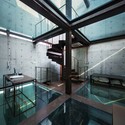
The Vertical Glass House by Chinese architects Atelier FCJZ is disingenuous to say the least. Its name suggests a vertical derivative of Philip Johnson's canonical house, and in fact its architects describe it as a 90-degree rotation of the typical modernist glass house. Instead, what welcomes visitors at Shanghai's Xuhui waterfront is a four-story concrete house without any windows. Where is all that promised glass, you might ask?
The answer is inside. The house's textured concrete walls give it the appearance of a bunker, but the interiors are actually light-filled. The architects accomplish this through an inverted sense of space. Where one expects walls of glass, yielding a platonic prism that brazenly exposes inhabitants to the outside world, the house instead delivers a surprising twist: the 7-cm-thick floor slabs are completely transparent, endowing users with a Superman-like sense of see-through vision. The experience of looking up through all of the house's spaces, even the most private spaces like the bathroom, is breathtakingly novel.
Read on for more about the phenomenon of window-less houses
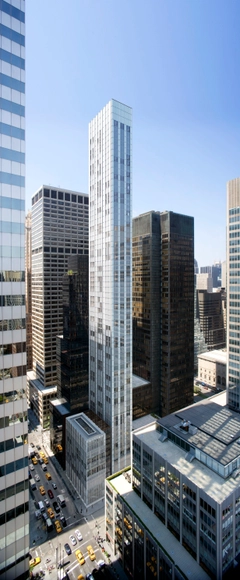
Construction is officially underway on 610 Lexington Avenue, a 700-foot ultra-thin condominium tower designed by Foster + Partners in New York City. Designed as a contrast to its neighboring landmark, Mies van der Rohe’s midcentury Seagram Building, the slim 61-story tower will feature 91 luxury units encased within a pure white glass facade.
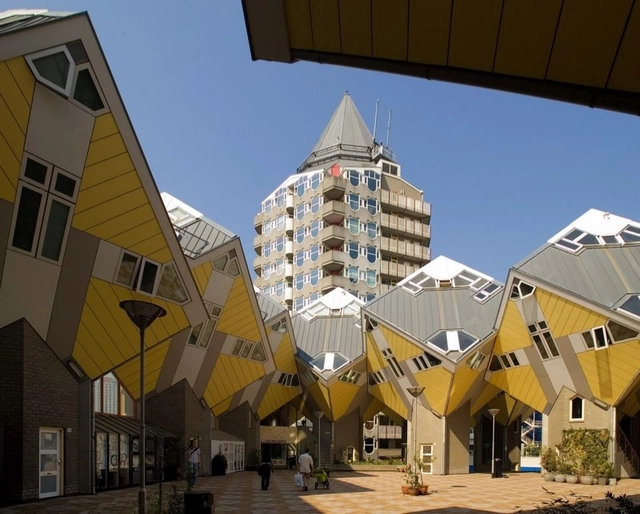
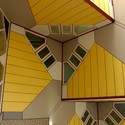
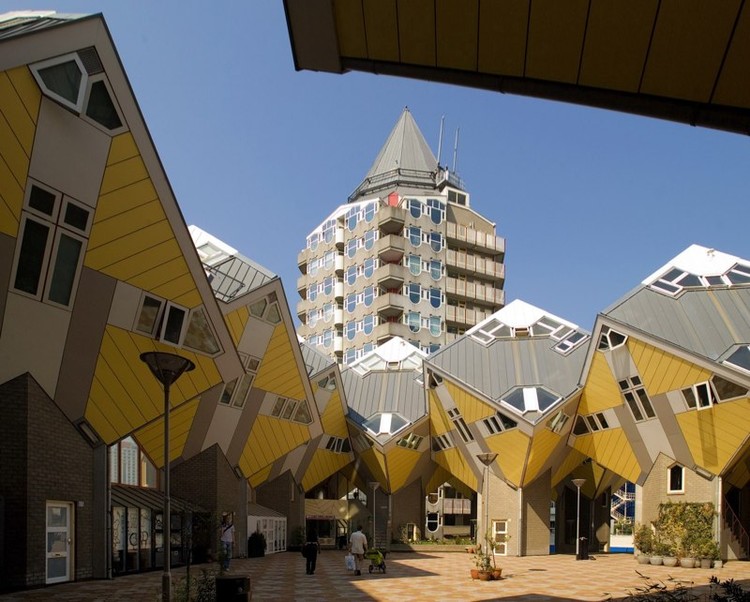
A popular tourist attraction and bizarre architectural experiment, the Kubuswoningen is located in the Oude Haven, the most historic section of Rotterdam’s port. Following the destruction of the Oude Haven during the Second World War, architect Piet Blom was asked to redevelop the area with architecture of character, presenting him the opportunity to apply his earlier cube housing exploration in Helmond to a more urban context. Known for his desire to challenge conventions, Blom did not want the Kubuswoningen to resemble typical housing; he strived to dissolve the attitude that “a building has to be recognizable as a house for it to qualify as housing.” During a time when the rebuilding of Rotterdam was pivotal, the Kubuswoningen served as an influential precedent for progressive and innovative architectural development.
Richard Meier & Partners has unveiled designs for their first project in Bogota: Vitrvm. Conceptualized as two towers united at the base, the new 13-story residential development will provide 36 apartments along Septima Avenue in the north section of the city.
“The project is contextually inspired by the beauty of its immediate surroundings,” described the architects. “It aims to reflect and to engage the beautiful gardens and large trees at the Chico Park and the Seminario Mayor,” one of the largest and most important seminaries in Colombia.
Freakonomics has just posted a fascinating new podcast that takes on the question posed by Alastair Townsend in our AD original article: “Why Japan is Crazy About Housing.” The podcast consults with Townsend and economic experts to present a thought-provoking answer to the puzzling question of why Japan builds architecture that is avant-garde and yet, ultimately, disposable. The answer may just surprise you. Listen to the whole podcast here:






















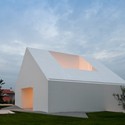
.jpg?1393936939 "The source of illumination for the Ryunsenji House (2008) in Japan, is a light well on the roof. Image Courtesy of Uno Tomoaki")