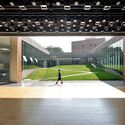
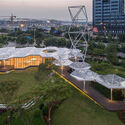
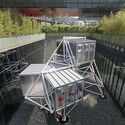
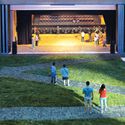
The Pavilion of China at the 19th International Architecture Exhibition - La Biennale di Venezia presents the exhibition CO-EXIST, curated by Ma Yansong, founder of MAD Architects, and organized by the Ministry of Culture and Tourism of the People's Republic of China at the Arsenale. Through ten works by twelve interdisciplinary groups, the pavilion examines how traditional Chinese philosophical thought can inform architectural responses in the age of advanced technology and artificial intelligence.
These days, the architecture industry cannot disregard how significant the challenge of sustainability has become. One strategy for achieving sustainable development is a circular economy, based on a sustainable life cycle. This strategy minimizes resource usage and extends the useful life of buildings from a design perspective. Moreover, another challenge is how to increase the usability of the building itself, in addition to how we've incorporated building disassembly into the cycle. This requires that designers take the future into account when making design decisions, integrating the requirements of the present with the potential outcomes of what has not yet happened.
The 9th edition of the Urbanism\Architecture Bi-City Biennale (UABB) of Shenzhen and Hong Kong opened on December 10, 2022. Curated by Lu Andong, Prince Gong, and Aric Chen, the exhibition features hundreds of artists, designers, and architects from fifteen countries. The exhibition will last for three months.
The Biennale's theme, "Urban Cosmologies," encompasses both spatial symbiosis and the temporal rhythms of life. It is a source of ancient Chinese wisdom as well as a cosmology that looks to the future. The "Cosmology of the City" is a field of symbiosis, a part of the "community of life between man and nature".
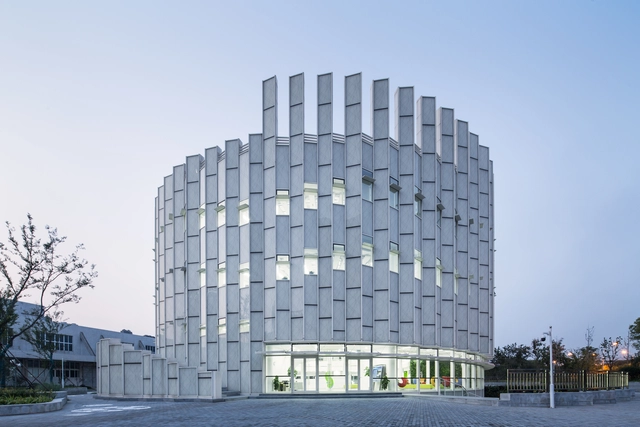
Nanjing Green Light House. Image Courtesy of Archiland International
Climate change mitigation has become a priority issue, with the architectural industry accounting for 38% of global energy-related CO2 emissions. In December 2015, the Paris Agreement proposed to limit global warming to less than 2 ℃ above pre-industrial levels and strive for no more than 1.5 ℃. The architectural industry must achieve net zero carbon emissions by 2050 in order to meet the Paris Agreement's goal.
China proposed at the 75th Session of the United Nations General Assembly on September 22, 2020, that "China will work to peak carbon dioxide emissions before 2030 and achieve carbon neutrality by 2060." It has defined its carbon neutrality goal and execution approach in order to solve global climate and environmental concerns effectively.
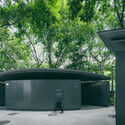
In recent years, with the accelerated urban development of public spaces in China, public washrooms have been assigned numerous new roles. Designers have come up with a variety of proposals which suggest turning public washrooms into a place where social gathering can be redefined, and temporary stay can be more engaging. Although the scale of public washrooms is significantly smaller than that of any other type of architecture, Chinese architects have been working innovatively on fitting the public washrooms into the changing social contexts. Below are a few examples that demonstrate some current architectural experiments with public washroom design in China.
Since the beginning of modernism, countless architects have expressed their architectural theories and concepts through the design of residential interiors. In Vanna Venturi House, Venturi exaggerated the scale of internal components to create a counterbalance to the small house, expressing complexity and contradiction. In Villa Mairea, Alvar Aalto built an ‘imperfect’ home, as a way of rebelling against the strict aesthetic standards of functionalism.
Conceptual and theoretical experimentation of housing interiors in China has had a delayed start due to political influences and differing pace of development. While the birth of communism lead to standardisation, rapid urbanisation and economic rebirth has provided the perfect catalyst for architects to challenge the status quo and conceptualise new definitions of interior and living.

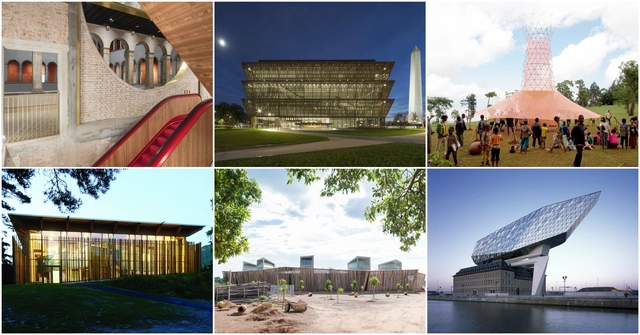
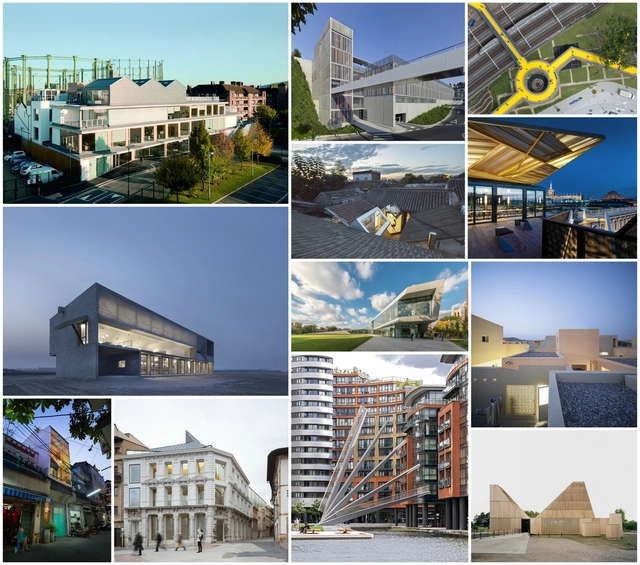
The Design Museum in London has announced the shortlist projects in the running for the 2017 edition of their prestigious Beazley Design of the Year award. Now in its tenth year, the award was established to “celebrate design that promotes or delivers change, enables access, extends design practice or captures the spirit of the year.”
This year, a total of 62 projects have been nominated across six categories: Architecture, Digital, Fashion, Graphics, Product and Transport – including 13 projects from the Architecture category. A winner from each category and the overall winner will be announced on January 25, 2018. Previous winners of the architecture category include: IKEA’s Better Shelter last year (also the overall winner), Alejandro Aravena's UC Innovation Center in 2015, and Zaha Hadid Architects’ Heydar Aliyev Center (overall winner in 2014).
After a three-day event attracting over 1,000 visitors, the 2016 ARCHMARATHON came to a close, with the presentation of its annual awards. Now in its 3rd year, the Milan-based exchange awarded projects in ten different categories, as well as an overall winner, and a “crowd award” based on voting on the event’s website. The 42 presented projects were judged by the international jury, chaired by Luca Molinari and composed of internationally famous architects and critics such as Lucy Bullivant, William Menking, Wassim Naghi, Li Brian Zhang and Elie Haddad. See all 12 awarded projects after the break.
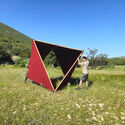
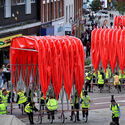
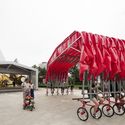
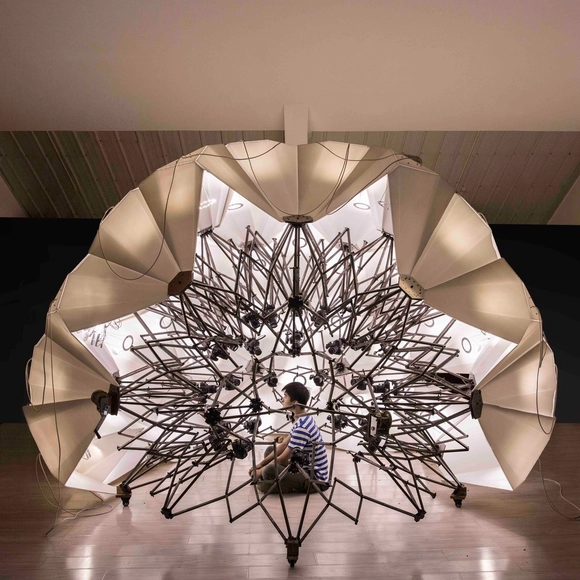
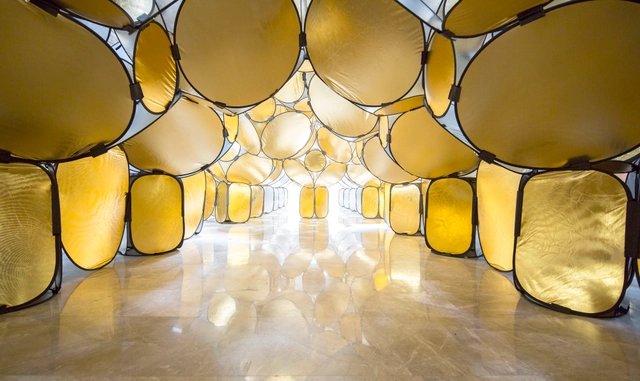
Inspired by the recent popularity of amateur photography in China, People’s Architecture Office (PAO) + People’s Industrial Design Office (PIDO) repurposed reflective photography panels to create multipurpose Pop-Up Habitats. Incredibly lightweight and comprised of only flexible steel rings and a soft fabric, the Pop-Up Habitats can fold quickly and form self-supporting structures when expanded.
The Pop-Up Habitat has been exhibited in numerous architecture and design festivals around the world -- including Beijing Design Week and the Bi-City Biennale of Urbanism/Architecture in Shenzhen -- and in numerous forms. The Pop-Up Habitats have been turned into an auditorium, a gallery and a canopy, in addition to “an unintended but apt backdrop for selfies" at one exhibition. A consumer version has also been developed as a “weatherproof modular tent.”
Check out some of the exhibitions the Pop-Up Habitats have been featured in after the break.
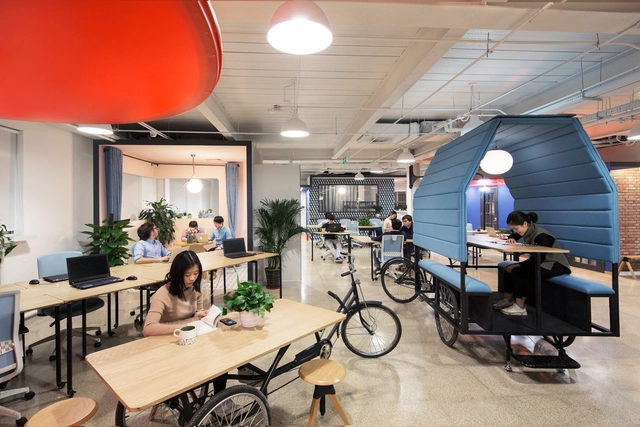
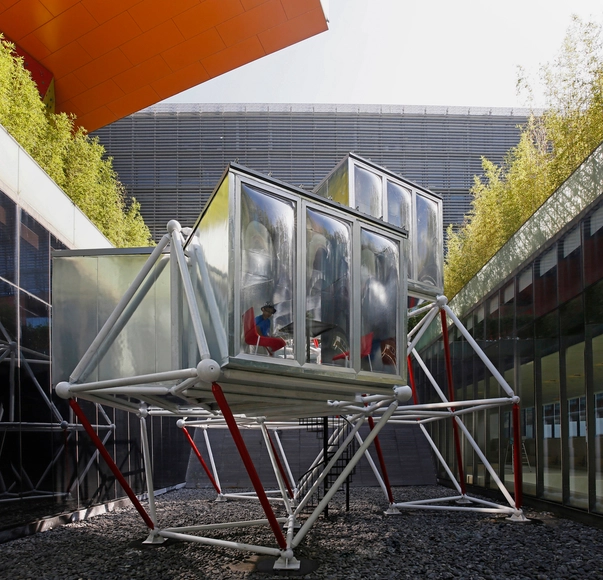
Designed by People’s Architecture Office (PAO) + People’s Industrial Design Office (PIDO), the Tricycle House and Tricyle Garden was designed to address the theme of the 2012 Get It Louder Exhibition. The inability to own land is a fundamental condition in China unique from many western countries. The Tricycle House suggests a future where the temporary relationship and the public nature between people and the land they occupy is embraced. More images and architects’ description after the break.