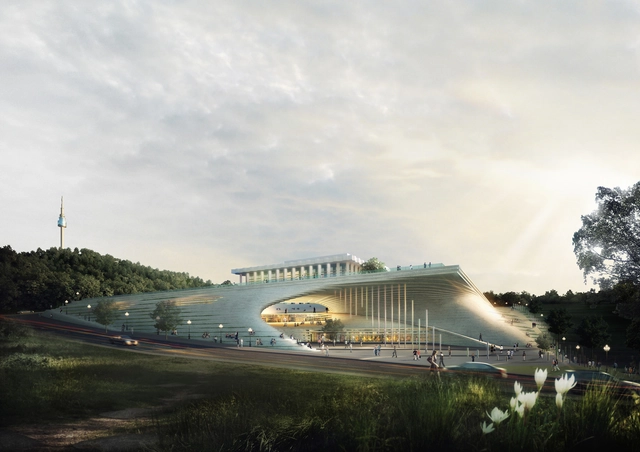
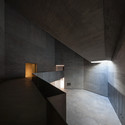
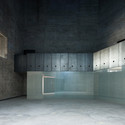
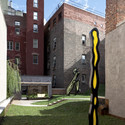
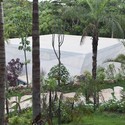
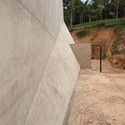
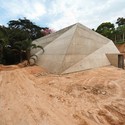
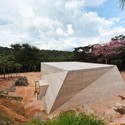
Designed by Archiplan, their second prize winning proposal for the Performing Arts Studio of the National Theatre of Korea is an extension design concept for the performers practice facilities in the basement of the existing plaza. The main issue is the vitalization of the environment which is now 'blocked' by the retaining wall on the edge of the main road and by the steep slope that makes a disconnection of the site. By embracing art, culture, and the city itself, this proposal connects the two-dimensional old theatre-plaza and the nearby park to link the performer and the citizens while allowing the art and culture flow well. More images and architects’ description after the break.
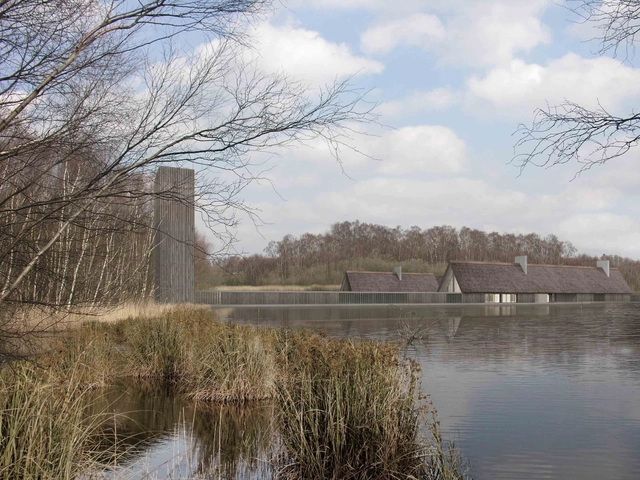
The proposed Great Fen Visitor Center by Arrigoni Architetti consists of three barns arranged on the edge between land and water in a clear orthogonal layout. Gathered around an open space, the buildings will represent the welcoming meeting point for single visitors and groups as well as the ideal setting for outdoor activities and events. The goal is to find a balance between architecture and landscape, loosening the boundaries between inside and outside, allowing different views and encouraging the curiosity for an individual, non preset experience. More images and architects’ description after the break.
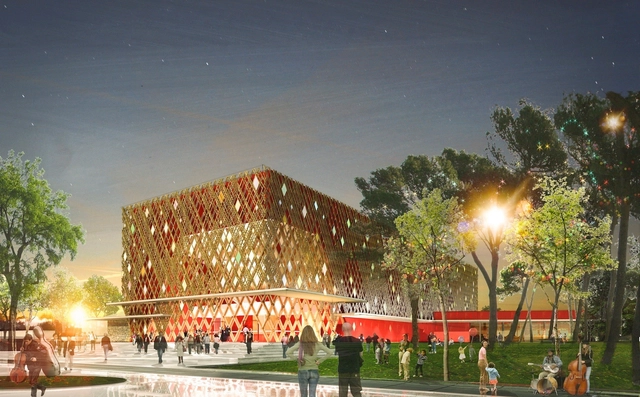
The renowned Montpellier architecture firm A+ Architecture has been entrusted with the project of building a new site at the domaine d’O, the Jean-Claude Carrière theatre. A unique and environmentally friendly project, the project is based on a global environmental approach aiming for general energy efficiency and for environmental quality standards. Other than the slab that supports it, the entire structure could be dismantled and rebuilt on a different site. The unique design is enhanced by a light wooden lozenge structure recovering the entire building. More images and architects' description after the break.
Designed by Charry C. Bougadellis & Associate Architects+Georges Batzios Architects, their proposal for the Piraeus Museum of Underwater Antiquities, which received an honorable mention, was divided in two elements based on the notion of ‘Viollet-le-Duc’: the negative element being the void, whilst the positive being the vertical and horizontal elements that define a space (walls and slabs). The link between these two elements, which defines the unity of the space is man. Therefore, the architectural space cannot be applied without the presence of man. More images and architects' description after the break.
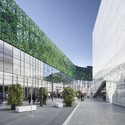
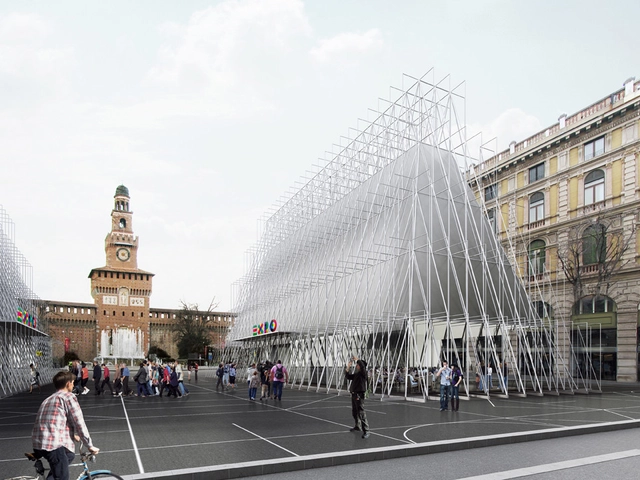
The winning proposal in the Info Point competition at Milano EXPO 2015 by Scandurrastudio aims to be an impressive void; a square and two pavilions. Featuring a great open space, a central square between two booth-like pavilions, the gate to EXPO 2015 will offer an ideal opportunity to talk about growth and evolution, while marking the time before the opening event. More images and architects’ description after the break.
Designed by Alexandros Avlonitis + Aggeliki Anagnostopoulou, their proposal for the Great Fen Visiting Center is derived by the observation of the natural environment of the site and its manipulation by he human factor. The concept is based on an attempt to mimic a very common phenomenon of agricultural terrains: the stacking of blocks of hay, and their impulsive installation in the middle of endless fields. Therefore, the new Great Fen Visitor Center becomes not a building, but a stack of volumes placed in the landscape. More images and architects' description after the break.
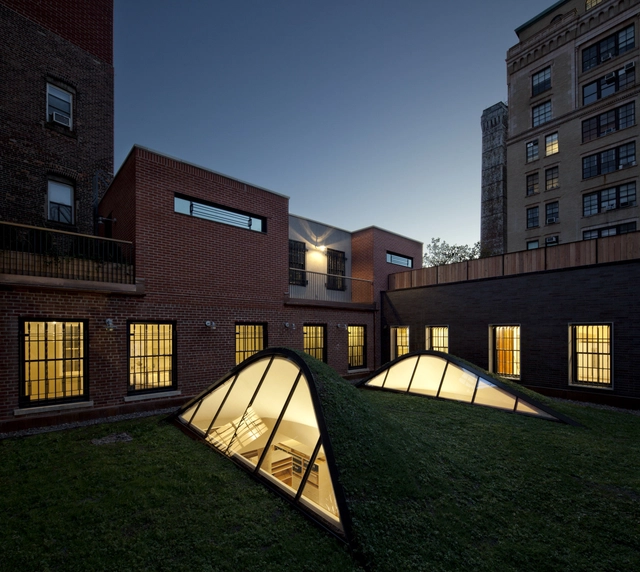
nARCHITECTSis designing a cultural education complex for the Wyckoff House Museum in Brooklyn on the site of New York's oldest house. The Wyckoff House has an immense history as it was the first landmark designated by the Landmarks Preservation Commission in 1968. nARCHITECTS’s educational complex will act as a portal between its present day environment and historical site. Due to its exceptional spatial and temporal intervention, the design was recently awarded an AIA New York Design Merit Award.
Read more about the award-winning design after the break...
Text description provided by the architects. As an update to last year's post featuring Memory Cloud as the winning commission awarded to RE:site and METALAB by Texas A&M University for the new Memorial Student Center 12th Man Hall, they have shared with us their most recent images upon the completion of their installation this February. Located in a place of deep traditions that are played out on the football field at every game and in the everyday lives of students, will create the imagery that will be played within the layers of the LED matrix at different speeds and durations. The gallery of images, and a video of the project can be viewed after the break.
Daniel Madeiros and Jonathan Schwinge were recently announced as the winners of the ideas competition organized by Millennium Point and the RIBA to enhance the visibility and image of Millennium Point in Birmingham from the Jennens Road approach. The jury panel was struck by the beauty and grace of their winning idea which was underpinned by craft and technology, convincing the jury that the dramatic form could be constructed. Also demonstrating complexity and sensitivity to the site, Millennium Point will benefit greatly from this competition and the opportunities it now has for its next phase of architectural evolution. More images and architects' description after the break.