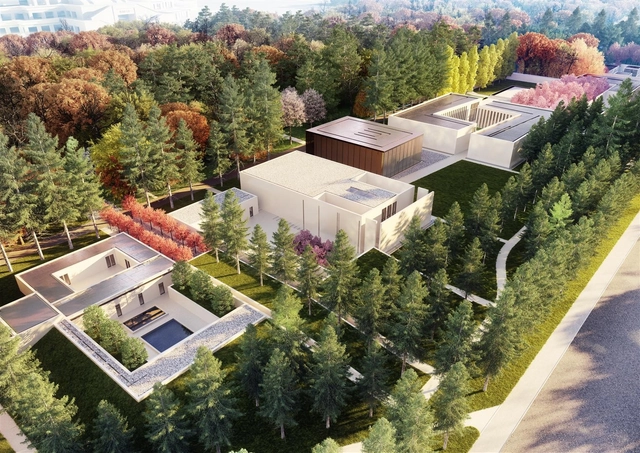
Following OAC’s win in the international design competition and completion of the master plan for the Famen Temple Zen Meditation Center in 2012, the architects recently completed the schematic designs for the buildings, landscape, and experiential features and art installations for meditation in the first phase of the project called the ‘Eightfold Path Forest’. As part of the new cultural master plan development on the site of the renowned 1,800 year-old Famen Buddhist Temple (aka Dharma Gate Temple) outside Xi’an, China, this project is one of the largest architectural and landscape commissions in the world focused around an historic religious temple.More images and architects' description after the break.
Designed by Gil Even-Tsur Architecture Workshop, their concept for the new National Library suggests that the architecture should be critical, strong, but also deferential and contextually responsive. Their intent is to display an almost aesthetic neutrality in terms of its form, assemblies, and materials by providing an architecture that acknowledges this complexity. More images and architects’ description after the break.
Organically revealing itself from the ground, the Crone Partners' winning design for the Orange Regional Museum aims to respectfully integrate a new building and program to the existing cultural precinct. Additionally, the architects intend to create a new identity whilst strengthening current civic conditions within the site. More images and architects’ description after the break.
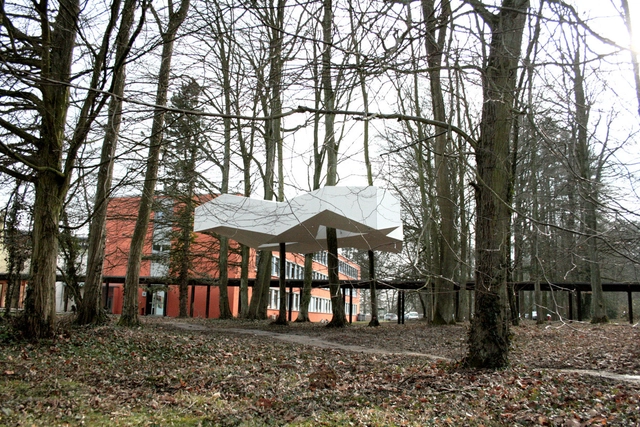
Raum Architects shared with us their recent project titled 'Neither Cloud nor Rock', an art installation for the National Institute of Agricultural Research in Nancy. The piece covers an exterior area intended to people who work there, opposite to the restaurant. It protects researchers from rain and sun. The object floats, clinging to the trees, and moves with them. More images and architects' description after the break.
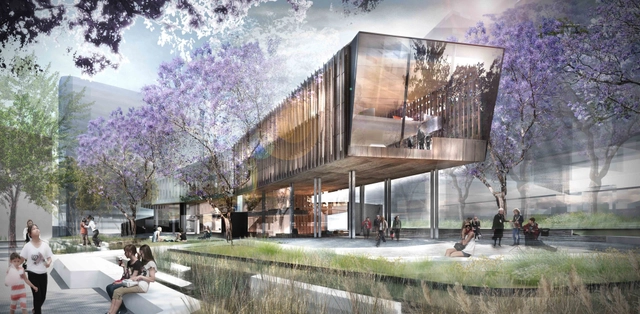
Part park, part urban square and part garden, the public realm of the Green Square Library proposal is a unique landscape offering to this new urban community and is an exemplar of contemporary community public space design and place making. Designed by ASPECT Studios, the public realm is designed to integrate with the program of the library building and facilitate a richness of public experiences and moods by changing scales and tempos. More images and architects' description after the break.
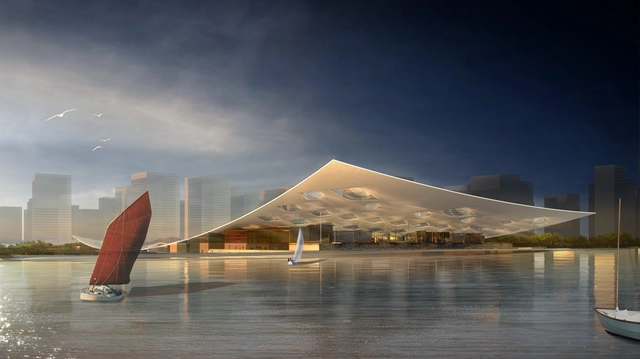
Situated outside the city of Tianjin in Northern China, the proposal for the new National Maritime Museum is designed to house both new and old maritime items with a focus on celebrating the historical achievements of Chinese naval exploration through out time. Designed by Holm Architecture Offce (HAO) + AIthe museum combines all aspects of the maritime world, from aquarium to sailing to education, combining a series of unique visitor experiences under one roof. More images and architects’ description after the break.
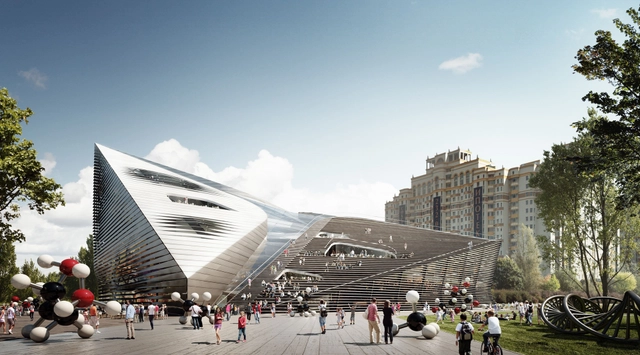
With the aim to be a meaningful building beyond its iconic form, the new Museum & Educational Center (MEC), designed by 3XN,is about connecting with people, while opening up the world of science, technology, innovation and Russia’s extraordinary achievements in these domains. Through both an internal and external architectural expression of flexibility, this proposal, which was a finalist in the international competition, recognizes that architecture shapes behavior. More images and architects' description after the break.
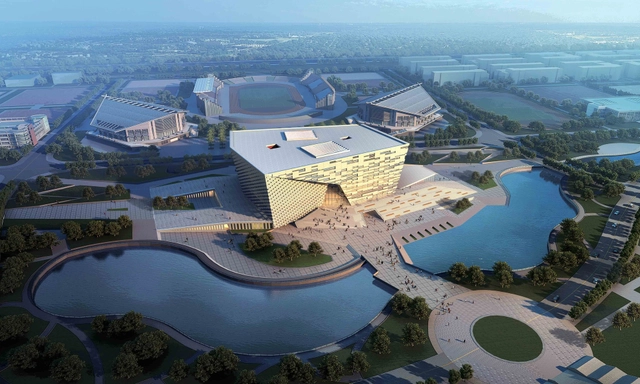
With an area of 48,636m2, the site of the Hebei University Library is located in the center of the new Beicheng Campus. This competition winning proposal by Damian Donze, of the Tongji Architectural Design and Research Institute, is clearly divided. The base of the building is designated for some offices, an archive, a network center, a convention center and an exhibitions center. This way, the West entrance is reserved for the offices and the the network center while the East entrance is reserved for the convention center and the exhibition center. More images and architect's description after the break.