1. ArchDaily
  2. CODA

CODA: The Latest Architecture and News

Morning Rituals: Architecture of Breakfast Spaces

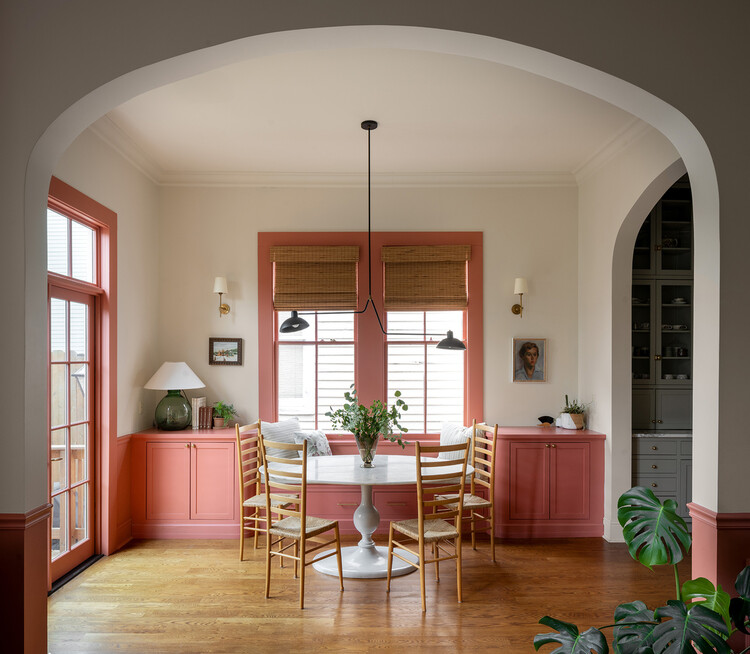
Breakfast nooks emerged in the early twentieth century in response to increasing domestic density and shifting ideas about everyday life. Rooted in the American Arts and Crafts movement and popularized through bungalow housing of the 1910s and 1920s, they evolved from the more formal Victorian breakfast room into compact, built-in spaces embedded within the kitchen. As houses grew smaller and more economical, architects and millwork companies used fixed benches and tables to occupy corners, alcoves, and bay windows that might otherwise be inefficient. These light-filled enclosures provided an affordable means of concentrating daily activities while preserving comfort and spatial clarity.

Morning Rituals: Architecture of Breakfast Spaces - Image 1 of 4Morning Rituals: Architecture of Breakfast Spaces - Image 2 of 4Morning Rituals: Architecture of Breakfast Spaces - Image 3 of 4Morning Rituals: Architecture of Breakfast Spaces - Image 4 of 4Morning Rituals: Architecture of Breakfast Spaces - More Images+ 13

How CODA Used Hundreds of White Plastic Chairs To Build A Recyclable Pavilion

This article is part of our "Material Focus" series, which asks architects to elaborate on the thought process behind their material choices and sheds light on the steps required to get projects actually built.

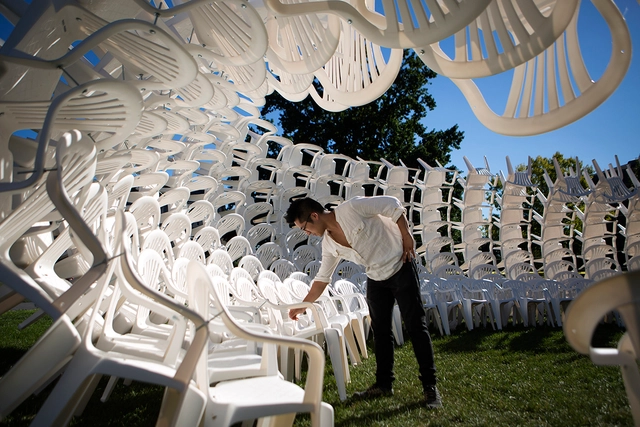
In this exceptionally imaginative and thought-provoking exercise in perceptual shifts, Ithaca- & Brooklyn-based CODA transformed hundreds of humble plastic lawn chairs into a project in the Arts Quad at Cornell University. Viewed from afar as a spiky singular entity, close inspection reveals the simple, unpretentious repeated module. CODA explains, "the object’s features are no longer understood in terms of their use (legs, arms, seat) but in terms of their form (spikes, curves, voids) as, due to their rotation away from the ground, they lose their relationship with the human body." We asked Caroline O'Donnell, principle at CODA, to explain the challenges faced in the development and construction of the fully-recyclable URCHIN.

Niche Tactics Book Launch

Niche Tactics: Generative Relationships between Architecture and Site (Routledge 2015), the first book by architecture's Edgar A. Tafel Assistant Professor Caroline O'Donnell, explores architecture's relationship with site and its ecological analogue: the relationship between an organism and its environment.

Espacios de Paz 2015: 5 Cities, 5 Communities, 20 Architecture Collectives

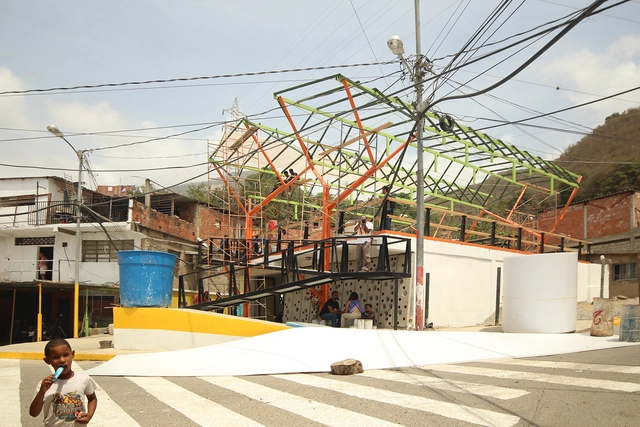
Between Sunday, May 17 and Monday, May 18 projects developed under the second phase of Espacios de Paz (Spaces of Peace) were inaugurated in five cities across Venezuela. A genuine exercise in participative design, 20 Latin American architecture groups worked for five weeks with communities in neighborhoods dominated by violence, high dropout rates and crime to convert deteriorated and abandoned spaces into public places of peace.

For each project, four groups of young architects worked together to carry out a process of dialogue, research, design, and ultimately the construction of either an athletic, social or educational facility to be administrated by the local community. Espacios de Paz is coordinated by the local office of PICO Estudio, with guidance from public institutions and under the leadership of Isis Ochoa, the High Presidential Commissioner for Peace and Life.

ArchDaily en Español Editors, Nicolás Valencia M. and José Tomás Franco, were invited by PICO Estudio to document and view the five projects in their final phase of construction and speak with the architects and community representatives about the development of the projects and some of the challenges faced in the process.

Learn more about each of the five projects after the break. 

Behind "Hy-Fi": The Organic, Compostable Tower That Won MoMA PS1's Young Architects Program 2014

Subscriber Access | 

This article, published by Metropolis Magazine as "Behind the Living's "100% Organic" Pavilion for MoMA PS1", goes behind the plans for this year's MoMA PS1 Young Architects Program's winning design, "Hy-Fi" - looking at the compostable eco-bricks which make the design possible.

"It all starts on local farms with waste corn stalks," says Sam Harrington of Ecovative, who will help build this year’s winning entry for the MoMA PS1 Young Architect’s Program. Hy-Fi, designed by the New York-based firm The Living, will be made of bricks that are entirely organic and ultimately, compostable. A good chunk of that material is corn stalks, stained clay-red with an organic dye from Shabd Simon-Alexander and Audrey Louisere . The rest is mycelium—mushroom roots to you and me—that will hold the corn stalks together as they cohere into a molded shape. The technology, developed by Ecovative in 2007, has so far been used as a packaging material. "But we love the chance to try something bold, and that’s what PS1 is all about," Harrington says.

Read more about the bricks behind Hy-Fi after the break

CODA’s Skateboard Scrap ‘Party Wall’ Kickstarts MoMA’s Summer Music Series

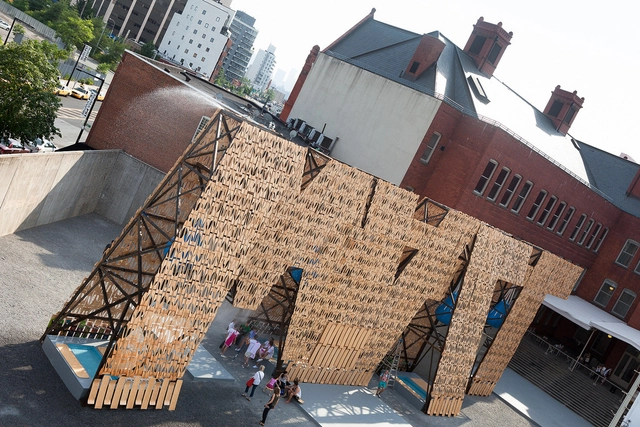
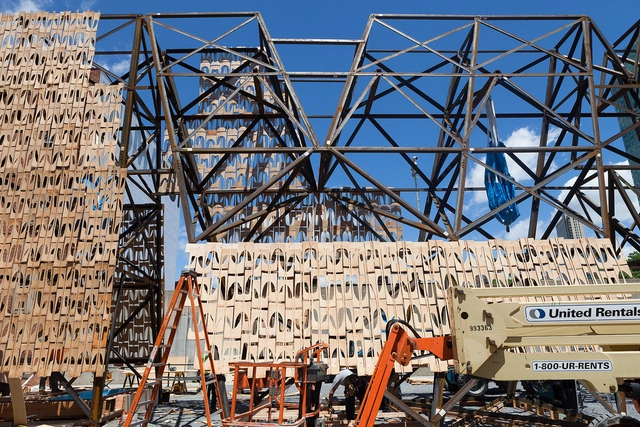
The Museum of Modern Art has kicked off the popular Warm Up Summer Music series in the courtyard of MoMA PS1 with the grand opening of Party Wall. The towering installation, designed by Ithaca-based studio CODA, was the winning proposal of the 14th annual Young Architects Program in which provides emerging architects a chance to construct an innovative project as long as shades, cools and seats visitors.

With a porous skin made of woven skateboard scraps, the experimental structure has successfully met the challenge by providing a shaded refuge for the crowds with refreshing cooling stations and detachable wooden seats. 

See Party Wall in action after the break...

AD Interviews CODA, MoMA PS1 YAP Winner 2013

Starting this Saturday, the public will finally be able to admire the winner of this year's Young Architects Program - Party Wall - at the MoMA PS1 courtyard in Long Island City. Every Saturday this summer through September 7, Party Wall will be the multi-functional backdrop (at once wall, water feature, shading and seating storage device) for Warm Up 2013, an outdoor music series.

We spoke with Party Wall's designer, Caroline O'Donnell, principal of CODA, just this morning; she told us that although much has been made of Party Wall's ingenious material (skateboarding scraps) and multi-functionality, it's most important feature is it's referentiality to the urban language of Long Island City.As O'Donnell told us: "we started to understand the relationship between the wall and the other languages—Long Island City, the billboards, the graffiti. We realized we had entered into a dialogue with a bigger urban context."In fact, the wall itself is a legible sign - written in the shadow it forms.

Read our interview with O'Donnell on Party Wall's ingenious design, after the break...

CODA wins P.S.1 with Skateboard Scrap ‘Party Wall’

CODA wins P.S.1 with Skateboard Scrap ‘Party Wall’ - Featured Image
via MoMA

The Museum of Modern Art and MoMA PS1 has selected CODA’s (Caroline O’Donnell, Ithaca, NY) large-scale, self-supporting Party Wall, made from leftover shreds of skateboard material, as winner of the 2013 Young Architects Program (YAP). Drawn from five finalists, the porous skin of CODA’s temporary urban landscape will shade visitors of the Warm Up Summer Music series with its reclaimed woven screen, while providing water in refreshing cooling stations and seating with its detachable wooden skin on the lower half of the linear structure.

Europan 11 Proposal: 'Counterspace' / CODA

Subscriber Access | 
Europan 11 Proposal: 'Counterspace' / CODA - Image 7 of 4
Courtesy of CODA

In typography, the ‘Counter’ is the space contained by letters (this is where monkish Irish Illuminators famously had space to play). For the monks, the space between the letters was as meaningful as the letters themselves. In ‘Counterspace’, the winning proposal by CODA for the Europan 2011 competition in Dublin, the linear forms of the traditional rows are transformed and interwoven to create a range of counterspaces: from enclosed collective space for safe children’s play, to urban plaza for adults’ lattés. Just like on the 19th century street of industrial terraced Dublin, the life of the community happens in the space between the rows of housing, in the counterspace. More images and architects’ description after the break.