Snøhetta, in collaboration with the Beijing Institute of Architectural Design (BIAD), has won the international competition to design the Beijing Art Museum in Tongzhou District, Beijing. The project officially broke ground on December 31, 2025, with completion and public opening anticipated in 2029. Conceived as a new landmark for the eastern part of the city, the museum will form part of Tongzhou's cultural and civic development strategy as Beijing's sub-center. The commission marks Snøhetta's second major cultural project in the Chinese capital, following the Beijing Library, which opened to the public in 2023 and has since become a key reference for contemporary civic architecture in the city.
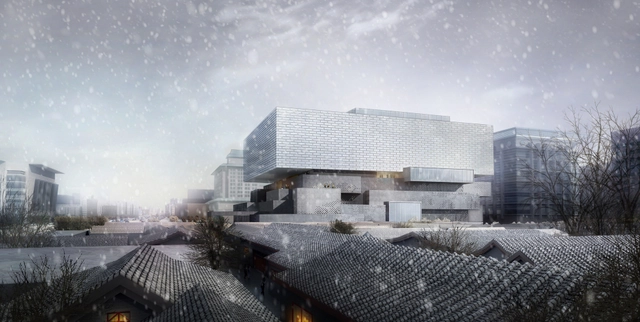
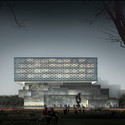
The Guardian Art Center features none of the dramatic cantilevers and futuristic formal experimentation of Büro Ole Scheeren's other works. Instead the "hybrid art space" - located in the heart of Beijing, just a stone's throw from the Forbidden City - references the scale and materiality of the adjacent traditional buildings. The lower floors, containing an auction house and a museum with a 1,700 square meter exhibition-events space, comprise an aggregation of small "pixelated" blocks, clad in stone with a pattern of perforations derived from a 700-year-old Chinese landscape painting. Though the upper portion of the building, containing a 120-room hotel and a restaurant, is larger in scale, it is broken down by a facade of oversized glass "bricks," again a reference to the materials of the hutong next door and a "humble and non-elitist symbol in Chinese culture," according to the press release.
To find out more about this intriguing building, we spoke to Ole Scheeren, who assured us that in spite of its appearance, the Guardian Art Center is just as radical as his previous works. Read on after the break for the full interview.





.jpg?1390443516 "© Yang Chaoying")


