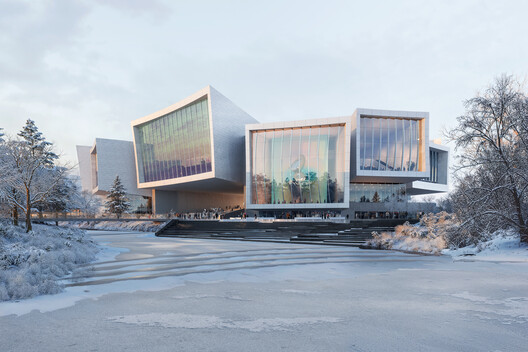
Snøhetta, in collaboration with the Beijing Institute of Architectural Design (BIAD), has won the international competition to design the Beijing Art Museum in Tongzhou District, Beijing. The project officially broke ground on December 31, 2025, with completion and public opening anticipated in 2029. Conceived as a new landmark for the eastern part of the city, the museum will form part of Tongzhou's cultural and civic development strategy as Beijing's sub-center. The commission marks Snøhetta's second major cultural project in the Chinese capital, following the Beijing Library, which opened to the public in 2023 and has since become a key reference for contemporary civic architecture in the city.
With a total floor area exceeding 110,000 square meters, the Beijing Art Museum is envisioned as a multidisciplinary cultural institution capable of accommodating a wide spectrum of artistic practices, including fine arts, intangible cultural heritage, fashion design, and contemporary art. The program positions the museum not only as an exhibition venue, but also as a civic platform that supports cultural exchange and public life. By combining large-scale galleries with flexible public spaces, the project is intended to contribute to the cultural infrastructure of Tongzhou while reinforcing its role within Beijing's expanding urban framework.
The architectural proposal is structured around the concept of "vision," which informs both the spatial organization and the visitor experience. Rather than functioning solely as a repository for art, the museum is conceived as an environment that encourages observation, interaction, and interpretation. Visual connections between interior spaces, as well as between the building and its surroundings, play a central role in shaping how visitors navigate and engage with the museum, establishing a dialogue between artists, audiences, and the city.
Related Article
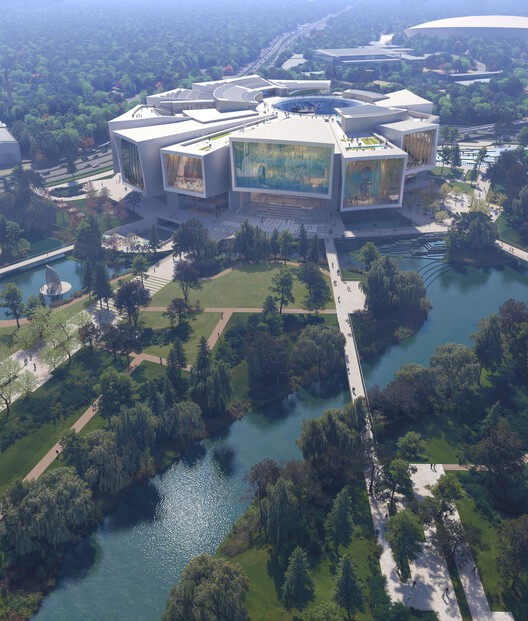
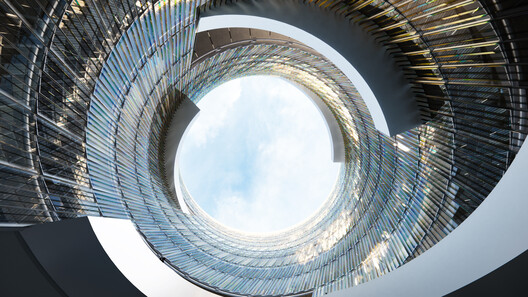
Rethinking Museums: A Conversation with Béatrice Grenier on Architecture as Cultural PolicyLocated directly above an active metro line, the Beijing Art Museum integrates transportation infrastructure into its architectural and urban strategy, allowing the building to operate simultaneously as a cultural destination and a mobility node. The sculptural massing radiates outward from a central core, responding to both programmatic requirements and infrastructural constraints. Lens-like, rippled facades articulate the exterior envelope, softening the transition between architecture and landscape while contributing to the formation of an accessible public realm around the museum.
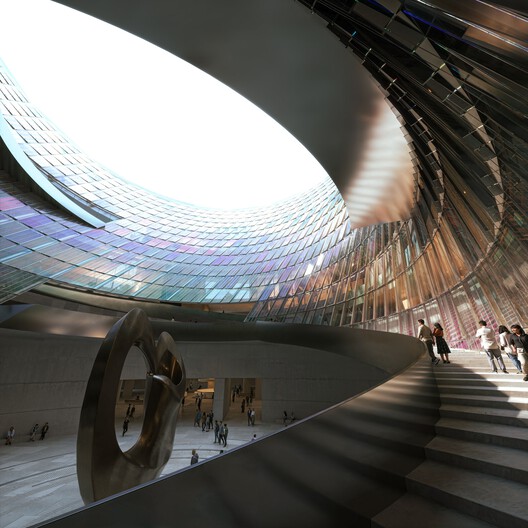
At the core of the project, a large circular atrium organizes circulation and spatial relationships throughout the building. Acting as an orienting element, the atrium draws visitors inward and connects galleries, storage areas, and support spaces arranged in a spiraling sequence. Semi-open platforms and gallery extensions distributed across multiple levels support vertical continuity and informal social interaction. The galleries extend into petal-shaped volumes that frame views of the surrounding district, reinforcing the reciprocal relationship between looking out and being visible within the urban context.
The landscape design extends the building's radiating geometry into a series of civic outdoor spaces intended for sculpture displays, events, and everyday public use. Conceived as a spatial continuum rather than a separate element, the landscape links architecture, interior, and exterior into a cohesive cultural environment embedded within the city. Environmental strategies are integrated throughout the project, including photovoltaic panels on the roof and a landscape system aligned with sponge city principles, incorporating water management measures to enhance resilience and ecological performance.
In other recent news, Snøhetta has released new images of its winning proposal for the Düsseldorf Opera House, following its selection through the "Opera House of the Future" competition. The practice has also been chosen to design the Qiantang Bay Art Museum in Hangzhou, China, developed in collaboration with the Architectural Design & Research Institute of Zhejiang University Co. and Buro Happold as part of the Qiantang Bay Future Headquarters district. In addition, in summer, Snøhetta has unveiled plans for Jesselton Docklands, a waterfront master plan in Kota Kinabalu, Malaysia, which reimagines the city's former port as a new civic and cultural gateway connected to the broader Southeast Asian region.