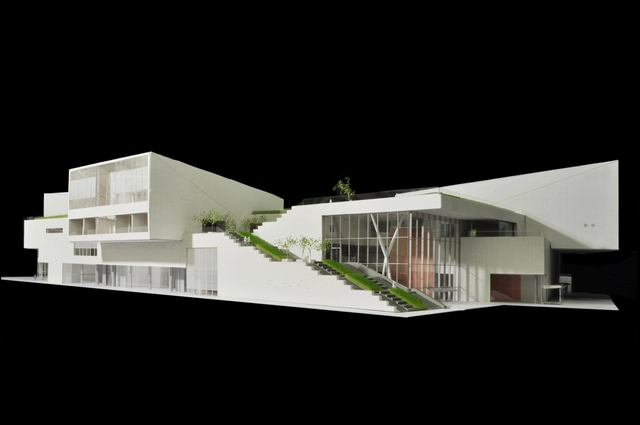
“We wanted to offer the local residents an internationally important museum that would help promote the development of China’s creative industries and further progress design in China,” stated China Merchants Group (CMG) vice president Sun Chengming. CMG is collaborating with London’s V&A to realize the project.
Ehrlich Architects, a Los Angeles-based practice dedicated to the philosophy of Multicultural Modernism, has been selected to receive the American Institute of Architects (AIA) 2015 AIA Architecture Firm Award. The award celebrates Ehrlich Architects' 35 years of practice, which, as the AIA notes, has become renowned for “fluidly melding classic California Modernist style with multicultural and vernacular design elements by including marginalized design languages and traditions.”
The firm, originally founded by Steven Ehrlich in 1979 after working with the Peace Corps in Africa, is now led by four diverse partners: Ehrlich, alongside Takashi Yanai, Patricia Rhee, and Mathew Chaney. You can preview some of their most notable projects and watch an interview with Ehrlich, after the break.
Fundamentals, the title of the 2014 Venice Biennale, will close its doors in a matter of days (on the 23rd November). From the moment Rem Koolhaasrevealed the title for this year’s Biennale in January 2013, asking national curators to respond directly to the theme of ‘Absorbing Modernity 1914-2014’, there was an inkling that this Biennale would be in some way special. Having rejected offers to direct the Biennale in the past, the fact that Koolhaas chose to act not only as curator but also thematic co-ordinator of the complete international effort, was significant. This announcement led Peter Eisenman (one of Koolhaas' earliest tutors and advocates) to state in one interview that “[Rem is] stating his end: the end of [his] career, the end of [his] hegemony, the end of [his] mythology, the end of everything, the end of architecture.”
Courtesy of Strelka Institute for Media, Architecture, and Design, via Flickr. Used under Creative Commons
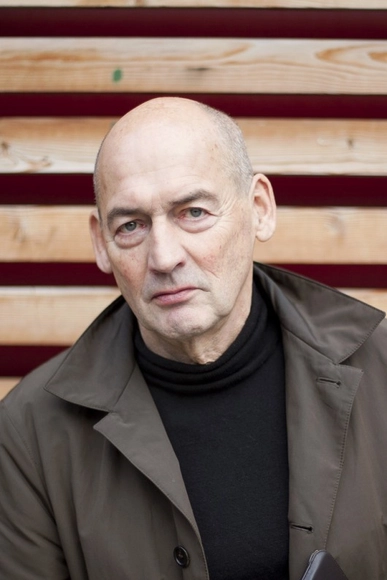
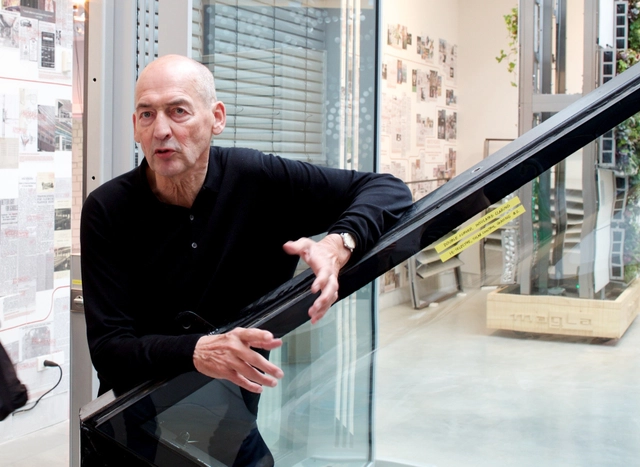
Rem Koolhaas, one of today's most celebrated architects, has lived a significant year. With the closing of his much-talked about Venice Biennale just days away, the Dutchman also turns 70 years old this coming Monday.
https://www.archdaily.com/567462/help-us-honor-rem-koolhaas-on-his-70th-birthdayAD Editorial Team
A self-trained American architect residing in Phoenix’s urban desert, Will Bruder, FAIA, has built a reputation for being one of Arizona’s most prized place-makers. For more than 40 years, Bruder has refined his craft with the completion of over 500 commissions ranging from large-scale civic and cultural projects to private residences and multi-family housing.
As summer draws to an end and we enter into the last quarter of 2014, we decided to round-up a selection of the most useful articles we've published over the past three years. Ranging from The 40 Architecture Documentaries to Watch in 2014 to The 10 Most Overlooked Women in Architectural History, we've also brought together app guides, career tips, and city guides. Alongside links to open-source CAD files and cut-out people, we've also featured book recommendations, study tips, and links to our complete coverage of some of the world's major architectural events and prizes. Delve into our collection and discover what our readers have found most useful!
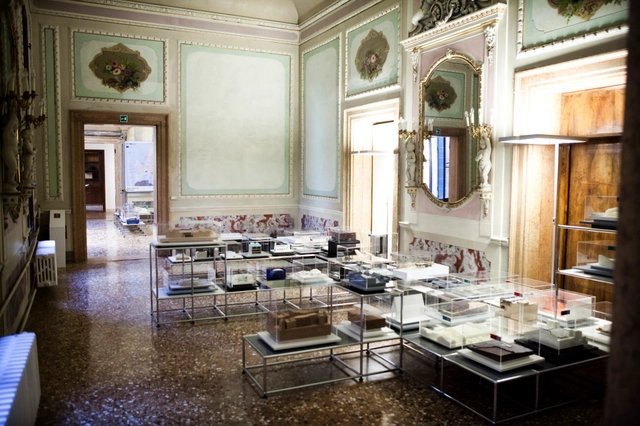
Showing an unparalleled examination of the development in European architecture over the past 25 years, the exhibition drew on the continent’s largest collection of documents (more than 2,500 projects and 230 original models) on contemporary architecture. On the site, you can sort and view projects by location, program, and author. Don't miss out on the opportunity to take advantage of this remarkable resource!
By the late 1960s, two dynamics were shaping a new urban reality in Italy: on the one hand, TV was heavily influencing Italian society, becoming an intrinsic part of daily life; on the other, the social tension resulting from student protests and accelerated immigration had begun to impact cities in a chaotic way. These dynamics paved the way for Milano Due, a new town on the outskirts of Milan, which promised a new, idyllic type of urbanism.
The complex, although traditional in appearance with its red pitched roofs, put into practice modern concepts: its 2,600 apartments, which had access to amenities for education and entertainment, were arranged around a giant artificial garden/lake and were connected via an elevated circulation system. Below ground, the complex housed the studios of the first private TV channel in Italy, a fact that would shape the lives of the inhabitants of Milano Due and eventually all of Italian society.
This interesting urban phenomena is analyzed by Andrés Jaque / Office for Political Innovation in “SALES ODDITY: Milano 2 and the Politics of Direct-to-Home TV Urbanism,” a project that was part of the Monditalia section at the Venice Biennale and was awarded the Silver Lion for the Best Research Project. According to the jury “The project presents critically a fundamental aspect of modern societies: how the power of media occupies other social spaces, both physically and politically. It is based on innovative research combining surveys and interviews with planners and residents and re-appropriation of the mass media language. While based on an Italian case, this issue is present in many international contexts dominated by contemporary technological and neo-liberal cultures.”
Dossier, trailer, and more photos of the project by Miguel de Guzmán, after the break:
With the first weekend of the Venice Biennale in the books, over the past few days reviews from critics have been flooding in. Each is eager to dispense their opinions on what has been one of the most highly anticipated Biennales in recent memory, and it seems that the event has not disappointed. From reviews of the festival as a whole to individual takes on the National Pavilions, read on after the break as we take a look at some of the most intriguing reviews so far.
The awards ceremony for the 14th International Architecture Exhibition have just wrapped and the results are in!
Rem Koolhaas, the director of the Biennale, Paolo Baratta, president of the Biennale, and the jury presented the awards for Lifetime Achievement and International Participations. The jury recognized that the Biennale was a tremendous opportunity to produce and share knowledge about modernity -- especially praising its role in uncovering and dissecting new areas of influence in the architecture world.
The Golden Lion for Best National Participation went to Korea for "Crow's Eye View: The Korean Peninsula" The jury cited Korea's "extraordinary achievement of presenting a new and rich body of knowledge of architecture and urbanism in a highly charged political situation."
Chile received the Silver Lion for a National Participation for "Monolith Controversies". The jury said, "Focusing on one essential element of modern architecture - a prefabricated concrete wall- it critically highlights the role of elements of architecture in different ideological and political contexts."
The Silver Lion for best research project in the Monditalia section went to Andrés Jaque/Office for Political Innovation for "Sales Oddity. Milano 2 and the Politics of Direct-to-home TV Urbanism."
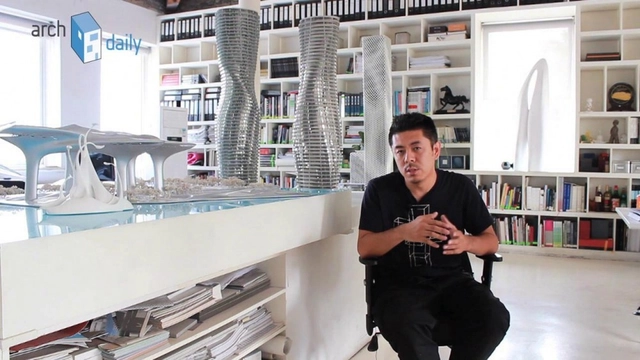
Ma Yansong, founder of MAD, has been named the 2014 Young Global Leader. The award, bestowed each year by the World Economic Forum (WEF), aims to "recognize the most distinguished leaders under the age of 40, nominated from around the world." Winning the title from a collection of 214 young leaders from 66 countries, Yansong is the first Chinese architect to be awarded this honour. According to the WEF, Yansong "commits himself to exploring the future of architecture by combining the city density, function, and the spirit of Shanshui, to reconnect the emotional link between human and nature." Watch our interview with Ma Yansong here.
Looking for something to do this week? If you are in the greater Los Angeles area, come check out the U.S. Department of Energy’s (DOE) sixth Solar Decathlon at the Orange County Great Park in Irvine. Currently on view through October 13, this (free!) event showcases nineteen student-built, solar-powered homes that claim to be exemplars of sustainable housing. After being closely monitored by the DOE throughout the length of the competition, one team will be crowned as winner for successfully blending affordability, consumer appeal, and design excellence with optimal energy production and maximum efficiency.
Catch a glimpse of each project, ranked in order of the current standings, after the break.
Although known for their iconic skyscrapers of glass and steel, SOM has begun to redefine our idea of the high-rise by pushing for wood as an alternative material for tall buildings. Not only could it help solve the worldwide problem of housing for those who are or will live in cities, but wooden skyscrapers could also address climate change by reducing a building's carbon footprint. Click here to read about the structural system that SOM has come up with and don't check out our previous coverage on the equally fascinating Timber Tower Research Project!
Videos
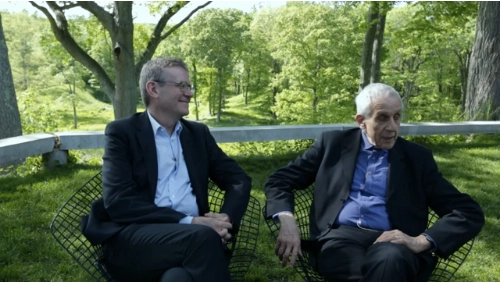
Mark Wigley with Kenneth Frampton, during the filming of The Glass House: “Conversations in Context”. Image Courtesy of http://vimeo.com/44405886
Mark Wigley announced Monday that he will be stepping down as dean of Columbia University's Graduate School of Architecture, Planning and Preservation (GSAPP) at the end of the academic year in 2014.
"In every context, he has represented the School and the institution in ways that make us all proud to be part of such a vibrant place," wrote Columbia President, Lee Bollinger, "And to all of it he has brought his unique humor and made us laugh."
https://www.archdaily.com/431160/mark-wigley-steps-down-as-dean-of-columbia-university-s-gsappJose Luis Gabriel Cruz
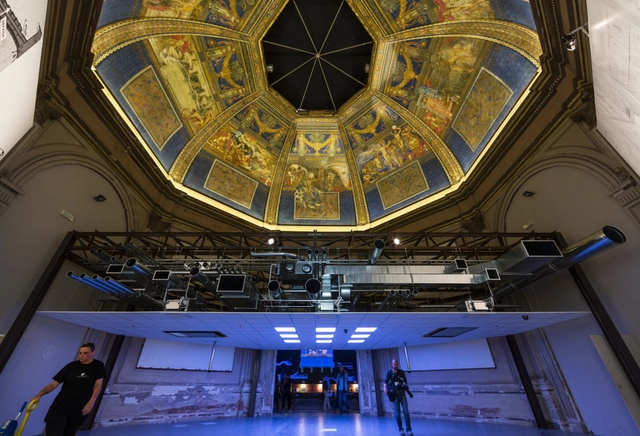
The Pinakothek der Moderne in Münich by Stephan Braunfels (2002) recently went through a complete renovation, and for the re opening of the museum Audi debuted the design wall, an installation that has become part of the permanent collection of the Die Neue Sammlung (The International Design Museum).
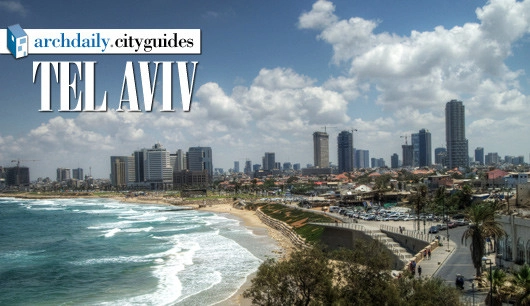
This AD Architecture City Guide is dedicated to the vibrant city of Tel Aviv, originally established as a garden-city on the sandy shores of the Mediterranean in 1909. Although widely known as “The White City” for boasting the world’s largest collection of International Style Buildings, Tel Aviv is not merely a monochromatic Bauhaus colony: it presents a rich mosaic of locally interpreted styles, from Eclectic to Brutalist to contemporary, which are the result of foreign and locally-born architects who adapted to the local cultural and climatic conditions.
Join us for our architectural city guide through the "Non-Stop City" after the break…
Something surprising has happened with many so-called “sustainable” buildings. When actually measured in post-occupancy assessments, they’ve proven far less sustainable than their proponents have claimed. In some cases they’ve actually performed worse than much older buildings, with no such claims. A 2009 New York Times article, “Some buildings not living up to green label,” documented the extensive problems with many sustainability icons. Among other reasons for this failing, the Times pointed to the widespread use of expansive curtain-wall glass assemblies and large, “deep-plan” designs that put most usable space far from exterior walls, forcing greater reliance on artificial light and ventilation systems.
Partly in response to the bad press, the City of New York instituted a new law requiring disclosure of actual performance for many buildings. That led to reports of even more poor-performing sustainability icons. Another Times article, “City’s Law Tracking Energy Use Yields Some Surprises,” noted that the gleaming new 7 World Trade Center, LEED Gold-certified, scored just 74 on the Energy Star rating — one point below the minimum 75 for “high-efficiency buildings” under the national rating system. That modest rating doesn’t even factor in the significant embodied energy in the new materials of 7 World Trade Center.
What's going on with these supposedly "sustainable" buildings? Read on, after the break...






.jpg?1402138225)