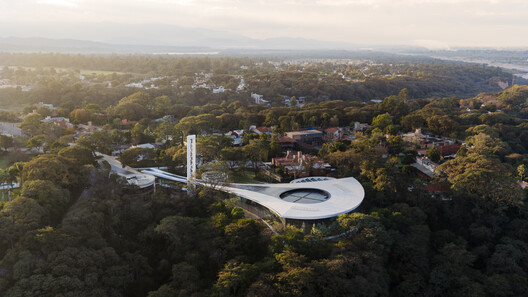
Pelli Clarke & Partners has completed the Lola Mora Cultural Center in San Salvador de Jujuy, Argentina, a new cultural institution dedicated to the life and work of Argentine sculptor Lola Mora (1866-1936). Located in the country's northwestern region, the project is the firm's first cultural building in South America and the final project led by its founder, the late César Pelli. Designed as a net-zero facility, the center brings together six of Mora's monumental marble sculptures for the first time in more than a century, providing a permanent home for works that were previously displayed outdoors in Jujuy.
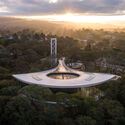
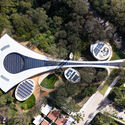
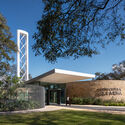
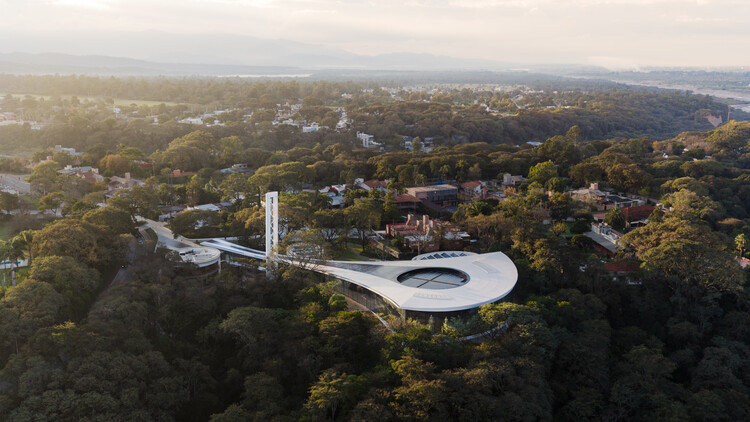
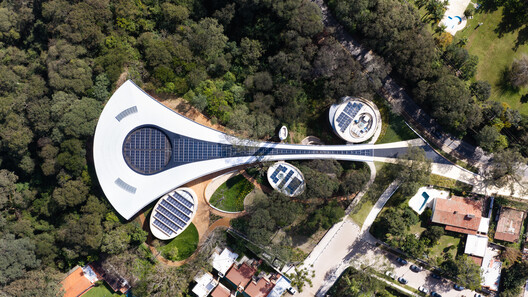
Located on a hillside overlooking San Salvador de Jujuy, the building sits at the edge of the Andes Mountains and is surrounded by the subtropical Yunga forest. Its curved form follows the site's topography and is arranged around existing native trees, while a bridge spanning a natural ravine provides access to the main entrance. The program includes exhibition galleries, an interpretation center, a library, a restaurant, a gift shop, and spaces for temporary exhibitions and visiting artists.
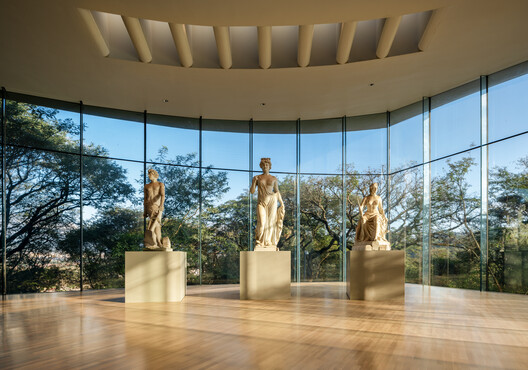
The center houses six allegorical sculptures carved in Carrara marble by Lola Mora, one of Argentina's earliest internationally recognized sculptors. Originally commissioned for the inauguration of the Argentine National Congress Palace in Buenos Aires in 1906, the works were removed from the site approximately fifteen years later and donated to the province of Jujuy. After more than a century of exposure to outdoor conditions, the sculptures -The Lions, Liberty, Progress, Work, Peace, and Justice- are now displayed within a purpose-built facility designed for their conservation and interpretation.
Related Article
MAD Completes Shenzhen Bay Culture Square, a Coastal Design Museum and Public Park in ChinaLandscape design for the project was developed by Balmori Associates, the practice founded by landscape architect Diana Balmori. Preservation of the site's ecological conditions informed both the landscape and architectural strategies, with the building carefully positioned among existing vegetation and adapted to the natural terrain. The project team describes the design process as one shaped by the characteristics of the site, collaboration with local stakeholders, and engagement with the cultural history of the region.
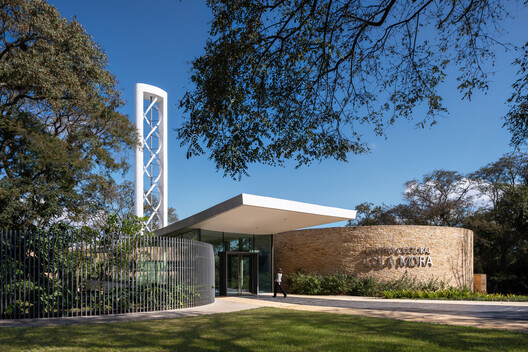
Environmental performance informed several aspects of the project's design. A vertical tower housing five wind turbines serves as a landmark within the landscape and contributes to the building's energy generation. Together with photovoltaic panels and solar thermal collectors, these systems are designed to meet the center's operational energy needs, while a high-performance envelope and efficient mechanical systems help reduce energy consumption. Additional environmental strategies include rainwater harvesting for landscape irrigation and a series of small dams integrated into the ravine to slow runoff and mitigate erosion. The project also incorporates locally sourced materials, including stone cladding, to reduce transportation-related impacts and support regional supply chains.
Recent project news includes the completion of major cultural and residential developments. MAD / Ma Yansong's Shenzhen Bay Culture Square, begun in 2018, is now complete, comprising a 188,000 m² cultural complex and park on Shenzhen's waterfront. The 3XN, B+H Architects, and Zhubo Design consortium has also completed the 100,000+ m² Shenzhen Natural History Museum, the largest of its kind in South China. In Amsterdam, OMA's The Martin has been completed as part of the transformation of the former Bijlmerbajes prison into an energy-neutral mixed-use neighborhood, following The Jay in 2025 and ahead of The Cardinal, due in 2030.