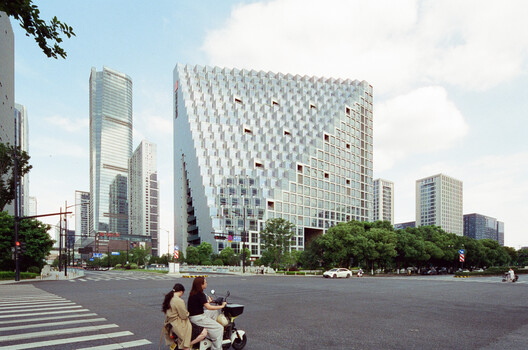
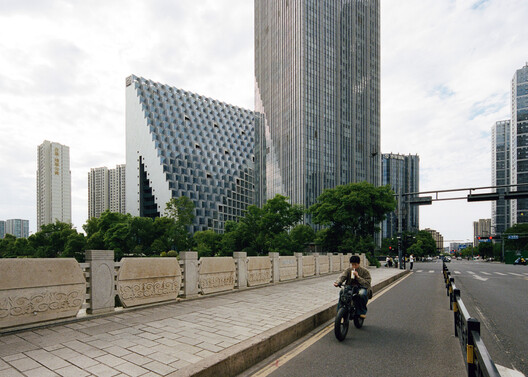
OMA has completed the Hangzhou Prism, a large-scale mixed-use development in Hangzhou's Future Tech City district, China, following a design and development process that began in 2016. Commissioned by Xinhu Real Estate Group and led by OMA Partner Chris van Duijn, with Michael Hadjistyllis serving as project architect, the project combines residential units, a hotel, offices, commercial spaces, and public amenities within a single building volume. Marking OMA's first completed project in Hangzhou, the development occupies a central site within one of the city's emerging innovation and business districts.
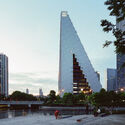
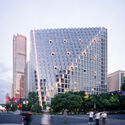
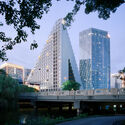
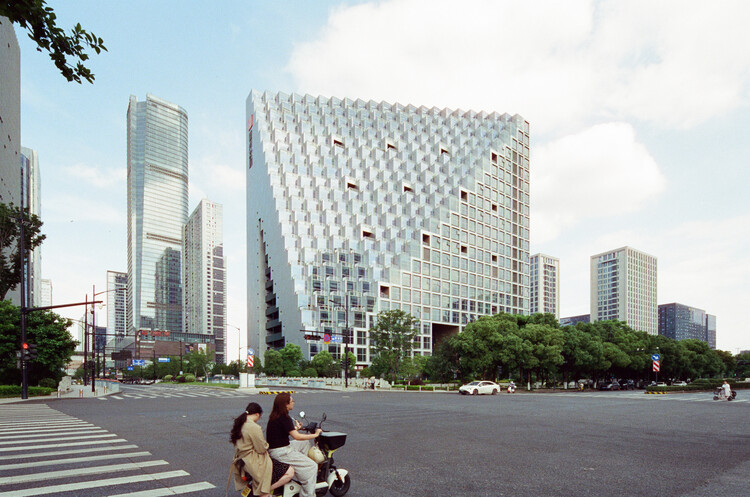
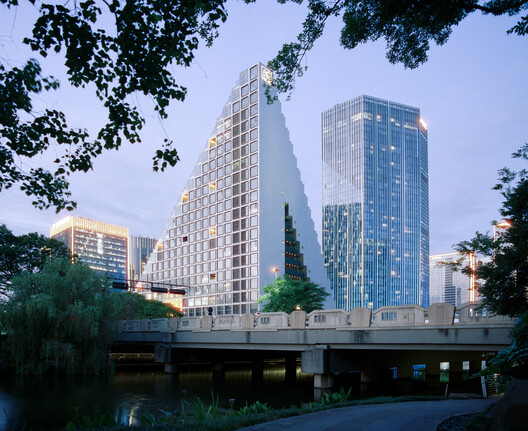
The building is defined by a pyramidal form shaped by two large oblique cuts that carve through its mass. These incisions establish visual connections between the development and significant elements of its urban context, including the high-speed rail station to the northwest and a public park to the southeast. The resulting geometry creates a distinctive silhouette while generating a series of terraces and outdoor spaces distributed throughout the structure. Situated at the core of Future Tech City, the project highlights the relationship between private programs and the public realm. Rather than functioning as an isolated development, the building is connected to the surrounding street network, adjacent canal, and nearby green spaces. Its open site strategy aims to enable pedestrian access through the project and integrate it into the broader urban environment.
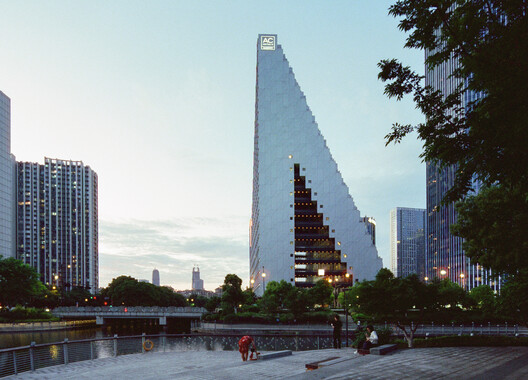
At the base of the building, a large outdoor atrium forms a publicly accessible civic space. Conceived as an extension of the surrounding public landscape, the square is planned to accommodate a range of activities and events while providing an area for informal gathering. This open ground-level condition establishes a porous interface between the building and the city, encouraging movement through the site and supporting different forms of public use.
The project's program is organized to accommodate a diverse range of users, including residents, hotel guests, office workers, and visitors. Residential lofts are positioned to provide privacy and access to individual outdoor terraces, while a network of shared gardens, terraces, and communal amenities introduces opportunities for interaction. These collective spaces are distributed throughout the building, creating connections between otherwise distinct functions and user groups. According to OMA, the project reconsiders the conventional model of residential tower clusters by consolidating multiple programs within a single structure. The design emphasizes spatial connectivity and the integration of shared environments, seeking to balance private occupation with collective use.
The completion of the Hangzhou Prism joins a series of recently completed and emerging projects worldwide. Among them are Studio Gang's Samuel H. Scripps Theater Center, the new permanent home of Hudson Valley Shakespeare in New York, and Safdie Architects' major expansion of Crystal Bridges Museum of American Art in Arkansas. In Paris, Herzog & de Meuron's Tour Triangle is also nearing completion, bringing to fruition a project that has shaped debates around the city's skyline for nearly two decades.