

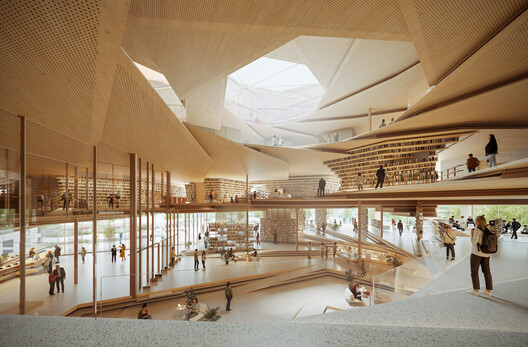
Kengo Kuma and Associates was recently awarded first prize in the competition to design a new library in Rzeszów, the capital of the Subcarpathian Voivodeship in southeastern Poland. The city, home to nearly 200,000 residents, lies on the Wisłok River and is known as a center for the aviation industry. Strategically positioned along the main Kraków-Lviv railway and road corridor, it also serves as an important transit point near the Ukrainian border. Located on Józef Piłsudski Avenue, the new library is conceived as a connector between the Marshal's Office of the Podkarpackie Voivodeship and the nearby Secondary School Complex, reinforcing the area's civic character. The program combines traditional library functions with cultural, educational, and artistic spaces. In addition to reading and collection areas, an expanded event zone includes a music hall, multifunctional hall, conference rooms, and administrative areas. A spiraling library volume forms the tallest element of the complex, while event spaces and roof terraces extend the program outward, linking the building's activities with the surrounding city.
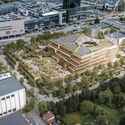
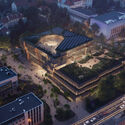
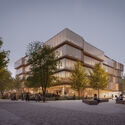
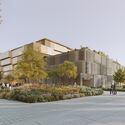
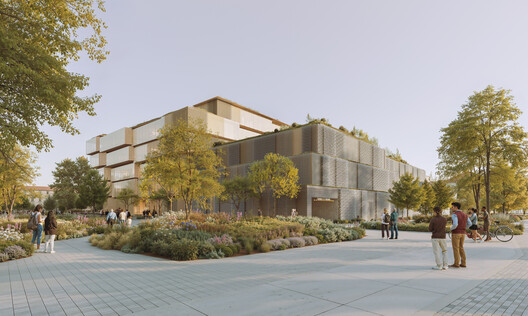
The project's position responds to its urban setting. Its form establishes a green buffer along the existing trees of the avenue, while the main entrance, set back from the primary artery, shifts attention toward the quieter southeastern part of the site facing the city center. This positioning introduces visitors to an atmosphere of concentration before entering the building. A "quiet promenade" running alongside the Marshal's Office facilitates a gradual transition from urban bustle to the library interior. Softly defined boundaries, incorporating greenery, low seating, pergolas, and unified paving, create continuity between the city and the project. Cycling and micromobility are prioritized near the entrance, with covered bicycle parking, service points, and underground electric charging outlets. Parking is arranged in pocket configurations, with accessible spaces located close to the entrance and longer-term parking near the Marshal's Office, designed for potential future adaptation. Mobility nodes connect the site to public transport, while varied external surfaces, durable slabs in high-traffic zones, and permeable paving in recreational areas, support water infiltration and thermal comfort.
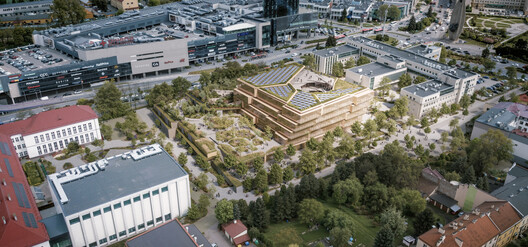
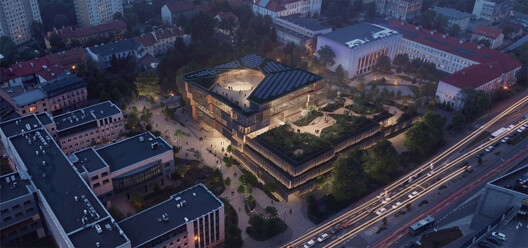
An entrance plaza acts as the project's primary gathering space, structured by pathways that follow natural pedestrian routes. The main axis leads directly to the foyer, while secondary paths and ramps connect terraces and a green roof, forming a continuous public promenade from ground level to rooftop. Concealed infrastructure, including 230/400V power connections, water supply, and drainage, allows the plaza to transform quickly into an event venue for book fairs, concerts, and public gatherings without visible technical equipment. Deliveries and logistics are separated from public areas through a dedicated service corridor leading to back-of-house and waste facilities. Fire access routes encircle the building, with maneuvering areas and hydrants carefully positioned to avoid conflicts with pedestrian movement. The design follows universal design principles to ensure full accessibility. Barrier-free routes connect all areas, while textured paving, tactile maps, Braille signage, induction loops, and low-glare lighting support inclusive use. Until the full event zone is completed, reserved areas will function as temporary gardens.
Related Article
Polish Pavilion at the 2025 Venice Architecture Biennale Investigates Architecture’s Role in Providing Security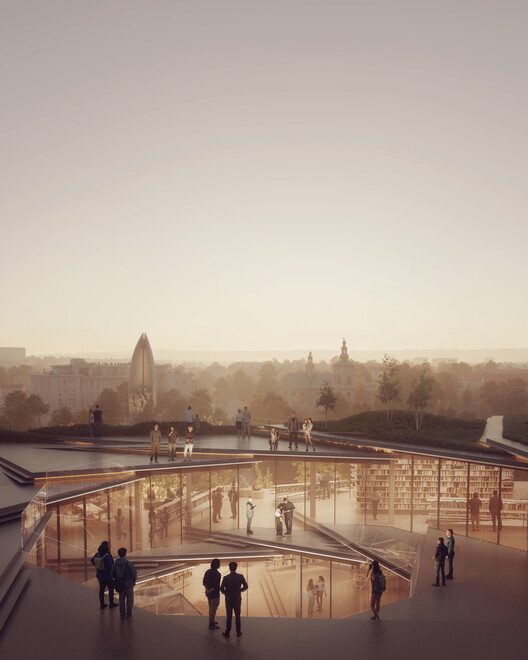
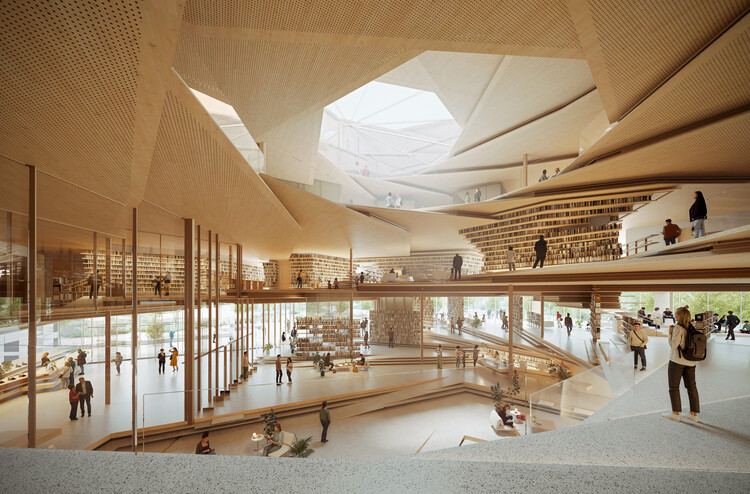
The building's form is defined by a spiral layout, the "vortex" that guides visitors from the ground-floor lobby to the rooftop terrace. Platforms rise gradually, while an external green ring wraps the structure, introducing planted terraces at higher levels and maintaining visual contact with both nature and the city. A cubic core is surrounded by lower, stepped volumes culminating at the library's peak, and multiple entrances offer varied spatial experiences depending on approach. The façade follows the spiral geometry, breaking the mass into smaller fragments that bring its scale closer to human perception. Glass panels with embedded champagne-toned metal mesh create a metallic glow by day and reveal interior activity at night. Exposed natural wood and mesh screens of varying density generate a layered interplay of transparency and shadow, while a green filter along Piłsudski Avenue softens the elevation.
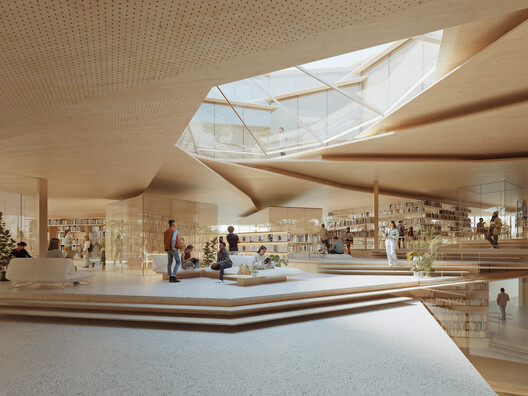
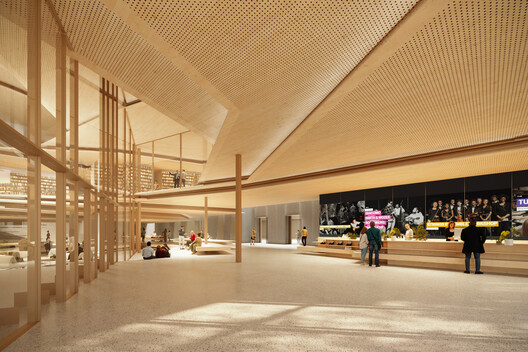
The hybrid structural system combines CLT (cross-laminated timber) or LVL ribbed panels with steel columns. Layered slabs integrate HVAC channels and structural reinforcement, with two 450 mm slabs forming a 900 mm-deep section capable of spanning approximately six meters. Steel inserts ensure load transfer at slab offsets. The use of renewable, carbon-storing timber reduces embodied carbon compared to reinforced concrete, while certified FSC/PEFC wood aligns with sustainability standards. The façade incorporates insulated glazing with integrated metal mesh for solar control, thermal performance, recyclability, and bird-safe visibility. Green-blue infrastructure, including rain gardens, infiltration strips, and tree canopies, enhances environmental performance. Fire safety requirements are met through non-combustible reinforced concrete, steel components, and protected timber elements.
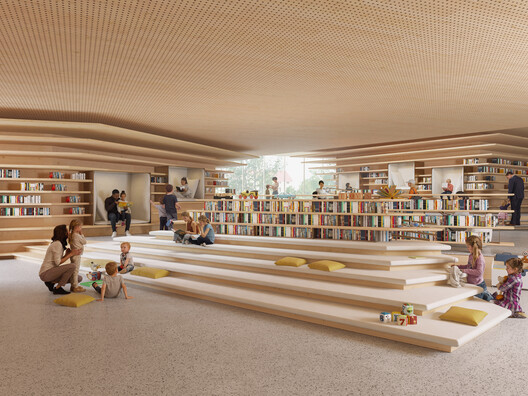
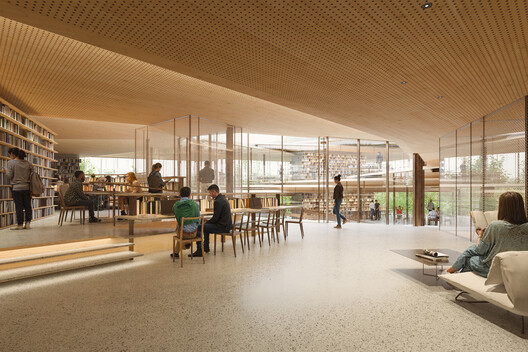
The library integrates architectural and energy strategies under the principle "Reduce – Produce – Store." Green terraces, deep overhangs, selective glazing, and passive shading reduce energy demand. Photovoltaic panels on roofs, shelters, and balustrades (BIPV), along with quantum-dot PV glazing, generate renewable energy, while smart skylights limit overheating. Surplus energy is stored as green hydrogen using electrolyzers and fuel cells operating in cogeneration mode. Heat pumps, high-efficiency heat recovery, LED lighting, predictive building management systems, and green roofs further enhance performance. Passive strategies include rainwater retention, high-performance envelope design, daylight optimization, and natural ventilation supported by automated façade openings and stack effect. Active systems comprise mechanical ventilation, a ground-source heat pump with district heating backup, underfloor heating and cooling, and integrated air distribution.
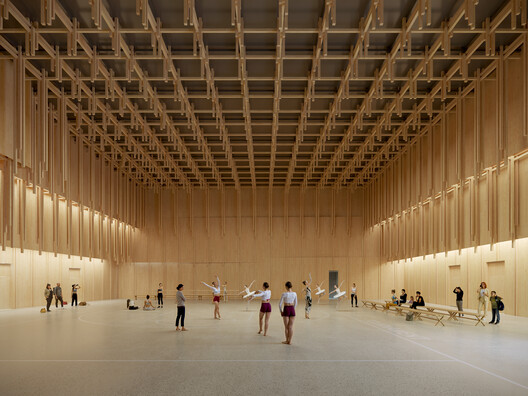
So far, the announcement does not include information regarding the project's implementation timeline or the start of construction. Phase one comprises the main library and entrance foyer, while the remaining portion of the plot will temporarily function as a garden and public plaza. Phase two comprises the expanded event zone, which includes a music hall, multifunctional hall, conference rooms, and administrative areas. Other recently announced projects of community interest include a new public library in Rio de Janeiro, Brazil, designed by Kéré Architecture; the selection of a team led by Níall McLaughlin Architects (NMLA) as the competition winner for the new Museum of Jesus' Baptism at Bethany, Jordan; and newly released renderings by WEISS/MANFREDI revealing updated plans for the ongoing transformation of the La Brea Tar Pits in Los Angeles, a comprehensive redesign integrating the museum, landscape, and active excavation areas into a continuous public and research-oriented campus.
Project Credits
Design Team:
KKAA - Kengo Kuma, Marcin Sapeta (partner), Nicolas Cazali, Olga Skrbenska, Zishen Pan, Pei-Ju Lin, Victoria Boutroux, Ethan Chiang, Polina Kazakevich, Hidde Dijkstra, Patryk Druzgała, Max Lesur, Yusuke Ito
Schick Architekci by TKHolding Truszczyński Kobierzewski - Andrzej Truszczyński, Paweł Kobierzewski, Maciej Obszańki, Dominik Kowalski, Patryk Prychodko, Kamil Kowalski, Natasza Ścibisz
CG: KIN Creatives and VIBSU
Physical model: Archimod
Consultants: Landscape - MASU Planning, Structure - Structured Environment and Häring Timber Technology AG, MEP/Acoustic/Façade - Buro Happold


