



-
Architects: Sturgess Architecture
- Area: 450 m²
- Year: 2014
-
Manufacturers: Kuraray
-
Professionals: Read Jones Christoffersen, PCL Construction Management Inc.



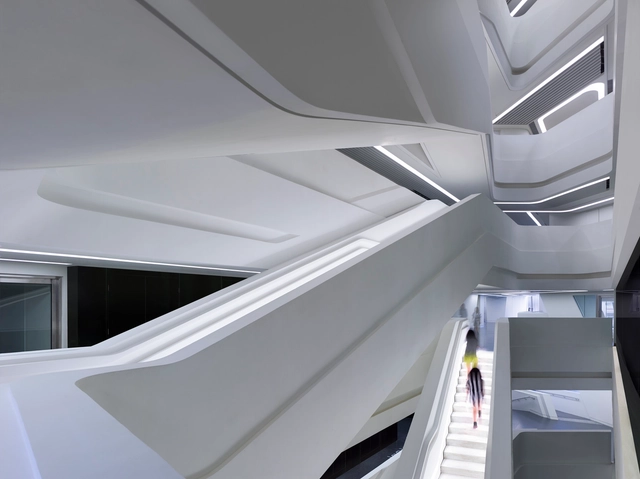
Apertures reflect a current architectural discourse of digital ecologies, emphasizing the relationship between the natural world and advances in digital technology, which leads to a new type of interactive, organic buildings. The installation focuses on a symbiotic relationship between nature, building morphologies, and material expression.
Rooted in Baumgartner+Uriu’s work and ongoing research, Apertures challenges the notion of an architectural opening as a static object. Moreover, it aims to redefine the DNA of a window both in terms of its appearance and materiality, as well as its nature as an object in continuous flux, responding to its environment through movement or sound. The pavilion and its apertures are designed to physically engage the visitor with the architectural work through sensors and sound feedback loops creating an immersive spatial environment in which the visitor can experience their own biorhythms.

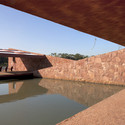
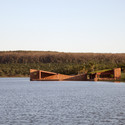
Five young design graduates based in Britain have recently won a competition to design an artist’s residency in the south-western region of the United Kingdom. Titled "The Observatories," these residences are split into two separate volumes: a study and a workshop. Artists will be able to live in the private back section of the study, which has a fold-out bed and necessary amenities. The workshop will be more open, allowing artists to teach and engage with the public. Both volumes are capable of rotating 360 degrees, giving residents a fresh frame of view, and facilitating interaction between these residents and passerby.


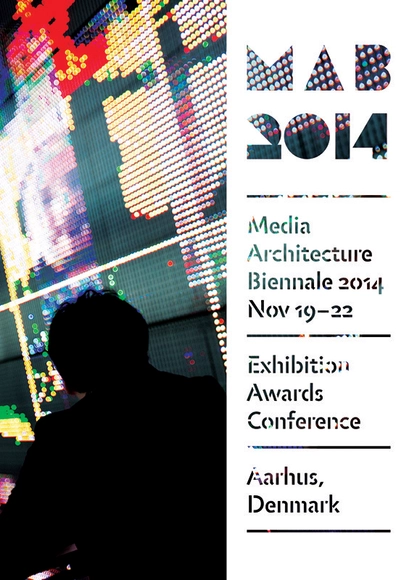
Architects, designers and artists meet with academia and industry, when the world’s premier media architecture event takes place on 19-22 November in Aarhus, Denmark, with a pre-event in Copenhagen.
The biennale brings together people and organizations that work with media and the built environment: With media facades, with urban screens and with buildings that communicate – be it with colorful LEDs, flashing light bulbs, or with heat-sensitive concrete that ’freezes’ the shadows of passers-by. Across professions and nationalities, participants will create and discuss the media architecture of the future. And they will investigate how media architecture shapes people’s lives in the cities of the world.
More information after the break.