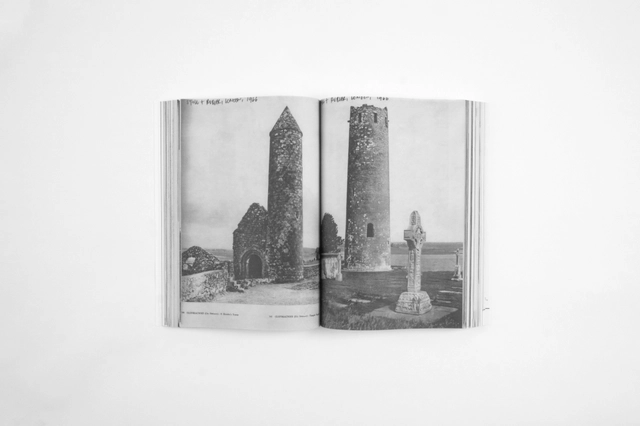
Earlier this year San Rocco, recipients of the inaugural Icon Award for Emerging Architectural Practice of the Year in 2013, published a limited single-edition run of a new publication: the San Rocco Book of Copies. Within five volumes of 4120 pages lies what they describe as "a database comprised of images that may be copied in order to produce architecture; a receptacle of a collective form of knowledge that we can provisionally call 'architecture'."
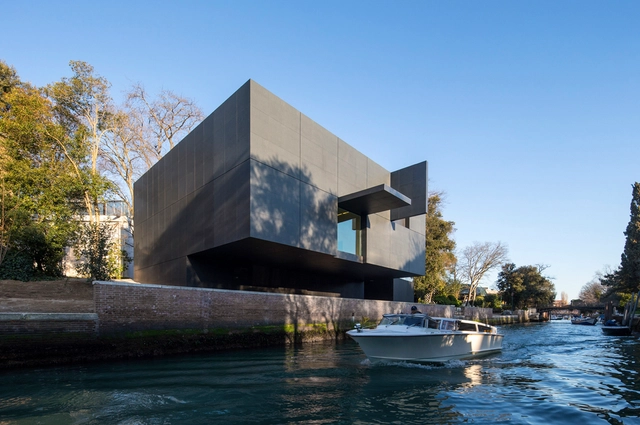
Australia’s new pavilion for the Venice Biennale has been officially completed by the Australia Council for the Arts. Designed by Australian practice Denton Corker Marshall, the granite-clad building is the first pavilion to be built in Venice in the 21st century, and replaces Philip Cox’s 1988 structure. The pavilion is to welcome its first visitors from May 9, as part of the 56th International Art Exhibition, with the work of artist Fiona Hall comprising its inaugural exhibition.
Learn more about the pavilion and view selected images after the break.
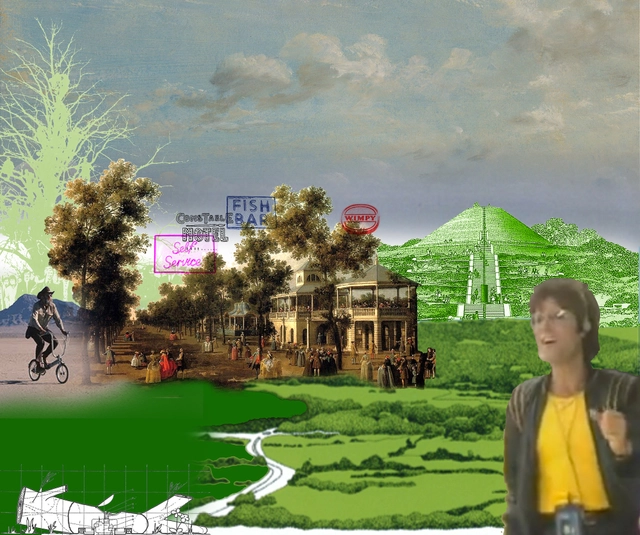
A ClockworkJerusalem, the exhibition showcased in the British Pavilion at last year's Venice Biennale, will make it's UK debut at London's Architectural Association (AA) next month. Commissioned by the British Council and curated by Sam Jacob, co-founder of FAT, and Wouter Vanstiphout, partner at Dutch practice Crimson Architectural Historians, the exhibition shines a light on the large scale projects of the 1950’s, 60’s and 70’s by exploring the "mature flowering of British Modernism at the moment it was at its most socially, politically and architecturally ambitious - but also the moment that witnessed its collapse."
Lateral Office'sArctic Adaptations exhibition, which was recognised with a Special Mention at the 2014 Venice Biennale, will travel make its debut in Canada at the Winnipeg Art Gallery this week before heading to Whitehouse, Vancouver, and Calgary. The exhibition "surveys a century of Arctic architecture, an urbanising present, and a projective near future of adaptive architecture in Nunavut" though interactive models, photography, and topographical maps of the twenty five communities of the area, as well as Inuit carvers’ scale models of some of the most recognised buildings in the territory. In addition, it proposes a future of adaptive and responsive architecture for Canada's northern territories.
Fundamentals, the title of the 2014 Venice Biennale, will close its doors in a matter of days (on the 23rd November). From the moment Rem Koolhaasrevealed the title for this year’s Biennale in January 2013, asking national curators to respond directly to the theme of ‘Absorbing Modernity 1914-2014’, there was an inkling that this Biennale would be in some way special. Having rejected offers to direct the Biennale in the past, the fact that Koolhaas chose to act not only as curator but also thematic co-ordinator of the complete international effort, was significant. This announcement led Peter Eisenman (one of Koolhaas' earliest tutors and advocates) to state in one interview that “[Rem is] stating his end: the end of [his] career, the end of [his] hegemony, the end of [his] mythology, the end of everything, the end of architecture.”
In this extended interview between Bernard Tschumi and The Architectural Review's Paul Finch, the pre-eminent Swiss-born architect discusses his education, writing, design and wider critical position. Speaking candidly, Tschumi explains how a visit to Chicago when he was seventeen years old sparked a life-long passion for architectural design - something that had been somewhat repressed due to his father who was, at that time, one of the world's most highly respected architects. His friendship with British architect and theorist Cedric Price led to the start of a career that saw his proposals for Paris's Parc de la Villette foreshadow the age of Deconstructivism. Ending with his take on the future of the profession, Tschumi also offers advice to students and young practices looking to make their mark.
House Housing, "An Untimely History of Architecture and Real Estate in Nineteen Episodes", was recently exhibited at Columbia University'sCasa Muraro in Venice. Staged as an "open house" organised and funded by the Buell Center, the exhibition responded unsolicited to Rem Koolhaas's call to exhibitors at the 2014 Venice Biennale to focus on Fundamentals by exploring housing in nineteen "discrete episodes." In narrating these episodes, brought together from across the last one hundred years in a mixture of domestic media, the exhibition brought together a collection of excerpts from global processes.
Arguing that the previous thirteen Biennales have, "more or less, tried to predict what is going to happen over the next five years," "Rem Koolhaas has changed the paradigm:" Rem's Biennale is about "the past of the present". Jencks, who describes Koolhaas as "the Corbusier of our time", suggests that his Biennale is about analysis rather than total synthesis. He has, however, "shown that research can be creative."
Videos
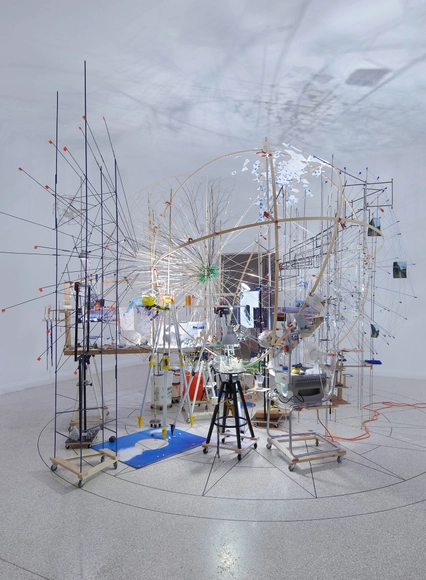
Wood, steel, plastic, stone, string, fans, overhead projectors, photograph of rock printed on Tyvek, mixed media at Triple Point (Planetarium), 2013. Image courtesy of Sarah Sze, Tanya Bonakdar Gallery, New York, and Victoria Miro Gallery, London. Photograph by Tom Powel Imaging
Is that rock inside or outside? Wait, is it even a rock? If not, then what is it? As bizarre as these questions may seem, they are the exact ones Sarah Sze wanted people to ask themselves when visiting her Triple Point (Planetarium) exhibit in the United States Pavilion at the 2013 Venice Biennale. Sze, whose work tends to distort the viewer's perception of reality, "transformed the U.S. Pavilion into a chain of immersive experiences through a series of interrelated installations."
Although the project was specifically designed to engage the Neoclassical Pavilion, part of it will be on display at the Bronx Museum of the Arts from July 3rd through August 24th of this year. For more on the artist and the exhibit, keep reading after the break.
Norwegian architect and Pritzker LaureateSverre Fehn’s original drawings for the Nordic Pavilion in Venice are to be presented alongside Ferruzzi’s monochromatic photographs of the building in an exhibition at the National Museum of Architecture in Oslo. Venice: Fehn’s Nordic Pavilion documents the incredible task undertaken by Fehn who, at the age of thirty-four, won the competition to design the pavilion and subsequently won international acclaim when the building was completed in 1962.
Writing about radical architects from the 1960s and 70s, the acerbic American critic Michael Sorkin wrote: “Some chose the resistance of advocacy planning and community defense, carrying on the identification with the oppressed. Many took to the woods, back to nature, to study communitarianism and to live a life of virtuous simplicity. Others wondered about the architectural equivalent of rock and roll.” Replace communitarianism with open source, or rock and roll with science fiction, and he could just as well be describing a group of young Italian architects working today. The practitioners of the 1970’s, especially in Italy, transformed their profession but ultimately failed to realize their utopias. What might this new generation achieve?
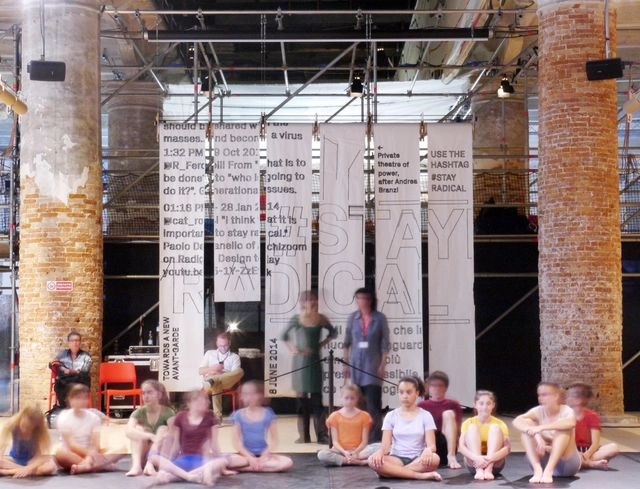
Towards a New Avant-Garde, an installation and series of discussions at the opening weekend of the Venice Architecture Biennale, will confront the work and approaches of past masters like Superstudio, Archizoom, and the Global Tools group with new, speculative, and politically-charged projects by groups like Itinerant Office, IRA-C, and Snark.
As Rem Koolhaas completes the introductory press circuit for the 2014 Venice Biennale, we're learning more about one of the most anticipated Biennales in recent memory. Here's what we've gleaned from Oliver Wainwright's revealing story in today's Guardian:
1. Koolhaas has been asked to direct the Venice Biennale before, but hasn't accepted until now. "I have been asked to direct it a number of times before, but I held out for two conditions: that I have a year and a half to plan it, and that I can sever all connections with contemporary architecture – which is not in particularly good health."
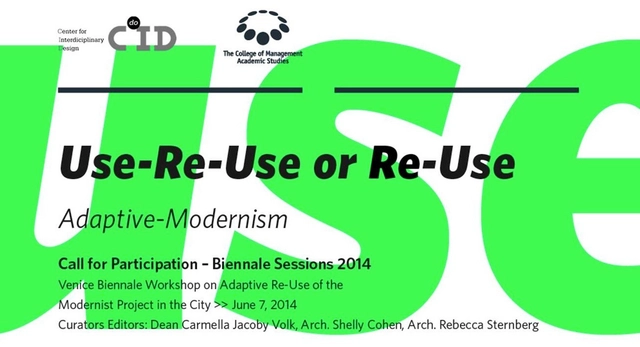
The Use-ReUse Adaptive Modernism Workshop will be held on June 7, 2014, during the opening day of the 14th International Architecture Exhibition of the Venice Biennale. It will be part of the 'Biennale Sessions 2014', Biennale's University Programme, a forum for universities. Its purpose is to suggest a wide range of perspectives on the contemporary significance of modernisms built legacy, within the context of the contemporary urban landscape.
“Recognized by all for its efficiency,” the pavilion that Álvaro Siza designed for last year’s Venice Bienniale of Architecture will remain on display and be utilized as “additional space” by the new curators in 2014 and 2016.
At a presentation in Italy this morning, Rem Koolhaas announced that the title of the 2014 Venice Biennale will be "Fundamentals." According to Domus magazine's live-tweeting of the event, Koolhaas wants this Biennale, which he will curate, to use historical research to explore how Modernity and globalization has, since 1914, formed the architecture we practice today. The Biennale will focus on the erasure of national architectural identities and the formation, over the last 200 years, of a global architecture which produces, in Koolhaas' words, "the same stuff, with the same materials, in the same styles. How did this happen?"
Read more about Koolhaas' 2014 Biennale topic, after the break...
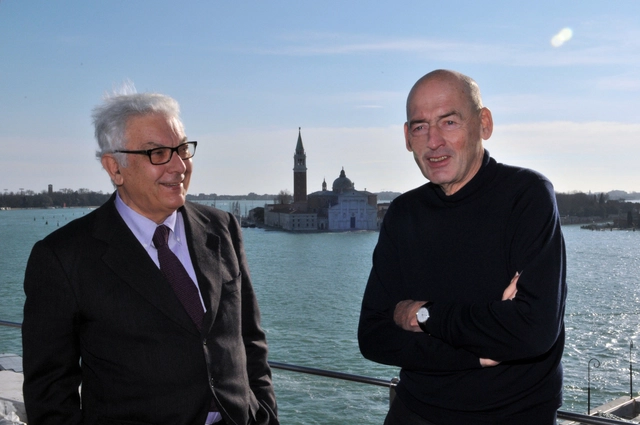
It seems the rumors were true. The Venice Biennale’s board has just confirmed that Rem Koolhaas will be the Director for the next Venice Architecture Biennale in 2014 (to take place June 7th to November 23rd).