Hokkaido-born Sou Fujimoto’s breakout masterpiece, the playful and cloud-like 2013 Serpentine Pavilion says a lot about who Fujimoto is and how he thinks about architecture. But even more so do the 100-plus sometimes painstakingly refined, sometimes roughly executed exploratory models that dot the minimalist gallery space of Japan House Los Angeles. This, his retrospective show, Futures of the Future, neatly reflects on Fujimoto’s career, which began when he opened his own Tokyo-and-Paris-based firm in 2000.
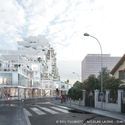
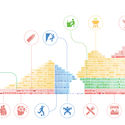
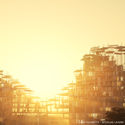
Sou Fujimoto, Nicolas Laisné and Dimitri Roussel will be building a new gateway to the city of Rosny-sous-Bois in Grand Paris. Their project, Village Vertical, has been chosen as the winning proposal for the "Inventons la Métropole du Grand Paris" competition. The team includes landscape and urban designers from Atelier Georges and urban developers from La Compagnie de Phalsbourg and REI Habitat.
Architecture meets the outdoors in Sou Fujimoto's L’arbre Blanc housing tower, under construction in Montpeller, France. Image Courtesy of SFA+NLA+OXO+RSI
The destruction wrought upon Ishinomaki by the 2011 Great East Japan Earthquake and Tsunami damaged the city’s civic hall and cultural center beyond repair. To rebuild, Ishinomaki City wanted to create a landmark combining these two facilities into a new complex—one that would be like a city unto itself, serving the community.
In 2016, design proposals were screened in a process that included public presentations, with many locals participating. In the end, Sou Fujimoto, a leader among the next generation of Japan’s architects, was selected for his innovative design.
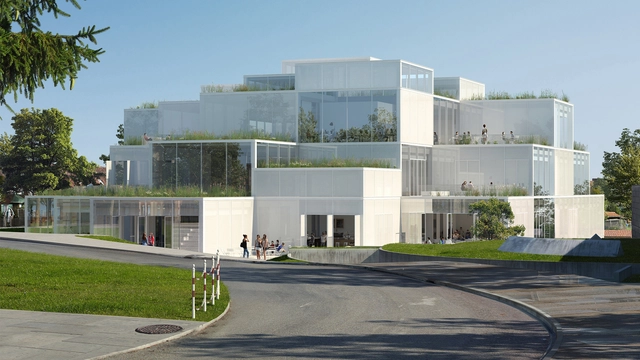
Sou Fujimoto Architects has been selected as the winner of a competition to design the new HSG Learning Center at the University of St. Gallen in Switzerland.
Chosen from a shortlist of 8 teams, Sou Fujimoto Architects’ proposal “Open Grid – Choices of Tomorrow” received the highest marks across the following criteria: architecture and urban planning, innovation in concept execution, functionality, sustainability and economic efficiency. According to the competition jury, the project was notable for its “highly developed didactic concept, compatibility with the district, architectural ambition and affordability.”
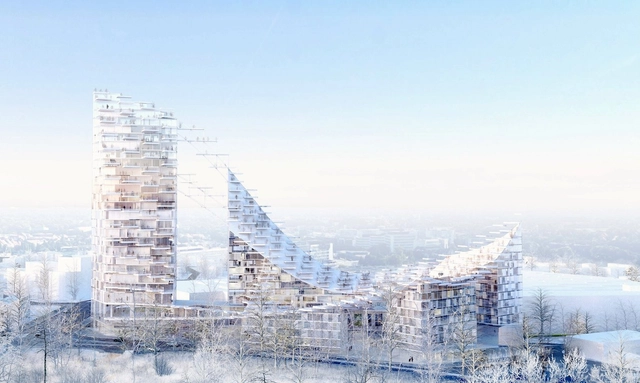
The Japanese/Belgian team of Sou Fujimoto Architects and AWAA has been selected as the winners of an international competition for the design of a new tower to be located at a significant crossroads in the outer Brussels municipality of Auderghem.
Led by developer Unibra and construction company Thomas & Piron, the competition asked architects to propose a new mixed-use urban development of between 25,000 and 50,000 square meters that would activate the the prominent triangular site at the corner of the Herrmann-Debroux viaduct and the Boulevard du Triomphe.
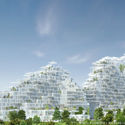
Early renderings for the project show a series of sloping residential highrises growing out of a mixed-use podium, including one taller tower and a longer building featuring a concave roof. The various structures appear to be connected at key points via lightweight terraces housing plantings.
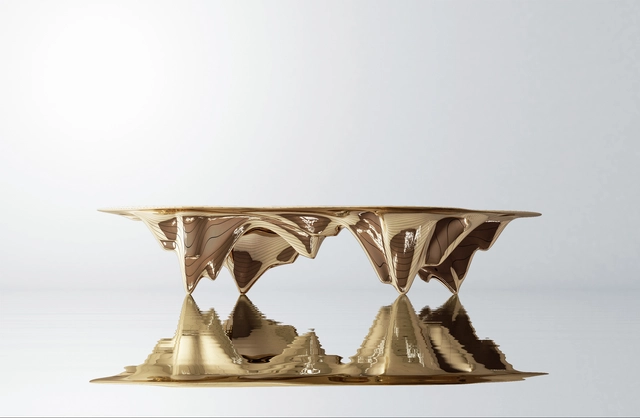
Table, MAD Martian Collection by MAD Architects. Image Courtesy of MAD Architects
With Design Miami/ Basel 2017 well underway (from June 13-18), ArchDaily has compiled a list of the best architect-designed furniture pieces on display at the event. This year, notable items include works by MAD Architects, Christ & Gantenbien, Trix & Robert Haussman, John Lautner, Jonathen Muecke, Jean Prouvé and Sou Fujimoto.
The Ross Development Trust, in collaboration with the City of Edinburgh Council and Malcolm Reading Consultants, has announced the seven finalists teams that will compete for the design of the new Ross Pavilion in the heart of Edinburgh, Scotland. Located in West Princes Street Gardens below Edinburgh Castle and at the intersection of the UNESCO World Heritage recognized Old and New Towns, the £25 million project will feature a landmark pavilion to replace an existing bandstand, a visitors center with cafe, and a subtle reimagination of the surrounding landscape. The new pavilion will host a range of cultural arts programming.
From an entry pool of 125 teams, the following seven were unanimously selected to continue on to the second stage of the competition:
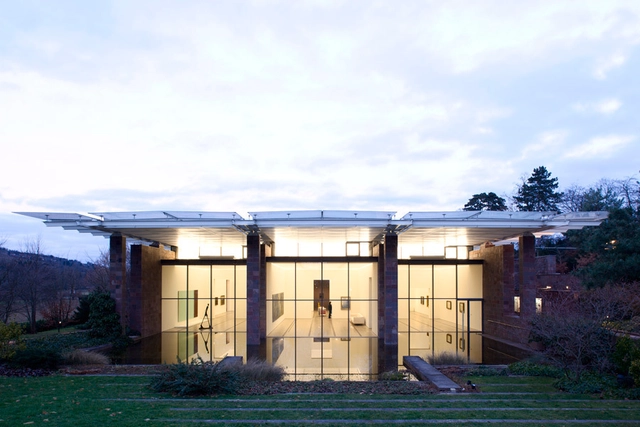
The office of Peter Zumthor has been selected to design an expansion to the Beyeler Foundation, located just outside Zumthor’s childhood home of Basel, Switzerland. The Swiss architect was chosen from a prestigious shortlist of 11 firms to add to the existing museum building, designed by Renzo Piano Building Workshop and completed in 1997.
“The sky above Basel, the city and its surroundings–those are the landscapes of my youth,” said Zumthor. “It is heart-warming to be able to design a major building here.”
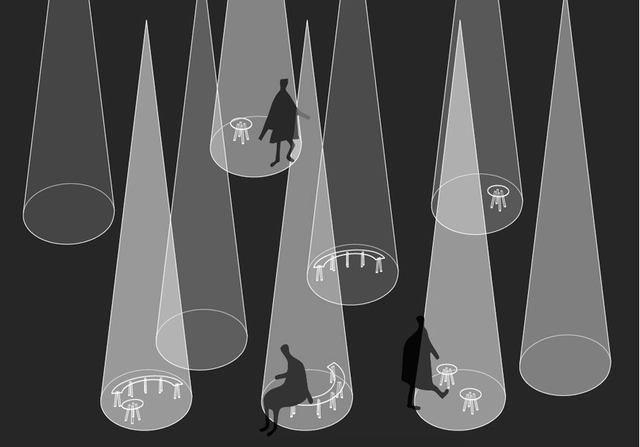
"In this installation for COS, I envisage to make a forest of light," said Fujimoto. "A forest which consists of countless light cones made from spotlights above. These lights pulsate and constantly undergo transience of state and flow. People meander through this forest, as if lured by the charm of the light. Light and people interact with one another, its existence defining the transition of the other."
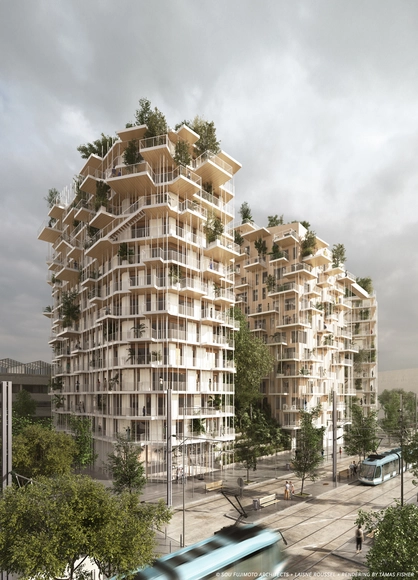
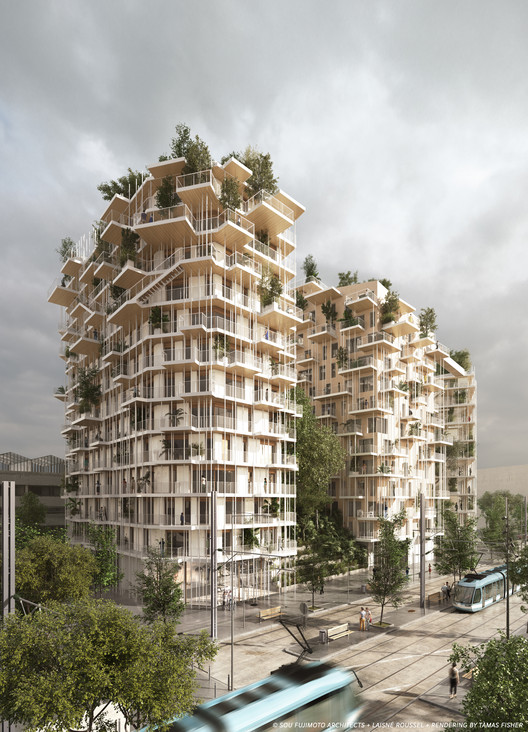
Following an invitation by the city of Bordeaux in December 2015, Sou Fujimoto Architects and laisné roussel have revealed their proposal “Canopia”: a mixed-use development, featuring a 50-meter-tall residential building made of wood and offering 199 homes, 3,770m² of office space and 500m² of retail outlets in Bordeaux, France. The tower would be one of the tallest wooden buildings in the world. Read more about this project after the break.
Sou Fujimoto has been commissioned by Swedish clothing brand COS to design its installation for this year's Salone del Mobile in Milan. Taking place from April 12-17, the event will be the brand's fifth year participating.
"In this installation for COS, I envisage to make a forest of light," said Fujimoto. "A forest which consists of countless light cones made from spotlights above. These lights pulsate and constantly undergo transience of state and flow. People meander through this forest, as if lured by the charm of the light. Light and people interact with one another, its existence defining the transition of the other."
Sou Fujimoto Architects' "Architecture is Everywhere" was among the ArchDaily editors' favorite exhibitions in the Chicago Architecture Biennial. The thought-provoking, entertaining collection of mundane objects truly embraced the idea that the public—not solely architects—should be included in the Biennial's celebration of architecture.
Before the fruits of architectural labor are realized, we rarely revel in the seeds cultivated in the minds of architects. It's hard to capture these formative ideas, much less present them in a way that seizes the satisfying moment in which architecture is "found."
The deceiving simplicity of displaying "found architecture" actually imparts a deeper, thoughtful lesson, which Fujimoto has inscribed on an accompanying placard "Architecture could come into being from anywhere. I believe fostering that architecture-to-be into real architecture itself is also architecture."
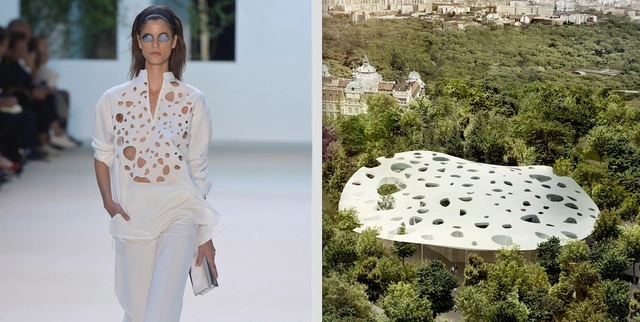
At this year’s Paris Fashion Week, Switzerland-based fashion house Akris showed its 2016 Spring/Summer Collection -- an assembly of garments based on the work of Japanesearchitect Sou Fujimoto.
Akris’ creative director, Albert Kriemler, was introduced to Fujimoto by photographer Iwan Baan while working on the Université Paris-Saclay. From a stance of admiration, Kriemler was thus influenced by Fujimoto’s work: "We share a vision to create an effortless relation between the body and the environment with utmost simplicity. Sou Fujimoto is an architect who understands that we have more senses than just the eye," said Kriemler.
With the award of the $100,000 Marcus Prize to Sou Fujimoto in 2013, graduate students at the University of Wisconsin-Milwaukee’s School of Architecture were offered the rare opportunity to learn from one of Japan's most respected architectural practitioners. Through a semester-long connection to the studio - which he led alongside University of Wisconsin-Milwaukee Associate Professor Mo Zell - Fujimoto and his students have realized a small architectural installation on an unused lot in Milwaukee's East side entitled faBRICK.
In this interview conducted in Tokyo last year, University of Wisconsin-Milwaukee student Robert Guertin speaks with Fujimoto about the ideas and themes of his work. In an attempt to shed light on the influence he had in the design of faBRICK, his answers are presented alongside images of the resulting installation.
French architect and filmmaker Vincent Hecht recently revisited Sou Fujimoto's House N, seven years after its completion, as part of his ongoing Japanese Collection series. Nestled within a traditional Oita neighborhood, the renowned family home resembles "living among the clouds," as Fujimoto once described. A rich layering of space carefully eliminates the notion of distinct boundaries, allowing a subtle shift in program to place a heightened awareness on the spaces in-between.
Tokyo-based French architect and filmmaker Vincent Hecht has captured the opening of Sou Fujimoto’s polyhedral Naoshima Pavilion on the Kagawa shoreline in Japan. The inhabitable, seven-meter, white stainless steel structure is part of the 2016 Setouchi Triennale. Watch the video above for a closer look.
Taichung Mayor Lin Chia-lung has temporarily “pulled the plug” on Sou Fujimoto’s ambitious Taiwan Tower, saying he would rather pay a penalty for breaking the contract than spend an estimated NT$15 billion to realize the “problematic” project.
The Banyan tree-inspired tower was hoped to become the “Taiwanese version of the Eiffel Tower,” as well as a model for sustainable architecture by achieving LEED Gold with its energy producing features. Its steel superstructure, which proposed to hoist a triangular section of the Taichung Gateway Park’s greenbelt 300-meters into the air, intentionally had “no obvious form” and was to be perceived as a natural phenomenon.
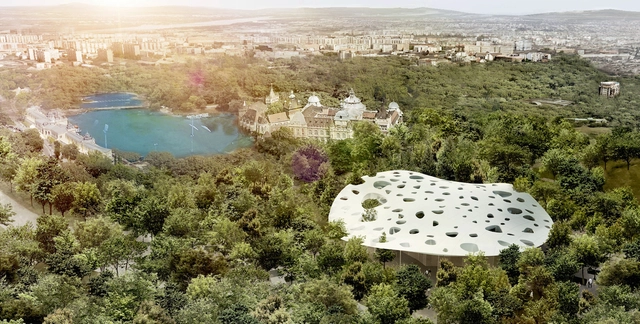
Sou Fujimoto Architects has been announced as one of three practices chosen to design buildings for the Liget Budapest project, one of Europe’s largest museum developments. Selected through an anonymous competition process, the Japanese firm will realize an undulating House of Hungarian Music that was “inspired by sound waves.” Its distinctive perforated “smart roof” will float on top an airy glass-walled interior illuminated by the canopy’s lightwells.


.jpg?1542548128&format=webp&width=640&height=580)


.jpg?1542548128)



_Malcolm_Reading_Consultants_and_David_Springford.jpg?1490671842&format=webp&width=640&height=580)
_Malcolm_Reading_Consultants__David_Springford.jpg?1490671931 "© Malcolm Reading Consultants / David Springford")
_Malcolm_Reading_Consultants__David_Springford.jpg?1490671898 "© Malcolm Reading Consultants / David Springford")
_Malcolm_Reading_Consultants_and_David_Springford.jpg?1490671842 "© Malcolm Reading Consultants / David Springford")
_(c)_Malcolm_Reading_Consultants__David_Springford.jpg?1490671862 "© Malcolm Reading Consultants / David Springford")
_Malcolm_Reading_Consultants_and_David_Springford.jpg?1490671842)
.jpg?1460544765&format=webp&width=640&height=580)
.jpg?1460544765 "COS × SOU FUJIMOTO. Image © Laurian Ghinitoiu")
.jpg?1460544778 "COS × SOU FUJIMOTO. Image © Laurian Ghinitoiu")
.jpg?1460544788 "COS × SOU FUJIMOTO. Image © Laurian Ghinitoiu")
.jpg?1460544802 "COS × SOU FUJIMOTO. Image © Laurian Ghinitoiu")
.jpg?1460544765)