The architecture and manufacturing industries are about to undergo a radical shift in how they make things. In the near future, designers and engineers will be able to create products, buildings, and cities in real time, in virtual reality (VR).
In predicting VR’s dramatic evolution, an analogy to early cinematic history is apt: As one legend has it, when the motion-picture camera first came out, actors were filmed on a set, in front of fake trees. Then someone said, “Why don’t you just put the camera in the forest?” Simple, but game-changing. VR technology is already available, and it’s only a matter of time before it is used to its full potential.
The four hurricanes that slammed into heavily populated areas from the Caribbean to Texas this summer are inching toward a half-trillion-dollar price tag in damages—to say nothing of the work and wages missed by shutting down entire cities. Buildings are the most visible marker of a place’s resilience after a disaster strikes. Surveying the catastrophic damage forces a difficult question: How can it be rebuilt better?
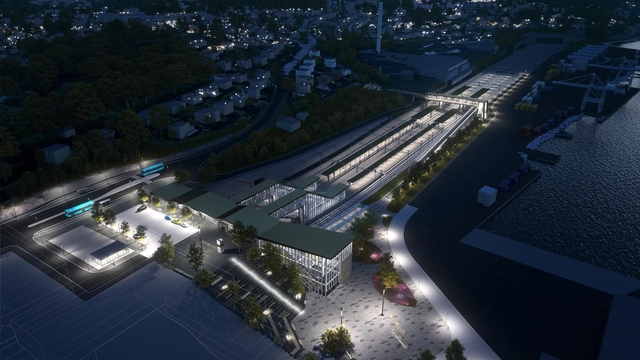
For a disruptive, 10-kilometer-long rail project that won’t even break ground until 2019, public officials and local residents of Moss, just south of Oslo, Norway, have been given an unusually vivid preview that, in the past, only the designers would have seen at this stage.
“We set up a showroom in the city where the public can come to view the project in a theater setting, and the feedback has been quite nice,” says Hans Petter Sjøen, facility management coordinator for Bane NOR, the year-old, state-owned company responsible for developing, operating, and maintaining the Norwegian national railway infrastructure. “Project members also have been receptive. They tell us that they have seen dimensions on the big screen that they did not see in person.”
Contemporary designers are recycling waste materials into useable and well-crafted objects, and it’s easy to get the impression that this burgeoning realm of fabrication is destined only for the craft fair. A quick survey of Blaine Brownell’s new guide Transmaterial Next: A Catalog of Materials That Redefine Our Future turns up a half-dozen Etsy-ready art and furniture curios. There’s jewelry made from coffee grounds, bowls made from plastic bags, and a chair made from artichoke thistle fibers (the “Artichair”).
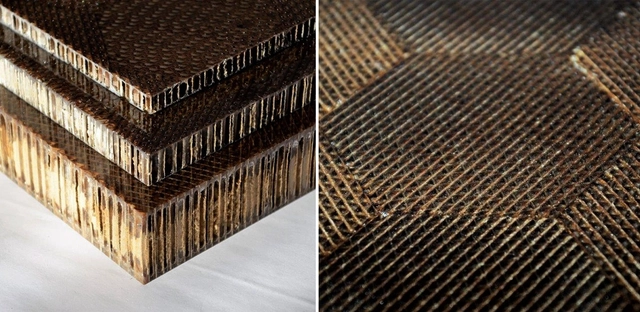
But these items don’t demonstrate the necessary capacity for heavy lifting and mass-market applicability for an age of climate change and dwindling resources. To grasp the kind of architectural upcycling that can divert trash from landfills and carbon from the atmosphere on a mass scale, it pays to step out of the design gallery and into the laboratory, where architects are inventing a new breed of modular building materials.
Ancient Romans mixed lime and volcanic rock to form a mortar, a precursor to modern reinforced concrete. This made engineering marvels like Rome’s Colosseum possible—still standing more than 2,000 years after its construction.
Today, this versatile material is evolving further: Precast concrete, which is formed and cured in factories before being installed onsite, is bringing about a new wave of architecture that streamlines the building process while reaching toward big, complex ideas.
https://www.archdaily.com/877871/how-one-concrete-manufacturer-helps-architects-reduce-project-costs-with-an-in-house-design-teamAngus W. Stocking, L.S.
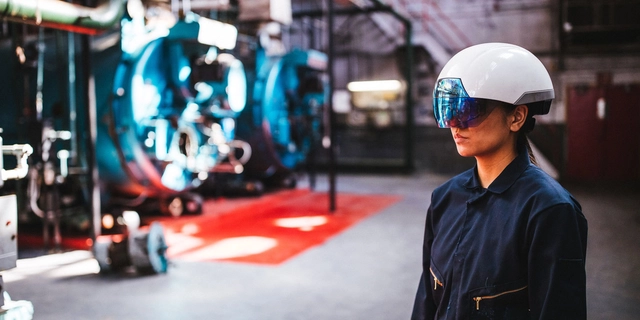
Imagine you’re part of a crew constructing a new office building: Midway through the process, you’re on-site, inspecting the installation of HVAC systems. You put on a funny-looking construction helmet and step out of the service elevator. As you look up, there’s a drop ceiling being installed, but you want to know what’s going on behind it.
Through the visor on your helmet, you pull up the Building Information Model (BIM), which is instantly projected across your field of vision. There are heating ducts, water pipes, and electrical boxes, moving and shifting with your point of view as you walk along the corridors. Peel back layers of the model to see the building’s steel structure, insulation, and material finishes. It’s like having comic book-style X-ray vision—and soon, it could be a reality on a construction site near you.
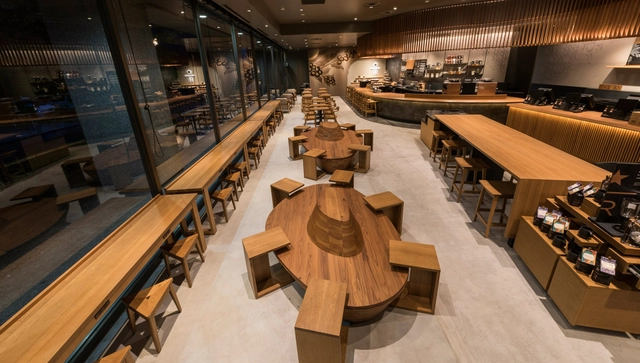
The Sanjo Karasuma Starbucks in Kyoto was renovated and re-opened in September 2016. The latest coffee flavors are presented within an aesthetic incorporating the concept of “beauty in simplicity” espoused by tea master Enshu Kobori. Image Courtesy of Starbucks Japan
It’s been 20 years since Starbucks opened its first shop in Japan, bringing a new paradigm to the country’s coffee shop culture—and creating a new, appealing “third place” option between home and work or school.
Notably, almost all of Japan’s 1,245 shops—across all 47 prefectures—are directly run by the parent company. As such, they are planned by Starbucks designers who, instead of settling for standardized designs for all locations, have worked diligently to incorporate features expressing regional, historical contexts and the lifestyles of locals—in short, to appeal specifically to the Japanese market.
As the impacts of global climate change escalate, forward-thinking architecture firms have committed to being part of the solution. Increasingly, these firms are signing on to the 2030 Challenge and American Institute of Architects’ supporting initiative, AIA 2030 Commitment, which provide a framework to reduce fossil-fuel dependence and make all buildings, developments, and major renovations carbon neutral by 2030.
The 2030 Challenge has been adopted by 80 percent of the top 10 and 65 percent of the top 20 architecture, engineering, and planning firms in the United States, as well as many state and local government agencies. Among these are Eskew+Dumez+Ripple (EDR), a New Orleans–based architecture and planning firm; HOK, a global design, architecture, engineering, and planning firm; and CTA Architects Engineers, an integrated design, engineering, and architecture firm with offices throughout the Western United States and Canada. Here, five professionals from EDR, HOK, and CTA share seven key tactics they’ve employed to move toward the 2030 target—and a sustainable future for the planet.
https://www.archdaily.com/869056/7-ways-architects-can-work-toward-carbon-neutral-buildings-by-2030Heather Head
If an architecture firm is lucky, it can hit two birds with one stone on a single project—for example, prioritizing both historic preservation and energy efficiency. But a team at KieranTimberlake, based in Philadelphia, is aiming for four ambitious goals with its pro bono project, the Mars City Facility Ops Challenge.
Architects Fátima Olivieri, Efrie Friedlander, and Rolando Lopez teamed up with National Institute of Building Sciences (NIBS), NASA, and the Total Learning Research Institute (TLRI) to create a virtual working city on Mars—one that might reap multiple rewards.
https://www.archdaily.com/867605/kierantimberlake-is-using-virtual-reality-to-design-a-home-for-future-life-on-marsKim A. O'Connell
It’s the holy grail for any biomimicry design futurist: buildings and structures that use generative geometry to assemble and repair themselves, grow, and evolve all on their own. Buildings that grow like trees, assembling their matter through something like genomic instructions encoded in the material itself.
To get there, architecture alone won’t cut it. And as such, one designer, Haresh Lalvani, is among the most successful at researching this fundamental revision of architecture and fabrication. (Or is it “creation and evolution”?) He employs a wildly interdisciplinary range of tools to further this inquiry: biology; mathematics; computer science; and, most notably, art.
No one puts solar panels on their house because they’re sexy—at least, not yet.
Jon Gardzelewski, an architect and associate lecturer at the University of Wyoming in the Building Energy Research Group (UW-BERG), wants to change that. He believes the fact that solar panels are usually an afterthought to the design of a building is a big barrier to integrating them into a critical mass of houses and buildings.
Videos
The new Watches of Switzerland store in London designed by Callison. Image Courtesy of Callison
With the rise of the internet, old-fashioned brick-and-mortar stores have struggled, as online ordering services have increasingly made it unnecessary to actually go to a store. The answer for the physical stores of the future? Make spaces not for purchasing the things people need, but experiencing the things people want, as explored in this article by Matt Alderton originally published on Autodesk's Redshift publication as "How Technology and Big Data in Retail Are Shaping Store Designs of the Future." Alderton looks at how forward-looking stores are being designed to appeal to customers, finding that the same technology revolution that threatened to make stores obsolete might also play a key role in saving them, too.
Shopping used to be stimulating. Although its end was sales, its means was a mix of status and spectacle. It was social commerce in which partakers transacted not just cash, but also cachet.
Nowhere was this more evident than in the earliest department stores, whose architects designed them to be destinations. In London, for instance, Harrods boasts the motto “Omnia, Omnibus, Ubique”—Latin for “All Things for All People, Everywhere.” Established in 1849, it has seven floors, comprising more than 1 million square feet across more than 330 departments. The store installed one of the world’s first escalators in 1898, opened a world-famous food hall in 1902, and sold exotic pets such as lion cubs until the 1970s.
There is a lot of discussion about the architect-client relationship circling the profession right now: about which clients architects ought to be prepared to turn down, or about the power developers have over the architects they employ. Often forgotten in these discussions is the fact that the key to making good architecture is for the architect to stick to their vision, and - crucially - to have their client's trust to do so. In this article, originally published on Autodesk's Redshift publication as "7 Tips to Build and Maintain Trust in an Architect-Client Relationship," Taz Loomans offers 7 ways that architects can create this trusting relationship.
“Without trust, your relationship does not exist; all you have is a series of transactions,” says Rosa Sheng, architect and senior associate at Bohlin Cywinski Jackson.
Trust is the foundation of any relationship between architect and client, and cultivating trust has huge benefits: repeat clients, patience when challenges arise, and referrals to new clients. But a weak or eroded sense of trust can harm your reputation, cost you future business, and even drive clients toward litigation.
Due to the complex nature of architecture projects, a number of factors can make or break an architect-client relationship. Here are seven tips from architectural experts to help you build and maintain trust.
In manufacturing, the dramatic recent expansion in the capabilities of 3D printing has threatened to revolutionize the way that things are made. In architecture though, while 3D printing has been received with enthusiasm its translation to the increased scale of buildings has been challenging. Most solutions to this problem have focused on increasingly large printers and the incorporation of existing principles of prefabrication - however there is another way. In this article, originally published on Autodesk’s Redshift publication as "4 Ways a Robot or Drone 3D Printer Will Change Architecture and Construction," Zach Mortice looks at four examples of cutting-edge research into 3D printing that utilize robots or drones to navigate architecture's challenging scale.
Buildings simply aren’t made like anything else—that goes for sunglasses, furniture, appliances, and fighter jets. No other production process brings massive amounts of material to one place, constructs one item, and then hauls away the garbage. The inefficiencies are monumental.
Modular construction has promised a great deal of potential to reduce waste. But what if one answer is to do more intricate construction on-site, not less? 3D printers attached to robots and drones are demonstrating that they might have the versatility to finally bring the unruly building process to heel.
Prefabrication is not a new idea for architects. It was a staple of the post-war modernist ideal, a great dream that precise modern structures would be created in clean factories and then shipped to site. However, the realities of post-war prefab were far from this ideal; buildings were often poorly designed or poorly constructed, and by the end of the century prefabrication was merely a footnote in the catalog of construction methods. In the 21st century though, prefabrication is experiencing a resurgence. In this article originally published on Autodesk’s Redshift publication as "Future of Construction: Your Next Building Won’t Be Built—It Will Be Manufactured," Autodesk's Phil Bernstein looks at the current wave of prefabrication, and answers the question: why now?
And BSB isn’t the only one with this type of ambitious plan for the future of construction. The industry is entering the age of the mass-manufactured building. Prefabrication is growing up, reaching a new level of maturity that is now going to change the industry and define new categories of building. Check the trailer-park stereotype at the door.
In the 20th century, urban planning went through some big changes, creating much of our current urban environment in a mold that is now widely seen as anti-human. Fortunately, in recent decades urban planning has changed again - partly revising and partly reverting the theories espoused by the 20th century. In this article, originally published on Autodesk’s Redshift publication as "What the Future of Cities Can Learn From Ancient Cities," James A Moore looks at why old models for creating cities have proved so timeless, and the role that they will play in creating 21st century cities.
As legend has it, upon leaving Carnegie Hall after a dissatisfying rehearsal, violinist Mischa Elman ran into two tourists looking for the hall’s entrance. They asked, “How do you get to Carnegie Hall?”
It’s an old and simple joke, but it points to an important reason why people are drawn to cities. Why do people move to Hollywood? They want to be in movies. Why do they move to Wall Street? They want to be in finance. In the best cases, cities enable citizens to pursue their aspirations.
https://www.archdaily.com/772464/why-ancient-cities-can-still-teach-us-about-urban-planningJames A. Moore