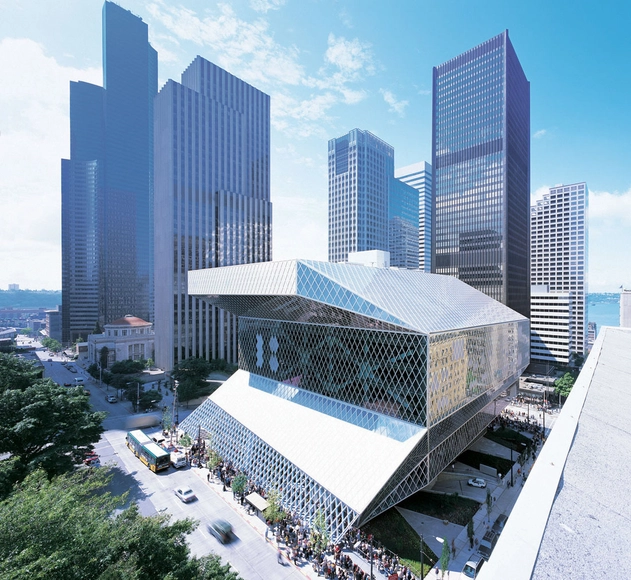
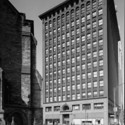
Bjarke Ingels worked on the Seattle Central Library during his time at OMA. Image Courtesy OMA
The world of architecture is small. So small in fact, that Rem Koolhaas has been credited with the creation of over forty practices worldwide, led by the likes of Zaha Hadid and Bjarke Ingels. Dubbed “Baby Rems” by Metropolis Magazine, this Koolhaas effect is hardly an isolated pattern, with manifestations far beyond the walls of OMA. The phenomenon has dominated the world of architecture, assisted by the prevalence and increasing necessity of internships for burgeoning architects.
In a recent article for Curbed, Patrick Sisson dug into the storied history of internships to uncover some unexpected connections between the world's most prolific architects. With the help of Sisson's list, we've compiled a record of the humble beginnings of the household names of architecture. Where did Frank Gehry get his start? Find out after the break.
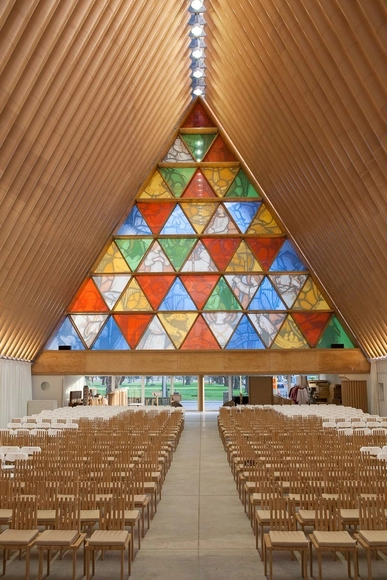
He may have risen to prominence for his disaster relief architecture and deft use of recyclable materials, but Shigeru Ban describes his idiosyncratic use of material as an "accident." Speaking to The Wall Street Journal, the 2014 Pritzker Prize Laureate recalls turning to cardboard tubes as a matter of necessity. "I had to create a design for an exhibition," Ban told the newspaper, "But I couldn't afford wood. Instead, I used the many paper tubes from rolls of drafting paper that were lying around. The tubes turned out to be quite strong." The most prominent of Ban's cardboard tube structures is Christchurch'sCardboard Cathedral, built in the aftermath of an earthquake that devastated the city in early 2011. Read WSJ's full interview with Ban here.
As the Pritzker Jury begins its deliberations for the 2015 Pritzker Prize, this is a critical time of year for shaping the landscape of architectural debate for the coming year and beyond. The following is an open letter to Martha Thorne, the Executive Director of the Pritzker Prize, from Conrad Newel, author of the popular blog Notes on Becoming a Famous Architect.
Dear Martha,
I have to hand it to you and all the people on the Pritzker committee, you guys are a very crafty bunch. Just when I thought I had you all figured out, you have now - even though only slightly - succeeded in confounding me.
From my 2011 analysis of the Pritzker, I figured that your potential pool of laureates was always a very predictable bunch. In fact anyone could look at my data and predict with reasonable certainty that the next laureate would most likely be an Asian or Caucasian male starchitect from Europe, The USA, or Japan. I further pointed out that none of your laureates have done much in the way of humanitarianism, despite the fact that the mission statement of the Pritzker also asks that the recipient should be making significant contributions to humanity. I maintained that this part of the mandate has been consistently overlooked.
“An earthquake doesn’t kill people, the collapse of a building kills people.” In Arbuckle Industries’ latest interview released following their world premiere of Archiculture, architect humanitarian Shigeru Ban clearly delineates “natural” disasters as a product of mankind, rather than nature. Hear the Pritzker laureate’s thoughts on designing for minorities, disasters, and the importance of travel in the video interview above.
To celebrate the first anniversary of our US Materials Catalog, this week ArchDaily is presenting a three-part series on "Material Masters," showing how certain materials have helped to inspire some of the world's greatest architects.
Shigeru Ban’s portfolio is a strange dichotomy, split between shelters for natural disaster refugees and museums commissioned by wealthy patrons of the arts. Even stranger is the fact that, in both cases, Ban’s material palette frequently incorporates recycled cardboard, paper, and old beer crates. The Pritzker prize laureate is unique in this regard, and so great is his predilection for recycled paper tubes (originally formwork for concrete columns), that he has become known as the “Paper Architect.” His work receives media attention worldwide for the unorthodoxy of its construction materials. Yet Shigeru Ban is not concerned with unorthodoxy, but with economy. It is for this reason that, when paper tubes are deemed unsuitable, Shigeru Ban constructs his buildings in wood. Inspired by the architectural tradition of his native Japan, Ban is not only the "Paper Architect," but also one of the most famous architects working in wood today.
Shigeru Ban has been included in Foreign Policy Magazine's 100 Leading Global Thinkers of 2014, dubbing this year's Pritzker Prize Laureate as "architecture's first responder." The annual list recognizes the 100 people whose ideas and actions have had the greatest impact on the outcome of world events, and this year 'disruption' is the buzzword; acknowledging a tumultuous year, the list focuses on the people who, for better or worse, "smashed the world as we know it."
Material Minds, presented by ArchDaily Materials, is our new series of short interviews with architects, designers, scientists, and others who use architectural materials in innovative ways. Enjoy!
Arthur Andersson of Andersson-Wise Architects wants to build ruins. He wants things to be timeless - to look good now and 2000 years from now. He wants buildings to fit within a place and time. To do that he has a various set of philosophies, processes and some great influences. Read our full in-depth interview with Mr. Andersson, another revolutionary "Material Mind," after the break.
Workers in Chengdu, China, assemble the Hualin Temporary Elementary School, designed by the Japanese architect Shigeru Ban after the 2008 Sichuan earthquake. Image Courtesy of Forgemind ArchiMedia
British writer Tim Abrahams finds Shigeru Ban's architecture "kooky, Middle Earthy, Hobbity" – an opinion which earns him the title of "idiot" in the eyes of newly appointed Architecture for Humanity Executive Director Eric Cesal. In an article for the Boston Review, Stephen Phelan uses the pair's opposing opinions to illustrate the Pritzker Prize winning architect's perceived failures and successes. Read his very engaging take, here.
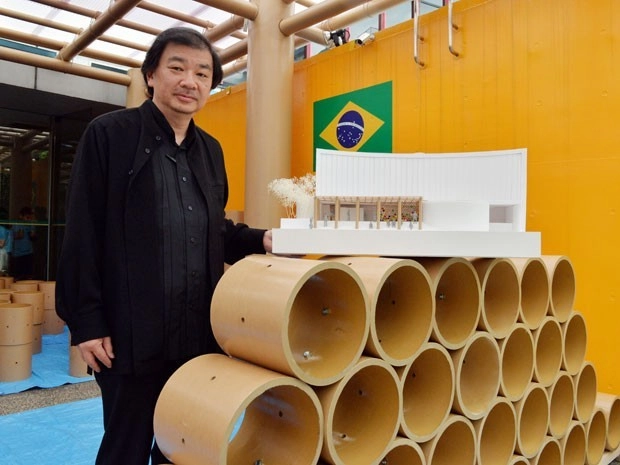
In honor of the World Cup (which starts today), the Brazilian Embassy in Tokyo, Japan, has invited Shigeru Ban, this year's Pritzker Laureate, to build a temporary pavilion.
Located at the entrance of the embassy, the three foot tall, 120 m² temporary structure will be a place where people can meet after the games since, due to the time difference, the games will not be broadcast on site.
On April 21st, ArchDaily tweeted about watching keynote speaker Shigeru Ban kick of the Cities for Tomorrow conference in New York. In his first appearance since winning the Pritzker Prize, he addressed how we should approach urban planning and development today with architecture critic Michael Kimmelman. To watch videos - of Ban as well as speakers such as Vishaan Chakrabati, Shaun Donovan, and Janette Sadik-Kahn discussing the future of our cities - click here.
Alvar Aalto: Early cantilevered armchair with stepped base, model no. 31, designed for the Tuberculosis Sanatorium, Paimio, 1929-1933 (Sold for £23,750). Image Courtesy of Phillips
UPDATE: The auction has concluded and more than £5.6 million was made. Find out how much the famous, architect-designed relics went for after the break.
Next week, a rare collection of over 100 relics designed by some of architecture’s most significant practitioners from the last two centuries will be auctioned off at the Phillip’s in London. Ranging from a full-scale paper tea house by this year’s Pritzker laureate Shigeru Ban to the Peacock chair designed by Frank Lloyd Wright for Tokyo’s Imperial Hotel, the items being showcased and sold are an ode to the ideas in which have had a profound impact on our built environment.
An exhibition of the items, appropriately titled “The Architect,” is already underway, prior to the auction on April 29.
Works by Gerrit Rietveld, Le Corbusier and Oscar Niemeyer are all available for purchase. Read on for a preview of the highlighted items...
A recent article from The New York Times confirms something we've all long-suspected. A Pritzker translates into big bucks. Demand for Shigeru Ban's Manhattan buildings has soared since his awarding of the prize. The New York Times reports that page views of the Metal Shutter Houses, for example, have quadrupled on the listings site Streeteasy.com. Why? The Pritzker name carries weight:
Last week, while the ArchDaily team was in Mexico City for the Mextrópoli Conference, we caught up with Pritzker Jury member Juhani Pallasmaa and asked him to shed some light onto the recent winners of one of architecture's highest honors. Watch Pallasmaa, a renowned Finnish architect and professor, explain what motivates his approach for recognizing architects in a world with "so much publicity."
"The Pritzker jury has now, for at least 5 years, tried to select architects who are not the most obvious names because there is so much publicity in the architectural world and we'd rather try to find architects who have not been published everywhere else..."
We culled the Twitterverse looking for reactions to Shigeru Ban's Prizker win - from readers and critics alike. While the responses were generally positive, some were less so.
See our favorite responses - from #baffled to #goodenough to #Banstheman! - after the break.
The following is Alejandro Aravena's response to the Shigeru Ban's Pritzker win. Aravena is the executive director of the firm ELEMENTAL S.A and a member of the Pritzker Jury who selected Ban as this year's Pritzker Laureate.
Shigeru Ban has expanded the field of architecture in unexpected ways. He has proved that the inspired artist and the skilled designer is not inevitably condemned to work for a privileged elite, but that innovation can take place while working for the majority, particularly those historically underserved, forgotten or neglected. In order to do that, he redefined the approach to deal with difficult, urgent and relevant challenges, replacing professional charity by professional quality. Ban has shown that no matter how tough the circumstances or scarce the means, good design far from being an extra cost carries the added value of sharp efficiency, power of synthesis and an uplifting feeling.
Last week we had the opportunity to interview this year's Pritzker Prize winner, Shigeru Ban, within his Metal Shutters Houses in New York City. The Japanese architect, who was a member of the Pritzker jury from 2006-2009, gave us his thoughtful, humble response to receiving architecture's most prestigious prize, saying the win is an "encouragement for me to continue working to make great architecture as well as working in disaster areas."
When we asked him how he remains so committed to humanitarian efforts, balancing them with his other commissions, he explained: "I also like to make monuments because monuments can be wonderful treasures for the city, but also I knew many people were suffering after the natural disasters, and the government provided them very poor evacuation facilities and temporary housing. I believe I can make them better."
Read the entire interview transcript, in which Ban discusses his innovative use of materials and gives us a few anecdotes about studying in the US, after the break.