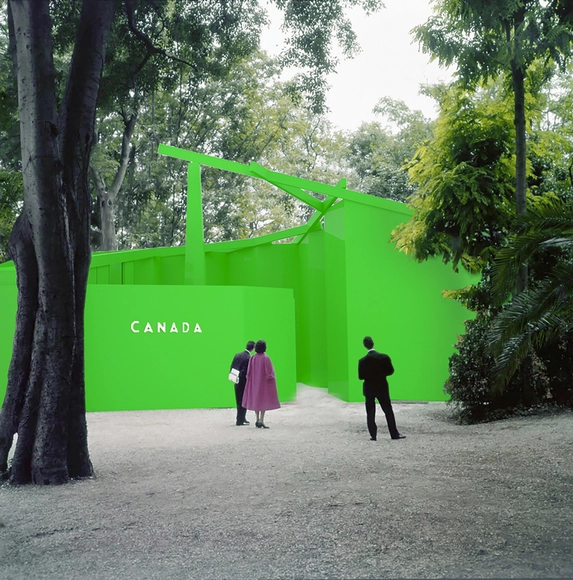
Courtesy of The Canadian Pavilion 2020 Curatorial Team
With its flashbulb neighbor to the south taking much of the spotlight, few know the extent of Canada's involvement in the film industry. The recently announced Canadian Pavilion for the 2020 Venice Biennale, curated by Montreal based practice T B A and McGill academic David Theodore, aims to change that.
https://www.archdaily.com/913351/the-green-screen-impostor-cities-of-canada-to-be-evaluated-in-nations-2020-venice-biennale-pavilionKatherine Allen
Berlin is the 21st century contemporary world’s ideal capital. The city left its torrid history behind to quickly grow and cement itself into the intellectual and cultural core of the world. Berlin is the epicenter of any new movement that starts to demolish the old-world order. Ever since the wall came down in 1989, Berlin has been known as a bohemian paradise, a place where the empty spaces between east and west could be pioneered and inhabited by the most creative types, who could create and carouse with impunity. Numerous artists from across the globe have taken full advantage of Berlin’s transition period throughout the 1990s and 2000s to find gallery and performance spaces in the most unexpected places. The underground art scene is very modern, very edgy and relatively unlimited in the city of Berlin.
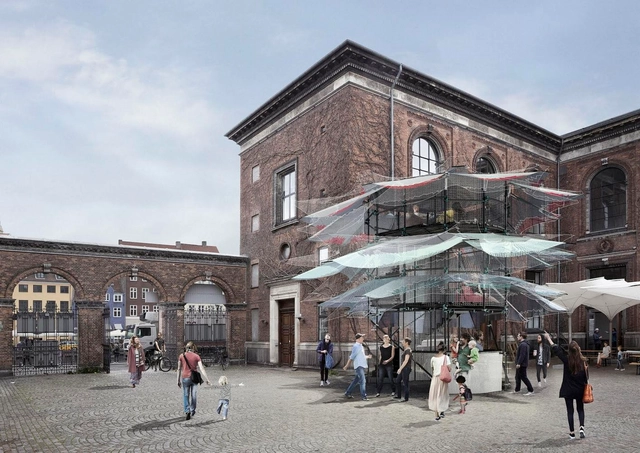
Spring Pavilion Amsterdam; Credits: Switch Competitions
MANIFESTO
Amsterdam has been one of Europe's pioneers of architecture and design, largely because of the 17th century rings of canal houses, gabled facades, windmills and drawbridges. Modern architecture developed organically in Amsterdam between the facades of historical buildings, making it one of the finest blends between Renaissance, Berlage and the Amsterdam School. The city has a very strong cultural and artistic identity. Amsterdam is the most important cultural and artistic center to the north from Paris and between London and Cologne.
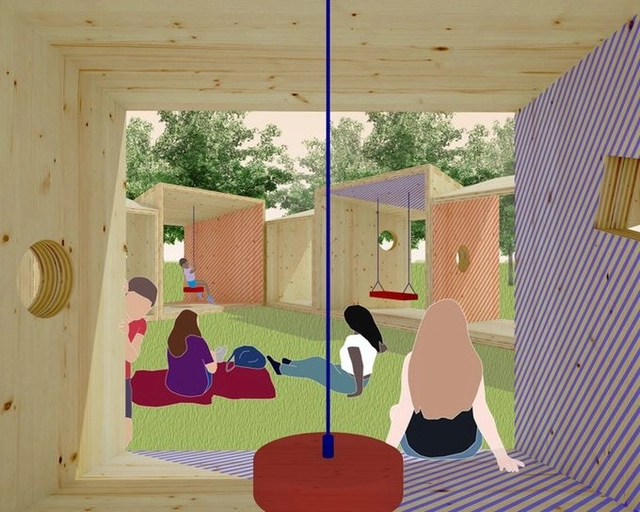
The pavilion, to be branded the “City of Dreams Pavilion,” utilizes scrap cross-laminated timber panels recovered from a construction project at the University of Arkansas, repurposing them in an “inviting summer pavilion” featuring 12 framed swing modules.
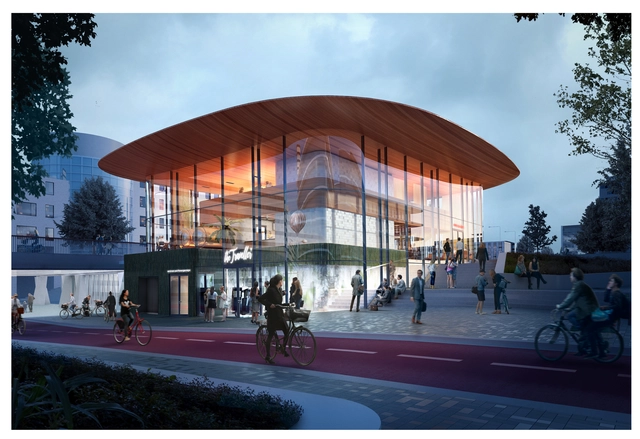
Construction has begun on the Powerhouse Company-designed pavilion for the ING campus in Amsterdam. Located in the up-and-coming district of Amsterdam Southeast, the 900-square-meter pavilion seeks to “make a bold statement while integrating with its surroundings."
The clean, minimalist pavilion will sit at the heart of the ING campus, serving as both a dining area and a multifunctional space for the community. Emphasizing the natural landscape, the pavilion offers a synergy between the built and natural environment through a friendly circular form, a timber interior, and green Tichelaar tiles on the north and east facades.
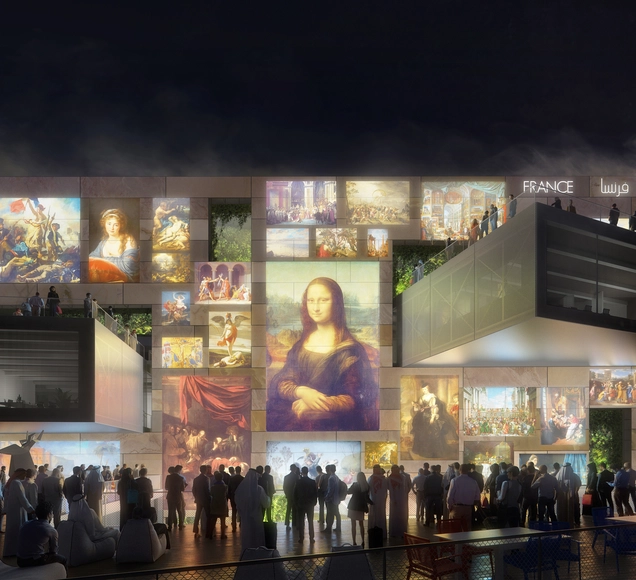
Clément Blanchet Architecture in collaboration with Etienne Tricaud (AREP) have been shortlisted for the French pavilion at Expo 2020 Dubai. The winner will be announced in February. The proposal is intended to enhance both the virtual world and the real to support human communication, cultures and interactions. The pavilion will be built around the themes of Light and Mobility to create a hidden oasis with two vertical gardens facing one another.
When learning about architecture, there is no replacement for practical experience: seeing how materials can be joined together, how structural elements respond to the stresses placed upon them, or how construction techniques can alter the finished project. For this reason, it is a good idea to give students a chance for some hands-on experience building real structures—something that, due to budgetary constraints and the academic culture of many architecture schools, has sadly been uncommon in the past.
However, in recent years, this culture has started to shift, with increasing numbers of architecture schools finding ways for students to be involved in construction projects, from small, temporary interventions and pavilions, to larger permanent buildings. In order to show the excellent work that can be done in an educational context, for the fourth timeArchDaily is calling on students and professors to submit the design-build projects they have completed in the past year. As always, we're teaming up with allofArchDailyen Español,ArchDaily Brasil, and ArchDaily China, in the hope that we can present the best work from students worldwide to a worldwide audience. Read on to find out how you can take part.
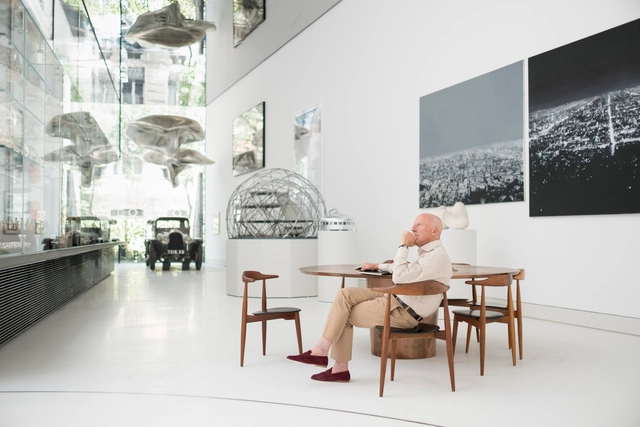
Earlier this month, the Norman Foster Foundation opened its doors in central Madrid. Inhabiting in an old residential palace, and having undergone extensive renovation works since, the Foundation have also constructed their own contemporary courtyard pavilion. Housing a treasure trove of artefacts from Lord Foster's personal collection, the structure—which is shaped like the wing of an aircraft—also exhibits a newly restored 1927 Avions Voisin C7 originally owned by Le Corbusier.
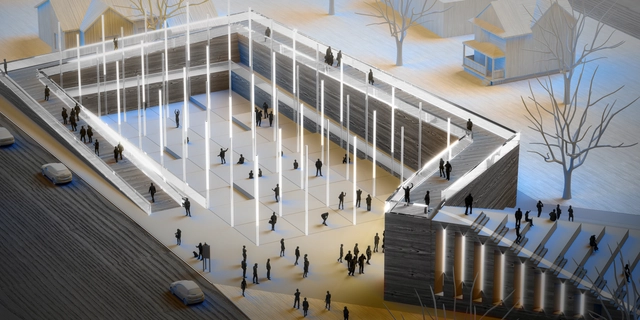
Cairo-based architect Mohamed Elgendy has won an international competition for the design of a new community pavilion in Roseville, Michigan. The Pavilion at Utica Junction competition, organized by the Roseville DDA, sought to attract proposals for a public pavilion on the site of an old tavern, creating a gathering space for residents and visitors to stage events, socialize, and play. The vision behind Elgendy’s winning scheme was for a dialogue between three elements – a plaza, a ramp, and an indoor pavilion.
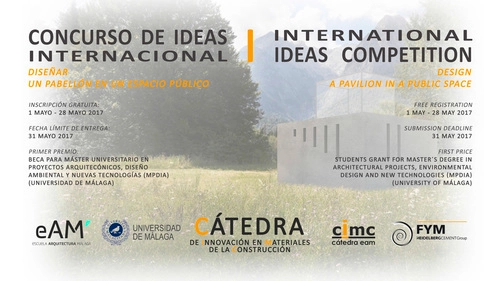
The Chair of Innovative ConstructionMaterials (CIMC) with the Higher School of Architecture of Málaga and Financiera y Minera S.A. announce the II International Ideas Competition for architects and students of architecture in their graduation project.
Calling for entries to design pavilions in line with notions of sustainable construction and fabrication methods, urbanization, and renewable materials, CHART ARCHITECTURE has announced the five finalists for its annual competition, addressing the theme ‘LIVING CITY’. Proposals included the use of IKEA bags, biogas reactors and solar energy amongst other innovative design solutions, judged by a jury headlined by Bjarke Ingels. The eventual winner will be awarded a mentorship program with a professional architect, a construction expert and a developer, intended to “support a young architect’s career as well as to promote cross-sector collaboration and networking.”
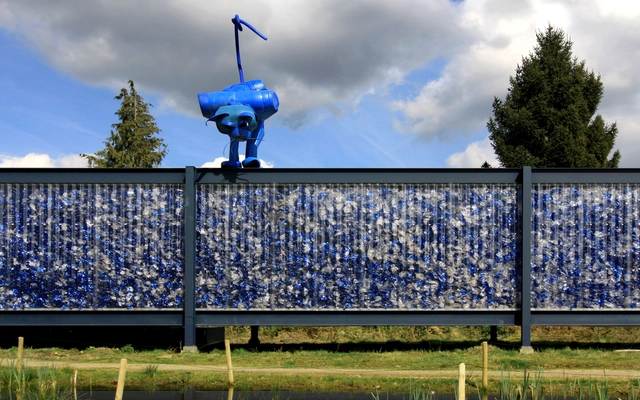
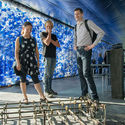
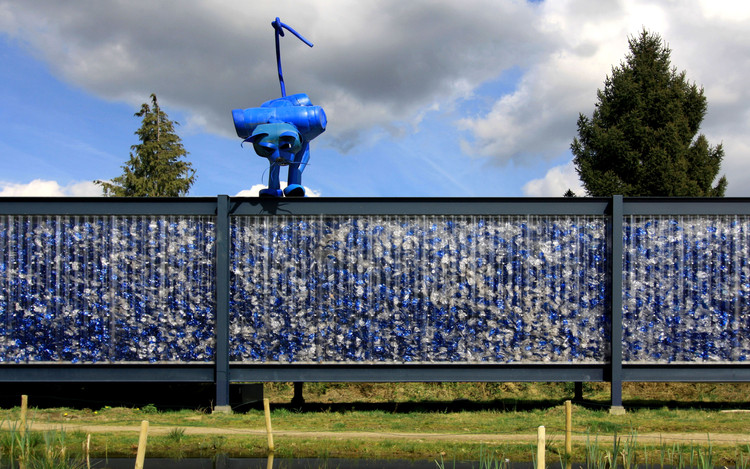
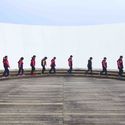
Project.DWG and LOOS.FM have unveiled their PET pavilion, a temporary structure in a community park in The Netherlands that focuses on issues of sustainable building, recycling, and waste by rethinking the ways that buildings are developed, built, and used. Specifically, the pavilion is a study of the use of plastic waste as a building material.
Using the elevated framework of Ludwig Mies van der Rohe’s Farnsworth House, the structure consists of two monumental slabs in a steel framework. “From floor to ceiling, double-walled transparent corrugated sheets hold over 40,000 plastic bottles,” with bottle caps attached to bottlenecks supporting the system.
CHART ARCHITECTURE competition, a key element of CHART SOCIAL, was launched in 2014 to promote young Nordic architects and explore the crossover between art and architecture. In 2017 CHART is extending the call for applications to young and newly established architectural practices, as well as welcoming students and recent graduates from the Nordic architecture schools.
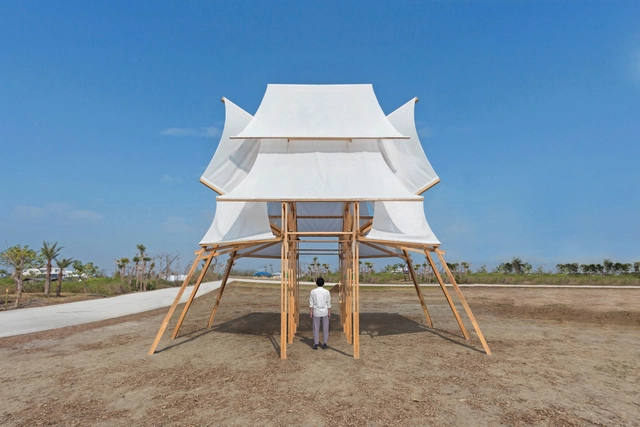
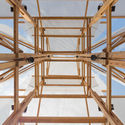
Building Trust international have announced their 7th international design competition which seeks to find an innovative design proposal for a landmark pavilion structure made from bamboo. The bamboo piece will be the centre of a Bamboo Festival Building Trust are hosting in Phnom Penh, Cambodia this March. The competition challenges architects, designers and engineers to provide a design solution which has the chance to shape the future of building with bamboo globally.
At Autodesk's 2016 conference in Las Vegas, a team from Autodesk's BUILD Space led by principal research engineer Andrew Payne collaborated with manufacturer Quarra Stone, engineers Simpson Gumpertz and Heger, and University of Michigan assistant professor Sean Ahlquist to unveil its new Generative Design Pavilion. The project is an exploration of materiality, with stalagmite stone forms that rise up from geometric floor panels to meet fabric that stretches down from a canopy above. The junction of textile and stone aims to emphasize the distinct behaviors of the two materials.
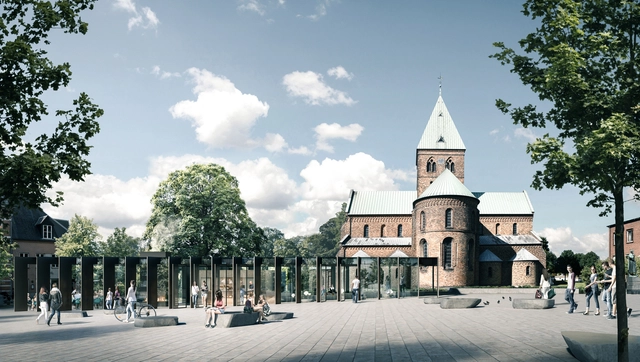
There is so much history in and around Ringsted Square, said Hvidesten. I am therefore delighted that the winning project gives us a pavilion that will not just integrate with the overall architecture of the square; it will also forge a link with history, retain a clear view of St. Bendt’s Church, and provide a new focal point of the square and its many functions, which will appeal to both young and old.

























.jpg?1485891056&format=webp&width=640&height=580)
_(1).jpg?1485891189 "Courtesy of Quarra Stone")
.jpg?1485891118 "Courtesy of Quarra Stone")

.jpg?1485891081 "Courtesy of Quarra Stone")
.jpg?1485891056)