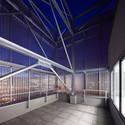
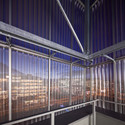
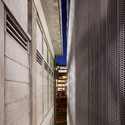
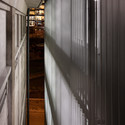
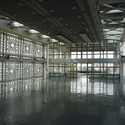
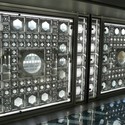
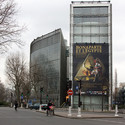
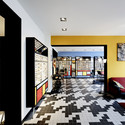
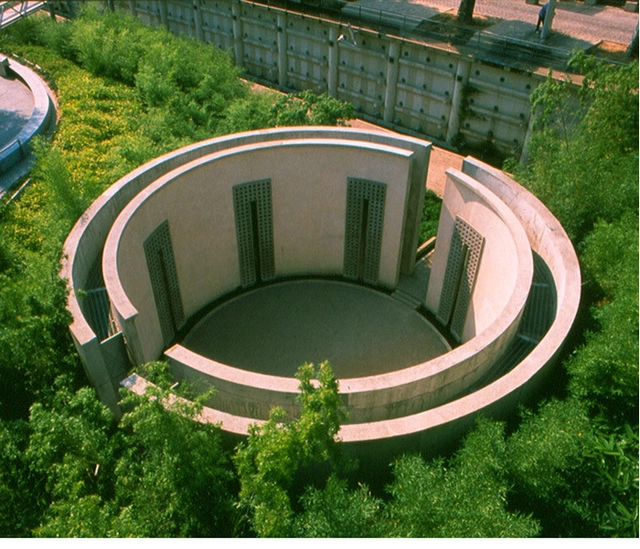
The series of a pavilions with different public functions and programs by AWP + HHF Architects are part of a future 113 hectare large public green space along the Seine river, in Carrière-Sous-Poissy, at the end station of the RER line A and close the renown Villa Savoye from Le Corbusier. The Park designed by the Paris based landscape architects Agence TER will be a public park and ecological showcase for local residents and a leisure destination for people living in and around Paris. More images and architects’ description after the break.
R4 is a territory whose urban and river-port aspects have been marked by exchanges, artists and the public. Yet it is not characterised as having any particular identity, but rather as a melting pot and a territory which is singularised by its ever-changing content.
BIG + Paris-based architects OFF, engineers Buro Happold, consultants Michel Forgue and environmental engineer Franck Boutte is the winning team to design the new 15.000 m2 research centre for Sorbonne’s Scientific university University Pierre et Marie Curie in Paris. More images and complete press release after the break.
Marc Anton Dahmen & Studio DMTW, in collaboration with Tilke & Partners, shared with us their third prize winning design for the Longchamp racetrack in Paris, France. One of the main aspects of their design is to understand each new structure as a solitary sculpture within the park to respect the landscape and nature of the Bois de Boulogne. Therefore it was very important to conserve as much of the spectacular mature trees as possible. In that sense, the design is aimed to maximize clear open moving space within that park. Consequently, the ground floor of the Grandstand was designed to be as open as possible to aids the visitors between the track and the betting halls, and also to achieve logical circulation between all functions within the site. More images and project description after the break.
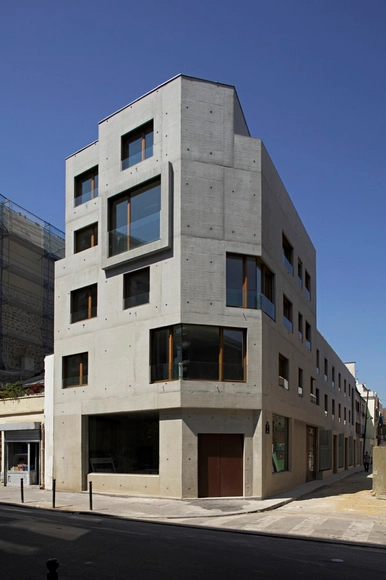
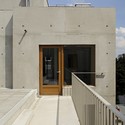
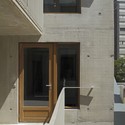
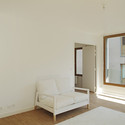
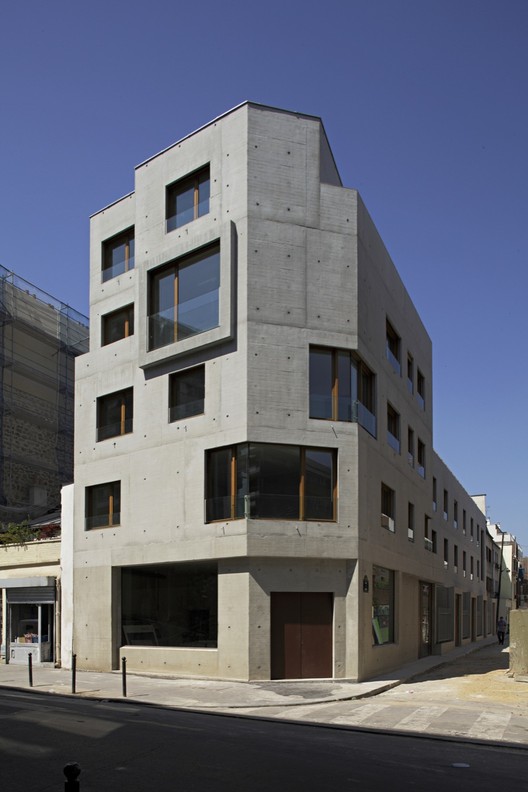
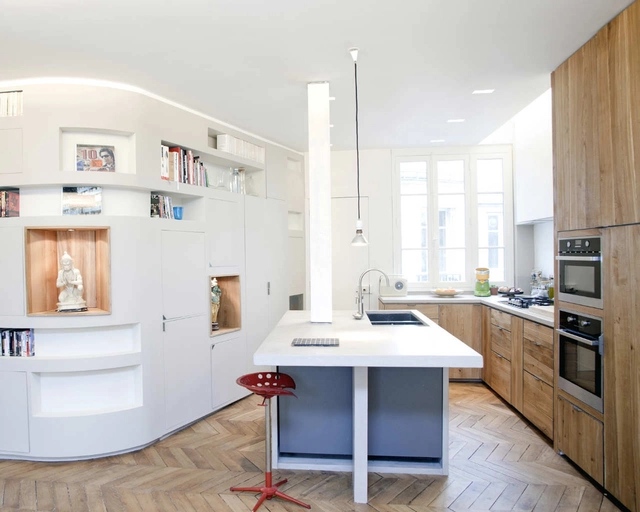
Karawitz Architecture recently announced the design for their passive co-housing project in Paris. Their principle of a self-governed independent residential initiative with 14 apartments (R+7), commercial premises, gardens (ground floor and roof area), car parks and communal areas (community house, laundry, bike shed and other areas) aims to reflect a new construction trend: private individual buyers joining together to form a cooperative to fulfil their own property and future housing project, in partnership with the SEMAVIP (Paris Site Manager) and Paris City and to share spaces and equipment.
In response to a public debate about rebuilding the historic wing of the Louvre in Paris, Carl Fredrik Svenstedt Architecte shared with us their initiative to extend the Louvre. Destroyed by the French Republic at the end of the 19th century as a symbol of royal and imperial power, this proposal aims to build a more democratic building better suited to the site and our times. More images and architects’ description after the break.
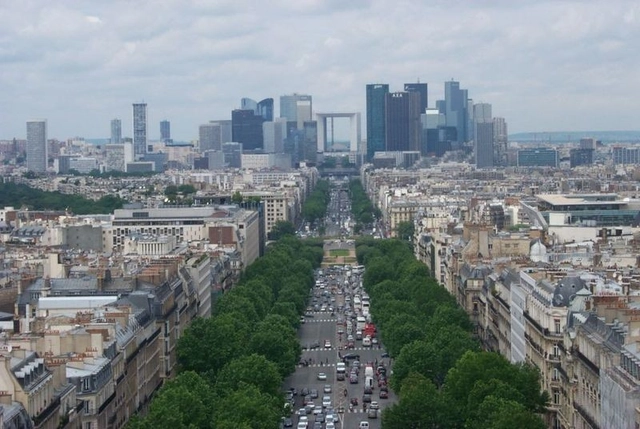
This week, with the help of our readers, our Architecture City Guide is headed to Paris. For centuries Paris has been the laboratory where innovative architects and artists have come to test their ideas. This has created a city that has bit of everything. Where the architecture of some cities seems to undergo phases of punctuated equilibrium, Paris’s architectural fossil record gives an impression of gradualism; all the missing links are there. This makes it easy to trace the origins of the most contemporary ideas throughout history. Nothing seems to come out of nowhere. If you look around you kind find the design’s inspiration running through the city’s Roman, Medieval, Renaissance, Baroque, Classical, Rocco, Neo-Classical, Empire, Art Nouveau, Art Deco, Modern, Post-Modern, and Contemporary Architecture. Seen in another context, many of Paris’s buildings might seem out of place, but the bones of this city support the newest iterations on the oldest and most profound questions. The 24 contemporary designs that comprise our list probably should not be viewed outside of this context, even though that is the stated goal of some of the designs.
As the most visited city in the world and arguably the capital of culture, it is impossible to capture the essence of Paris in 24 modern/contemporary designs. Our readers supplied us with great suggestions, and we really appreciate the help and use of their photographs. The list is far from complete and we realize that many iconic buildings are not yet on the list. We will be adding to it in the near feature, so please add more in the comments section below.
Next week we will be taking our Architecture City Guide to Paris and we need your help. To make the City Guides more engaging we are asking for your input on which designs should comprise our weekly list of 12. In order for this to work we will need you, our readers, to suggest a few of your favorite modern/contemporary buildings for the upcoming city guide in the comment section below. Along with your suggestions we ask that you provide a link to an image you took of the building that we can use, the address of the building, and the architect. (The image must be from a site that has a Creative Common License cache like Flickr or Wikimedia. We cannot use images that are copyrighted unless they are yours and you give us permission.) From that we will select the top 12 most recommended buildings. Hopefully this method will help bring to our attention smaller well done projects that only locals truly know. With that in mind we do not showcase private single-family residences for obvious reasons. Additionally, we try to only show completed projects.
https://www.archdaily.com/148793/help-us-with-our-architecture-city-guide-parisChristopher Henry